Get Full Government Meeting Transcripts, Videos, & Alerts Forever!
Get email alerts on the Land Use Subdivision Delegation topic
No spam. Unsubscribe anytime.
Sammamish staff proposes delegating final subdivision approval to hearing examiner, council raises oversight concerns
Summary
City staff proposed amending city code to let the hearing examiner sign final subdivision plats instead of the City Council, citing the ministerial nature of the step and state law protections; council members voiced concerns about vesting authority in a single official. No formal vote was recorded in the transcript.
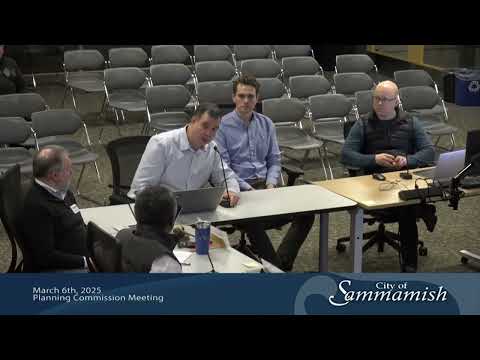
Sammamish City staff proposed moving final subdivision approval from the City Council to the hearing examiner, saying the last step is largely ministerial and state law limits council discretion.
The move would let the hearing examiner — who conducts the public hearing, does site visits and writes findings — sign final plats after staff confirm required infrastructure and conditions are complete. “There’s really no discretion at this point in the process for the City Council. It’s [a] ministerial act,” a staff member said during the discussion.
The proposal is intended to streamline the closing steps of a subdivision that can span many years under state rules. David, a city staff member, described the state framework under the Revised Code of Washington and city practice: once a complete application has been filed and conditions are met, state law requires a city to approve a final subdivision within 30 days, and subdivisions receive a five‑year vesting period after hearing approval. “The state law says when an application’s made and conditions are met, that a city shall approve a final subdivision within 30 days,” David said.
Staff argued the hearing examiner is already the most involved authority for subdivisions — preparing findings, conducting site visits and assigning conditions — so authorizing the examiner to finalize plats would not change outcomes but would avoid a largely ceremonial council step. “The hearing examiner is the one that really is pivotal and the most involved as an authority in it all,” David said.
Some council members expressed concern about concentrating final authority in a single official rather than a body. “I want to protect the community as well as the developer. I don’t want to put the decision in the hands of one person in lieu of a City Council,” a council member said, questioning whether a single examiner might develop a bias on a project. Staff noted the hearing examiner serves under contract with the council, and the council has the ability to replace an examiner if problems arise.
Staff also told the council that other nearby cities have moved to similar procedures since a 2017 legislative change that allowed delegation to hearing examiners, citing Bellevue, Kirkland, Shoreline and Auburn as examples. No formal ordinance, motion or vote was recorded in the meeting transcript; staff said they would “work to find a solution” and presented the option for council consideration.
The discussion summarized the subdivision lifecycle for context: preapplication and neighborhood meetings, application completeness review, a noticed public hearing with staff reports, the hearing examiner’s findings and conditions, construction and public‑works inspection certificates, and finally submittal of the final (plat) for recording so tax lots can be created. Staff emphasized that the final plat step occurs after infrastructure is substantially complete and is therefore largely a compliance check rather than a policy decision.
Next steps were not set in the transcript. The item was presented as a staff proposal; the transcript records council questions and comments but no formal direction, vote or ordinance adoption during this session.