Get Full Government Meeting Transcripts, Videos, & Alerts Forever!
Get email alerts on the Education Immigration Drones Grants Nil topic
No spam. Unsubscribe anytime.
House passes emergency bill covering school interactions with federal immigration agents, drone use, nonprofit grants and athlete pay rules
Summary
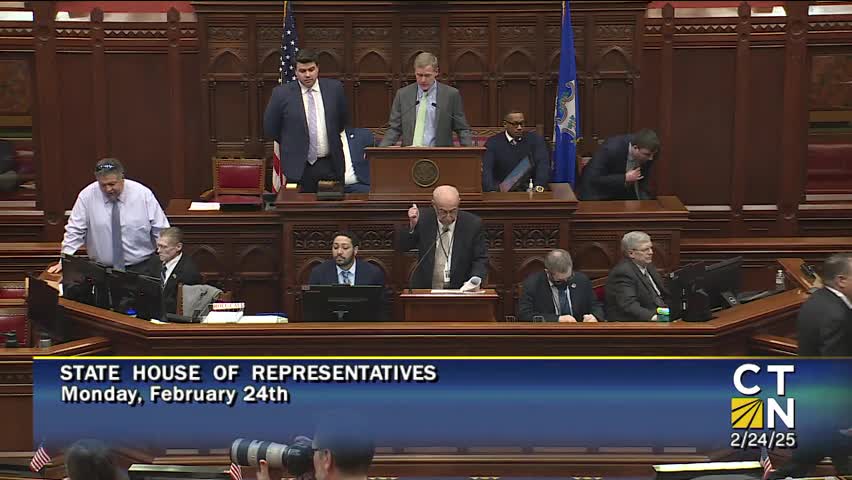
The Connecticut House on Feb. 24 passed emergency-certified House Bill 7066, a multipart measure addressing school interactions with federal immigration agents, drone use for state contracts, targeted nonprofit grants and university rules on student-athlete NIL and revenue sharing; the bill passed 94–49 with 7 not voting.
The Connecticut House on Feb. 24 passed emergency-certified House Bill 7066, a multipart measure addressing how schools should handle visits from federal immigration authorities, the purchase and use of certain drones for state contracts, grant funding for several nonprofits and new rules relating to student-athlete name, image and likeness (NIL) deals and revenue sharing. Representative Walker moved its passage; the bill passed 94–49 with 7 not voting.
The measure directs the State Department of Education to publish (and the bill to codify) guidance that requires each school building to designate at least one administrator to be the point person when federal immigration agents appear. Representative Walker, the bill proponent and chairwoman of the Appropriations Committee, opened debate by moving passage of the emergency-certified bill. Representative Walker said the change was meant to make schools “respect the people of Connecticut in this discussion,” and to add a single, identified contact into existing emergency teams.
Why it matters: supporters said the step gives families and schools a clearer protocol if federal agents visit a school, and opponents said codifying the guidance into statute risks legal conflicts and could carry unfunded local costs. Representative Nuccio pressed repeatedly for detail on whether the requirement creates a financial mandate for local districts; Walker and other proponents said the school teams already exist and the change does not itself add a new compensation obligation.
How schools and staff: under the bill the designated administrator is to ask immigration agents for identification and whether they have a judicial warrant, to note exigent circumstances, and to consult legal counsel or Department of Education guidance as needed. Multiple lawmakers pressed whether administrators would receive formal training; Representative Leeper said the current guidance does not require training. Representative Mastrofrancesco warned administrators are not attorneys and that the role carries responsibilities school staff do not normally perform.
Drone purchases and use: the bill contains language restricting the purchase or operation of certain drones as part of direct state or municipal contracts when those drones are produced by specified foreign manufacturers (debate described the provisions as intended to address national security concerns). Committee members clarified the restriction would not apply to private entities using drones for purely private work and would not apply to activities performed outside Connecticut. Supporters said routine uses — such as filming a high-school game — would not be affected when the drone is not being used under a state contract.
Grants to nonprofits and other appropriations: the emergency package includes targeted grants to nonprofits described in debate as serving immigrants, refugees and LGBTQIA communities, and an additional appropriation for a number of public-health and legal services providers. Representative Gilchrist told the House, “Planned Parenthood of Southern New England is running on an operating deficit, and spending down its financial reserve,” and described a prior $500,000 allocation as limited to specific services while the new $800,000 in the bill would be for overall operating support. Debate noted the state had recently provided other funds to some recipients; Representative Nuccio repeatedly asked why additional, pre-emptive funds were being provided if need was not yet demonstrated. The bill lists dozens of named recipients at amounts such as $62,500 for multiple community organizations and larger line items for judicial-contracting to administer grants.
Student-athlete compensation and revenue sharing: one section clarifies how universities and institutions can participate in NIL (name, image and likeness) activities and allows for voluntary revenue-sharing arrangements under a cap reflected in a referenced settlement. Representative Haddock (discussing the settlement framework) said universities could participate for the first time in NIL deals in a way that “enhances their opportunities” to generate outside revenue; lawmakers noted revenue sharing is a voluntary maximum, not a mandate.
Amendments and votes: two floor amendments were considered and failed. House Amendment Schedule A (LCO 5424) failed in roll-call vote; House Amendment Schedule B (LCO 5432) also failed. The bill then passed on the floor 94–49 with 7 not voting.
What supporters said: proponents framed the package as timely relief for community organizations facing interrupted federal funds, a clarification of school protocol, and a modernization of university rules around NIL participation.
What opponents said: critics called portions of the bill rushed (it was emergency-certified), warned the school-directed duties could create local burdens without new funding, and questioned the use of emergency procedure for items that had not had standalone hearings. Some members also asked whether the grant language might risk federal funding if federal policy were to change.
Next steps: with House passage the measure was transmitted to the Senate. The bill text names implementing agencies (the State Department of Education, the Department of Public Health for certain grants and the Judicial Department for contracts) and instructs those agencies to adopt procedures for notifications, contracting and, where appropriate, reporting back on uses of grant dollars.
Votes at a glance: on passage of H.B. 7066 the House vote was recorded as yes 94, no 49, not voting 7. Two floor amendments were taken and failed before final passage.
Ending note: the bill packages disparate policy items in an emergency-certified vehicle. Lawmakers on both sides said the measure was to address urgent needs — from nonprofit shortfalls to questions about school encounters with federal agents — but debate revealed differences about whether the subject matter and the expedited process were aligned.