Get Full Government Meeting Transcripts, Videos, & Alerts Forever!
Get email alerts on the Education Special Education topic
No spam. Unsubscribe anytime.
House passes emergency measure to create $40 million special-education municipal relief account
Summary
The Connecticut House on March 5 passed an emergency bill creating a temporary municipal special-education aid account to be funded from any year‑end surplus; lawmakers debated whether the measure circumvents the state's spending cap and how the funds would be distributed.
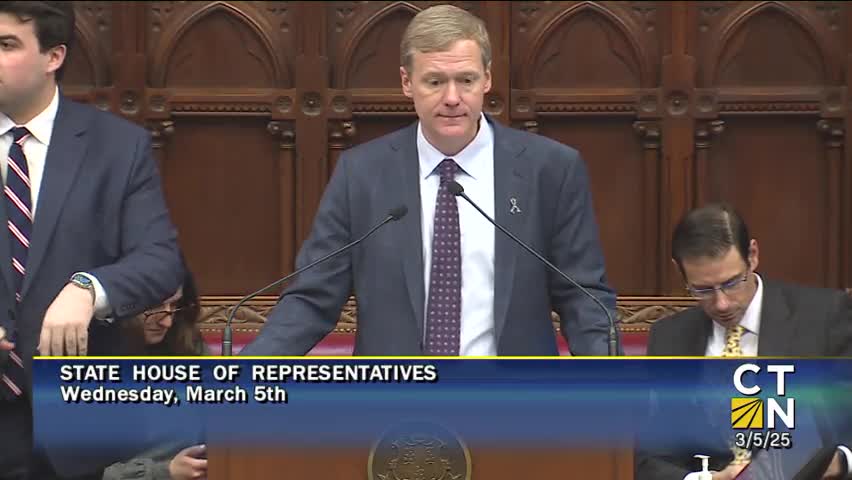
The Connecticut House of Representatives on March 5 passed emergency-certified House Bill 7163, creating a temporary Special Education Emergency Municipal Assistance account to provide municipalities relief for rising special-education costs.
The measure, offered as an emergency certified bill and advanced by Representative Perez, would transfer $40 million into a new account if the state's April 20 consensus revenue report shows a surplus. The money, lawmakers said, would be distributed to towns and school districts using the state's existing excess-costs formula for special education.
Supporters said the account is designed solely to backfill expenses municipalities are already incurring and does not create recurring spending or raise taxes. "This is about fairness. It is about ensuring that no town has to make the impossible choice between supporting students with disabilities and cutting other essential services," Representative Paris told the chamber.
Opponents said the mechanism effectively moves money off the general-fund budget and could undermine Connecticut's fiscal guardrails enacted in 2017. Representative Polleta and others argued the new account is an "off‑budget" vehicle that subverts the spending cap and urged leaders instead to use a direct surplus appropriation previously approved by the House.
Lawmakers who pressed questions sought clarification on timing, distribution, and sunset provisions. Rep. Paris said the transfer would be triggered if the consensus revenue projection around April 20 shows surplus funds and that only $40 million of the projected $350 million to $390 million surplus would be transferred to the special-education account. He and other speakers also confirmed the account is intended to be temporary; Representative Acker offered an amendment (LCO 5979) to explicitly terminate the account on June 30, 2025, then withdrew it after the bill's proponent affirmed the account's intended sunset.
The bill passed on a roll call: 117 in favor, 29 opposed, 4 absent. Supporters said the money would be distributed through the existing excess-cost formula; critics urged using direct surplus appropriations instead of an off-budget account to preserve the state's fiscal guardrails.
Votes at a glance HB 7163 (emergency certified): Passed — roll call 117 yes, 29 no, 4 absent. Motion to pass made by Representative Perez.
Context and next steps If the consensus revenue figures on or about April 20 confirm sufficient surplus, the administration would arrange the transfer and the education commissioner's office would distribute funds under the existing excess-cost formula. Lawmakers on both sides said the goal is to cover costs being incurred this year; proponents said statutory distribution language already governs how municipalities receive excess-cost payments.