Get Full Government Meeting Transcripts, Videos, & Alerts Forever!
Get email alerts on the Nonprofit Funding topic
No spam. Unsubscribe anytime.
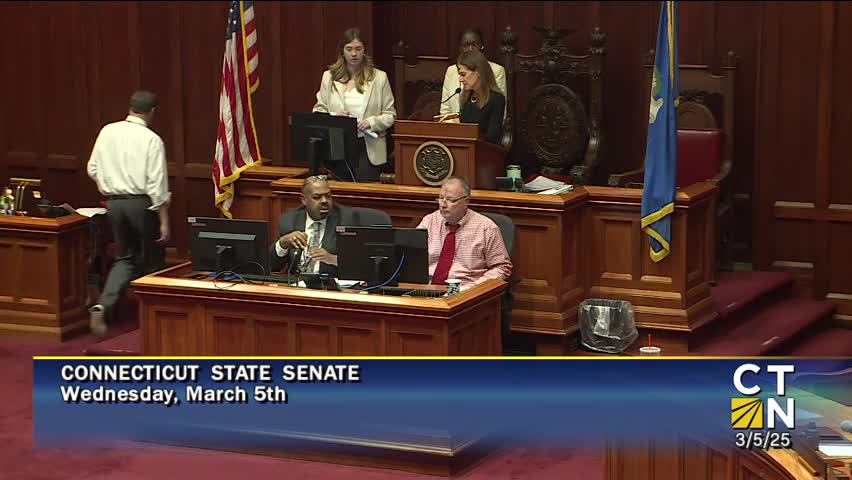
Senate passes $3 million emergency nonprofit assistance bill after debate on recipients and process
Summary
Senate Bill 1453, creating an emergency nonprofit assistance account with $3 million, passed after floor debate over recipients including Planned Parenthood and several immigration and LGBTQ groups. An amendment to redirect funds toward heating/elder nutrition failed.
The Connecticut Senate passed Senate Bill 1453 on March 5, an emergency measure establishing an “emergency nonprofit assistance account” and transferring $3 million from the general fund for grants to nonprofit organizations. The measure passed after an amendment offered by the bill sponsor (Senate Amendment A, LCO 5976) was adopted; the chamber later rejected a substitute amendment that would have reallocated much of the money to low‑income heating and elder nutrition programs.
Senator Austin, speaking for the Appropriations Committee, described the adopted amendment as a strike‑all that creates the account and directs a $3,000,000 transfer from the general fund with expenditures to be administered by the Office of Policy and Management (OPM) on or about April 20, 2025.
Opposition on the floor focused on the composition of recipients in the bill’s list. Senator Sampson and others criticized line items to organizations including Planned Parenthood (identified on the floor as receiving $800,000 in the schedule), IRIS (Integrated Refugee & Immigrant Services) and other groups that some senators described as advocacy‑oriented. Senator Sampson said the amended bill closely resembled a prior document vetoed by the governor and questioned whether the governor would sign the bill in its current form. He also queried accountability and whether recipients would be contractually bound to spend funds only for specified purposes; Senator Austin and the Appropriations chair replied that award contracts would include administrative cost provisions and single audits would ensure compliance.
Senator Sampson subsequently offered a strike‑all substitute amendment (LCO 5995) that would have redirected most of the $3 million to the Meals on Wheels/elder nutrition programs ($1,450,000) and to LIHEAP‑style heating assistance ($1,450,000), with $100,000 retained for Jewish Family Services of Greenwich. That amendment (Senate Amendment B) failed on a roll call (11–23 yes–no; 1 absent).
Floor votes on Senate Bill 1453 as amended showed the amendment A passed earlier (24–10; 2 absent), and final passage of the bill as amended recorded 25 senators in favor, 10 opposed and one absent. Proponents argued the funding would offer quick aid to nonprofits facing urgent shortfalls; critics sought clearer programmatic restrictions and stronger budgeting through the regular appropriations process.
Why it matters: The bill provides immediate, discretionary grant funding for nonprofits, and the floor debate exposed partisan and ideological divides over which groups should receive state funds and how to ensure accountability. Several senators pressed for line‑item restrictions or clearer contract terms to prevent funds being used for political advocacy rather than direct services.
What’s next: The bill will be transmitted to the House (or the governor where required) as part of the Senate’s transmittal process. OPM was identified as the implementation lead, responsible for drafting contract documents and executing grants and audits.