Get Full Government Meeting Transcripts, Videos, & Alerts Forever!
Get email alerts on the State Legislation topic
No spam. Unsubscribe anytime.
Senate approves emergency bill on school–immigration response, drone limits, nonprofit grants and college athlete pay
Summary
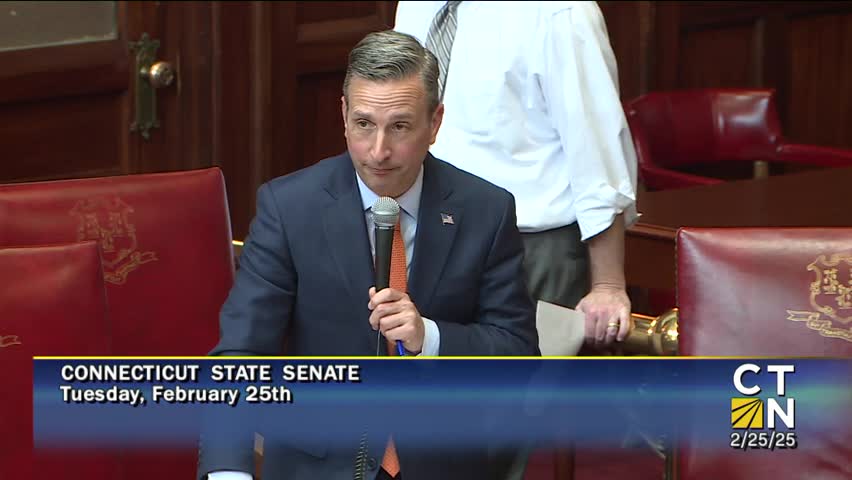
The Connecticut Senate on Feb. 25 passed an emergency-certified bill (House Bill 7066) addressing how school staff should respond to federal immigration authorities, restricting certain drone purchases and flights, granting one-time funds to a slate of nonprofit groups and enabling colleges to negotiate name, image and likeness (NIL) deals and limited revenue shares with student athletes.
The Connecticut Senate on Feb. 25 passed an emergency-certified bill (House Bill 7066) addressing how school staff should respond to federal immigration authorities, restricting certain drone purchases and flights, granting one-time funds to a slate of nonprofit groups and enabling colleges to negotiate name, image and likeness (NIL) deals and limited revenue shares with student athletes.
Supporters and opponents spent several hours debating whether the package qualified as an emergency and over whether the spending items were time-sensitive. The Senate ultimately approved the bill and sent it on for transmittal to the governor.
Why it matters: The measure combines four distinct policy areas into a single emergency-certified vehicle. Sponsors said a quick, statewide rule for school administrators and new limits on drone equipment are time-sensitive; opponents said the emergency designation short-circuited public hearings and rushed significant policy and spending decisions, including $800,000 noted in the bill for community health services to Planned Parenthood and roughly $2,087,500 allocated via the judicial department for a set of nonprofit grants.
Most important provisions - School interactions with immigration authorities: The bill puts into statute an approach that the State Department of Education had earlier issued as guidance. It requires school districts to designate an administrator to interact with federal immigration officials, update school safety plans and sets a notification requirement after any interaction. "Schools are no longer necessarily safe spaces as they were," Senator Winfield said during debate, arguing the measure fills an immediate need.
- Drone purchases and use: The bill restricts state and municipal purchases and future use of certain small unmanned aircraft systems manufactured by covered foreign entities, creates definitions for critical infrastructure, and bans drones carrying weapons or incendiary devices. It also phases in purchase and use prohibitions (for example, prohibiting certain purchases beginning Oct. 1, 2025, and use restrictions on later dates) while preserving limited waivers and exemptions for government and FAA-authorized commercial operations.
- Grants to nonprofits and community groups: The bill lists multiple one-time grants to nonprofit organizations, many serving immigrant and LGBTQ communities (the legislation names several recipients and funding amounts). Senate debate focused on how recipients were selected, whether the allocations followed appropriations committee vetting and whether the nonprofit grants represented an appropriate emergency expenditure. Senator Summers offered an amendment to redirect the funds to elderly nutrition and LIHEAP; that amendment was rejected on the floor.
- Student-athlete compensation: The bill allows colleges to enter NIL agreements earlier (upon a recruit's commitment) and authorizes athletic departments to share up to $20.5 million in athletic revenue with student athletes, subject to limits and a prohibition on general fund appropriations for that purpose. Supporters said the change is time-sensitive because recruiting follows March Madness and other states are moving quickly.
Debate and votes Opponents repeatedly challenged whether the package met the statutory standard for emergency certification. Senate Minority Leader Steve Harding and other Republicans argued the measure bundled unrelated items and denied the public a chance to testify; Harding said, "this is not truly an emergency, particularly 7066 that is before this chamber here." Senator Sampson and others echoed concerns that political aims were driving the emergency label.
Majority leaders and sponsor senators replied that leaders in both chambers certified the measure as an emergency and that some sections — notably school guidance and drone security — required quick action. After multiple roll-call and voice votes on procedural and amendment questions, the Senate voted to pass House Bill 7066. (Roll-call tallies were recorded on the Senate floor.)
What the bill does not do: The legislation does not create a general revenue appropriation to pay student athletes; it constrains payment sources to athletic department receipts. The bill also allows waivers and certain exemptions in the drone language and leaves implementation details and contract language for grant recipients to the agencies named in the statute.
Next steps: The bill will be transmitted to the governor. Agencies named in the bill (for example, the Department of Public Health and the judicial department for contract administration of certain grants) will finalize implementing details and contracts. Senators on both sides signaled intent to pursue further committee-level review and potential statutory fixes in coming weeks.
Ending note: The floor fight illustrated the tension between time-sensitive policy moves (security guidance, equipment restrictions, evolving NCAA rules) and lawmakers' insistence on public hearings for spending and regulatory changes.