Get Full Government Meeting Transcripts, Videos, & Alerts Forever!
Get email alerts on the Veterans Commission Salary topic
No spam. Unsubscribe anytime.
Lawmakers question veterans board’s 2023 pay increase for commissioner and resulting budget shortfall
Summary
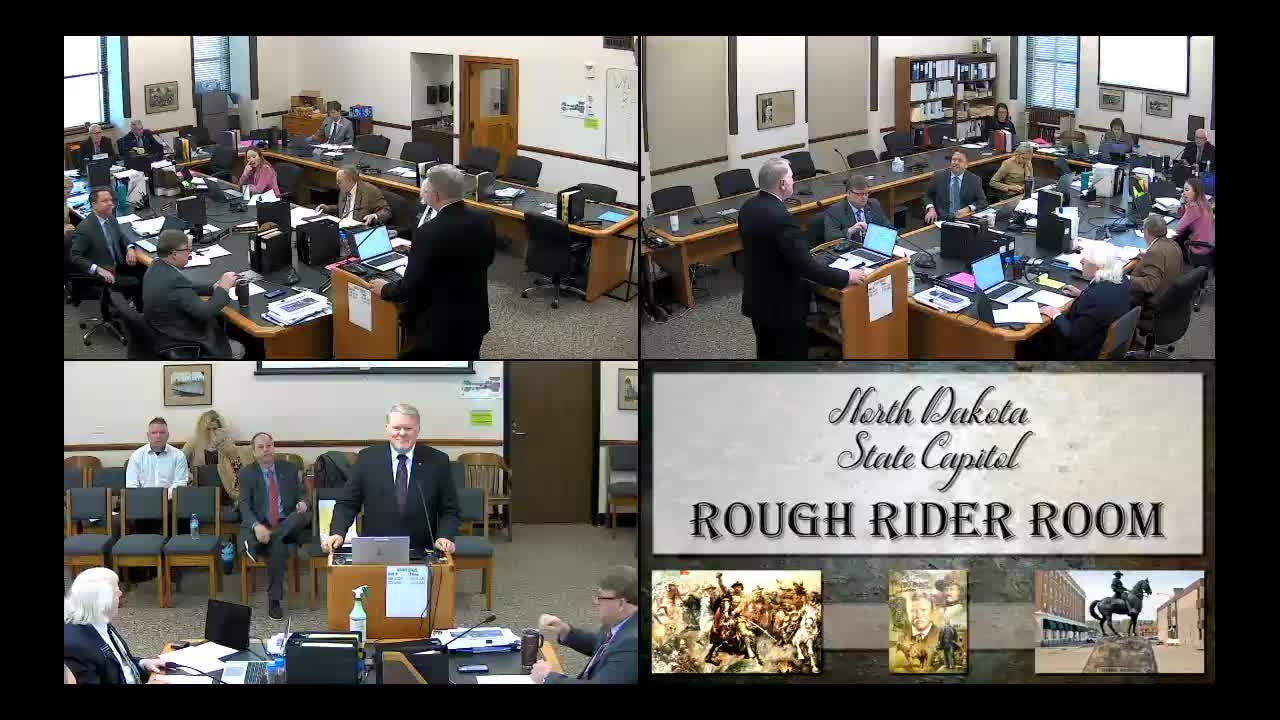
Colonel Dutch Bielke, a retired U.S. Air Force officer and past chair of the Department of Veterans Affairs and Budget Subcommittee of the North Dakota Administrative Committee on Veterans Affairs, told the House Appropriations Committee Human Resources Division that ACOVA voted to raise Commissioner Lonnie Wogan’s 2023 salary after comparing it to similar state agencies and peer state Veterans Affairs commissioners.
Colonel Dutch Bielke, a retired U.S. Air Force officer and past chair of ACOVA’s Department of Veterans Affairs and Budget Subcommittee, told the House Appropriations Committee’s Human Resources Division that ACOVA used its statutory authority to raise the 2023 salary for Lonnie Wogan, commissioner of the North Dakota Department of Veterans Affairs, after reviewing comparable state and national salaries and concluding Wogan was underpaid.
Why it matters: Committee members said the committee of legislators that controls state appropriations was not consulted before ACOVA increased the commissioner’s pay, leaving the Legislature to consider a deficiency appropriation to cover the shortfall. Committee members said the process and a roughly $80,000 funding gap created political and budgetary concerns about transparency and legislative oversight.
Colonel Bielke opened by outlining his credentials and ACOVA role. He told the committee ACOVA members “reviewed his annual compensation” against peers and state agency directors and “we found his compensation wanting,” and that ACOVA “collectively voted to increase Commissioner Wogan’s salary.” Bielke said the committee believed the increase fit within the committee’s statutory authority and the department’s biennial appropriation. He described Wogan as “exceedingly well qualified” and “a true advocate” for veterans.
Representative Brooke O’Brien (first reference: Representative O’Brien) challenged that account, citing North Dakota Century Code language that delegates certain appointment and salary powers to ACOVA but noting limits tied to legislative appropriations. “Our hands are tied because a decision was made without us giving the authority to do that as appropriators,” O’Brien said, adding that committee members expect ACOVA to bring such requests to the Legislature so appropriators can decide funding and priorities.
Committee members repeatedly pressed the distinction between a board setting a salary “within budget” and a board taking an action that produces a shortfall that requires the Legislature to fund a deficiency appropriation. Representative O’Brien and others said the committee did not receive ACOVA testimony before the pay decision and that an appropriations committee hearing is the normal venue for that discussion.
Commissioner Lonnie Wogan (first reference: Commissioner Lonnie Wogan, Commissioner, North Dakota Department of Veterans Affairs) also addressed the committee. Wogan told legislators the department had not been operating on a deficiency budget and that ACOVA had worked with the attorney general’s office and Office of Management and Budget staff while wrestling with how to apply the statutory authority. “We do not, NOT, not have a deficiency budget. We're not on that list,” Wogan said, adding that ACOVA had requested clarification and had been trying for years to resolve how salary-setting works under the current law.
Committee members and witnesses gave different estimates for the size of the deficiency request associated with the pay change; Representative O’Brien described “an $80,000 deficiency that we now have to make up,” while Colonel Bielke suggested he believed another number had previously circulated. The record does not contain a final appropriation vote by the House committee on this item.
Committee members said they were not disputing the commissioner’s job performance. Representative Murphy (first reference: Representative Murphy) repeatedly described Wogan as “steadfast” and praised his work for veterans, but said the process had left the Legislature with a fiscal problem because ACOVA’s decision exceeded what the Legislature had specifically appropriated.
Both witnesses and legislators told the committee they had sought legal guidance before acting. Bielke said ACOVA asked the attorney general whether it had authority to change salary levels within its appropriated budget and was told ACOVA had discretion “as long as you’re within legislative appropriations.” He said ACOVA concluded the change was within its delegated responsibility and not done “in a vacuum.”
The committee noted the Senate had included funding language in its budget related to commissioner salary equity and said those differences would be dealt with in conference. Chairman Nelson (first reference: Chairman Nelson, Chair, House Appropriations Committee, Human Resources Division) said the committee would move forward to hearing remaining agency overviews and return to budget decisions in conference.
Ending: The committee did not adopt a final action on the matter during the overview session documented here. Members asked ACOVA and Department of Veterans Affairs officials to provide additional documents (budget detail, invoices or deficiency request amounts and attorney general guidance) as the budget process proceeds; the committee noted the matter would be addressed in budget detail hearings and in conference committee if needed.