Get Full Government Meeting Transcripts, Videos, & Alerts Forever!
Get email alerts on the Transportation Emergency Response Safety topic
No spam. Unsubscribe anytime.
Committee widens penalties and adds protections for responders after crashes with emergency vehicles
Summary
The committee amended and advanced Senate Bill 2132 to create a stronger infraction for striking an authorized emergency vehicle in many on‑scene situations, added language tying protection to vehicles stationary with lights or hazard signals active, and raised the reportable damage threshold discussed in testimony.
The House Transportation Committee amended Senate Bill 2132 to broaden the circumstances in which striking an authorized emergency vehicle is an enhanced infraction and then voted to advance the bill with the changes.
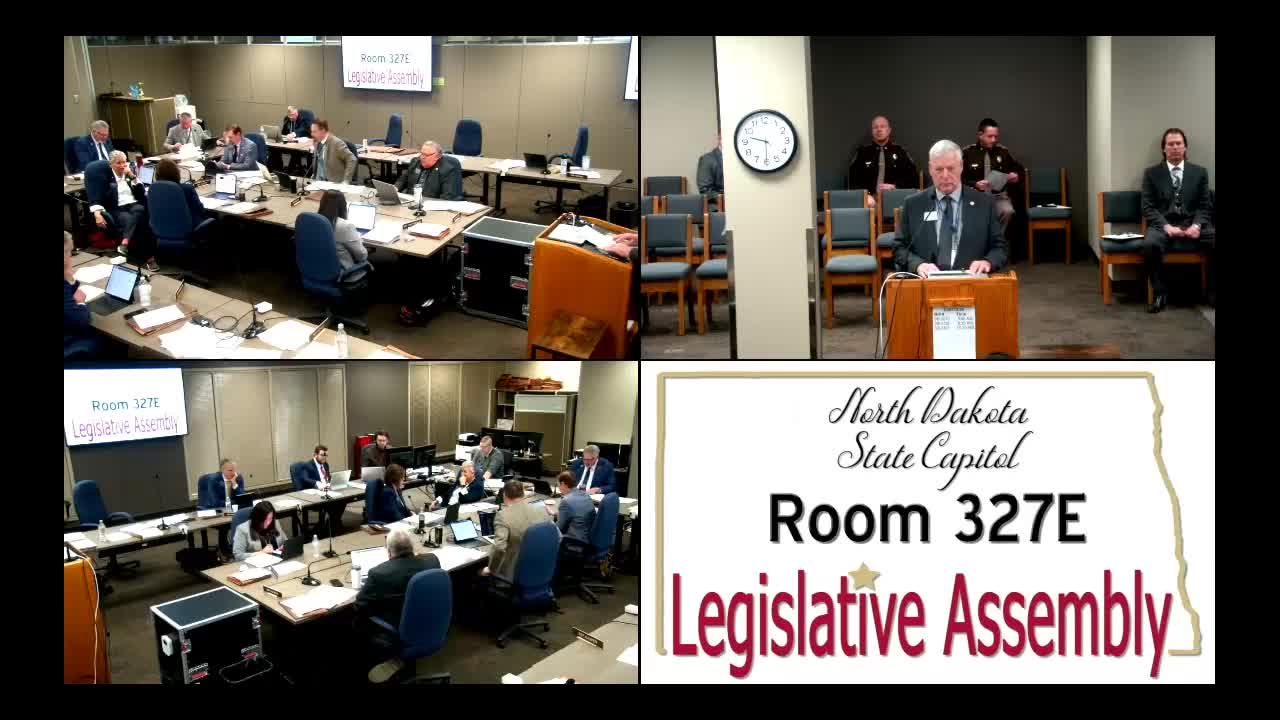
Senator Dean Romo of Dickinson, the bill sponsor, told the committee the intent is to provide clearer, stronger protections when emergency vehicles are stopped or personnel are on scene. “If you plowed into them and kill them, I would say it's gonna be an infraction,” Romo said, describing cases where responders working alongside an emergency vehicle have been struck.
Tom Iverson, chief of operations for the North Dakota Highway Patrol, provided data from the patrol showing 13 crashes involving department vehicles while personnel were acting in an official capacity between 2023 and 2024; 11 of those occurred during traffic stops or traffic control and most happened in inclement weather. “In all cases, overhead emergency lights were documented as being in use,” Iverson said, and noted nine patrol vehicles were totaled.
Committee debate ranged across several issues: whether the measure should only apply when emergency vehicles are stationary with lights or hazard signals active; whether a higher monetary threshold (for example, mirroring the reportable crash dollar threshold of roughly $4,000) should replace the bill’s $1,000 damage trigger; and how language should treat first responders who are acting “in the performance of official duties” versus volunteer or off‑duty responders.
After floor discussion and several suggested changes — including qualifying that the enhanced infraction applies when an authorized emergency vehicle or person is stationary on the side of the roadway and when overhead lights or hazard warning signals are active — the committee adopted the amendments and returned a do‑pass as amended recommendation. The clerk’s roll recorded the final committee vote in favor on the amended bill (yes recorded on the roll call), and the committee assigned a carrier for the bill.
Testimony from the Professional Firefighters of North Dakota and the Department of Transportation supported the bill and said public education would be an important complement to any penalty changes. Committee members also discussed criminal alternatives such as reckless driving or manslaughter in cases of death, with witnesses noting that more serious criminal charges would still be available in severe incidents.