Get Full Government Meeting Transcripts, Videos, & Alerts Forever!
Get email alerts on the School District Dissolution Fund Distribution topic
No spam. Unsubscribe anytime.
Bill would let county committees allocate up to $500,000 from dissolved school districts to local political subdivisions
Summary
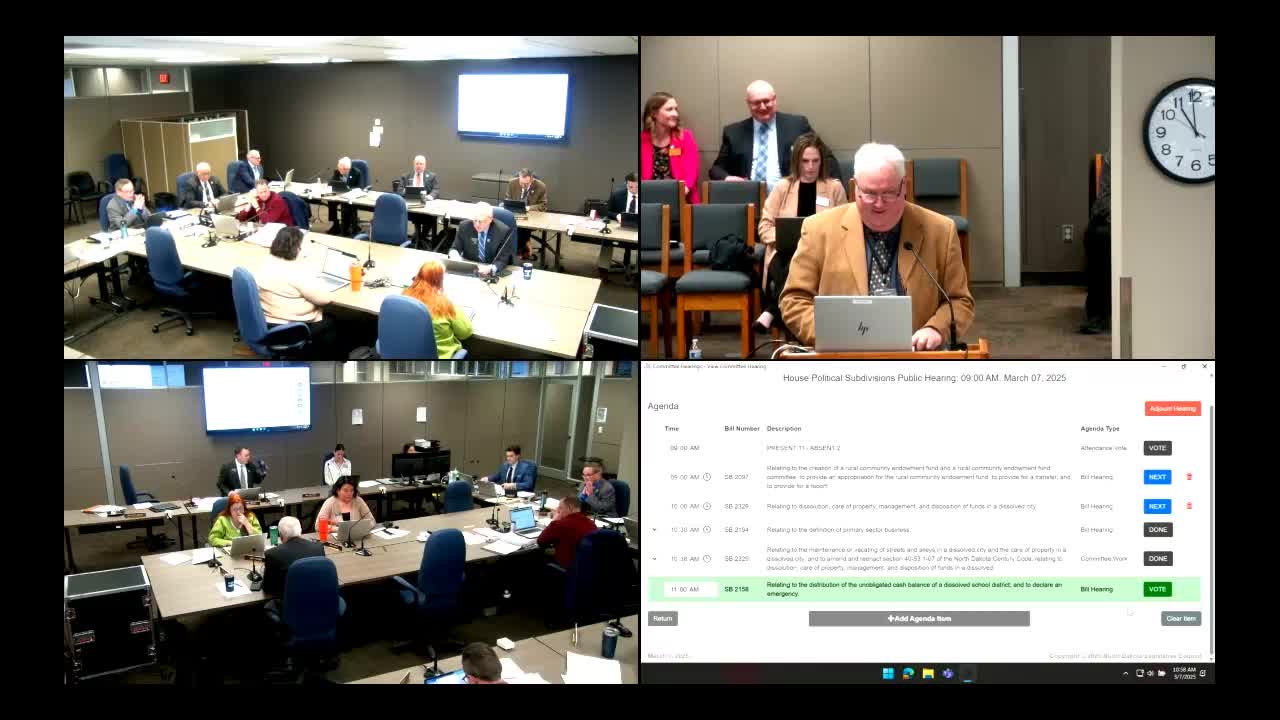
Senate Bill 2158 would allow county committees to distribute up to $500,000 of the unobligated cash balance from a dissolved school district to another political subdivision located within the district’s geographic boundaries.
Senator Don Schaible, sponsor of Senate Bill 2158, told the House Political Subdivisions Committee the bill seeks to resolve a legal conflict that prevented a dissolution plan from moving forward for a multi-county school district. Schaible said the local school board’s dissolution plan proposed transferring the district’s building to the city and providing up to $500,000 “for the repurposing and deferred maintenance,” and current code prevented that transfer of funds.
Schaible said the bill is intended to give locally elected officials the flexibility to implement a community-driven dissolution plan. “Passing 2,158 would allow the elected officials to finish the job as a school board member,” he told the committee.
Supporters from school governance groups and local officials echoed that point. Amy DeCook, executive director of the North Dakota School Boards Association, testified SB 2158 would be an option in limited circumstances and that commonly the receiving district chooses not to use a decommissioned school building. Landon Rice, an Edmore city council member, described plans to convert his district’s school into a community center and said the funds would be used for upkeep, utilities and maintenance; Rice described a proposed management board including city and school representatives.
Opponents and some landowners raised concerns about fairness and oversight. Joseph Botta, a landowner and member of a county reorganization committee, said the bill as written places no restriction on how a political subdivision might spend the funds and argued the funds are taxpayer dollars meant for education. Botta proposed limiting the distribution to $100,000 and requiring that funds be designated for use on the school property.
Committee members asked technical questions about who receives tax credits when a district dissolves and how refunds are calculated. Adam Tesher, a school finance officer with the Department of Public Instruction, clarified that tax credits or refunds are distributed to the current property owner as of the date of dissolution and that tracking original contributors would be administratively difficult. Schaible and other witnesses said the measure also carries an emergency clause to meet dissolution timelines before the next school year.
The hearing produced no committee vote; testimony reflected a split between local officials seeking tools to preserve community facilities and landowners focused on returning surplus funds to taxpayers.