Get Full Government Meeting Transcripts, Videos, & Alerts Forever!
Get email alerts on the Rural Development Endowment topic
No spam. Unsubscribe anytime.
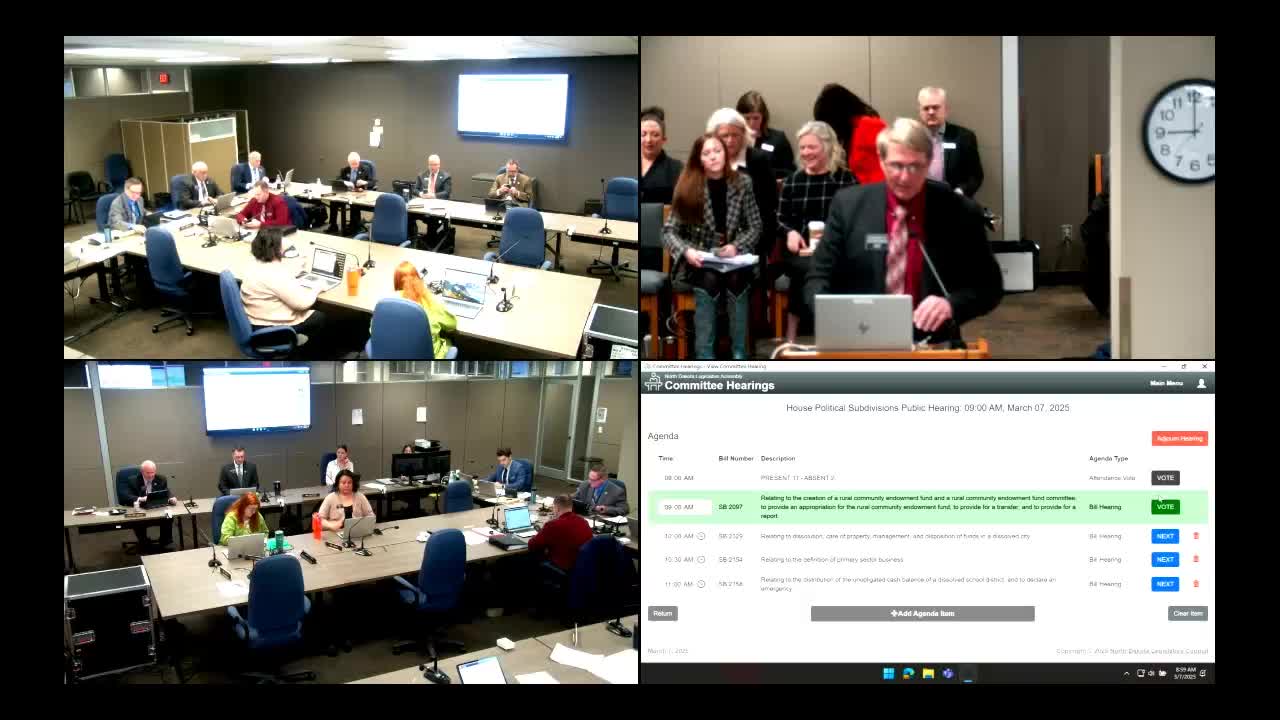
Committee hears testimony for rural community endowment fund aimed at towns under 1,000
Summary
Lawmakers and rural advocates testified for Senate Bill 2097, which would create a permanent Rural Community Endowment Fund to provide grants to communities with populations under 1,000. Supporters urged starting the fund now with $5 million; some witnesses recommended a larger initial appropriation or broader eligibility.
Representative Mike Brandenburg, a co-sponsor, told the House Political Subdivisions Committee that Senate Bill 2097 would create a Rural Community Endowment Fund “to get some money so that you can…look at housing, infrastructure needs, parks” for towns with populations of 1,000 or less. Brandenburg said he signed on because he represents many small towns and expects new jobs from a planned data center will increase local demand for housing and services.
The bill would establish a permanent endowment; earnings, not principal, would fund grants for eligible rural communities. Senator Tim Mathern, sponsor of the Senate version and a senator from District 11, told the committee the endowment is a way to “preserve rural North Dakota forever,” and urged the committee to add $45 million back into the original request (which had been reduced in amendment). Mathern also compared the fund’s intent to previous state endowments and said it would be monitored with requirements attached to grants.
Advocates from statewide and regional organizations described capacity and funding gaps they said the bill seeks to fill. Megan Langley, executive director of StrengthenND, said the organization has worked in over 150 communities and that SB 2097 was designed after more than a year of stakeholder work; she described the fund as a “permanent” source of sustainable grantmaking for communities under 1,000 and said the bill originally proposed a $50 million endowment that had been reduced to $5 million and lost an immediate grant component in amendment.
Dawn Mant, executive director of the North Dakota Association of Regional Councils, told the committee that regional councils already help assemble multiple funding sources for projects and that she supports the concept but recommended changes: raising the eligible population threshold (to 5,000 or 8,500) so “missing middle” communities aren’t excluded and aligning grant structures with other pilot programs (Senate Bill 2390). Several regional and local economic development leaders — including Taryn Doer (Roosevelt Custer Regional Council) and Danielle Michelson (JDA director, Rolla) — urged adding flexible matching requirements and using existing delivery systems to reduce overhead.
Witnesses gave examples of eligible uses they said the fund would support: housing, workforce development and retention, childcare, community centers, pool replacement, grocery stores, downtown building rehabs, and other quality-of-life projects. Doer and others recommended adding a flexible matching requirement (including in-kind waivers) to ensure local buy-in. Stakeholders argued the fund would help fill “gaps” where federal or existing state programs require burdensome studies or matches that smaller communities cannot afford.
Committee members asked whether the endowment is duplicative of other programs and whether the $5 million (the amended appropriation) is the proper funding source. Representative Clameen asked whether the fund overlaps with