Get Full Government Meeting Transcripts, Videos, & Alerts Forever!
Get email alerts on the Procurement topic
No spam. Unsubscribe anytime.
Committee advances bill tightening procurement records, vendor-pool rules
Summary
The State and Local Government Committee heard and advanced House Bill 11-22, a sweeping set of edits to state procurement law that would change open-records handling of bids and proposals, add IT and cooperative-purchasing clarifications, and require new guidelines and a five-year cap for multiple-award vendor pools.
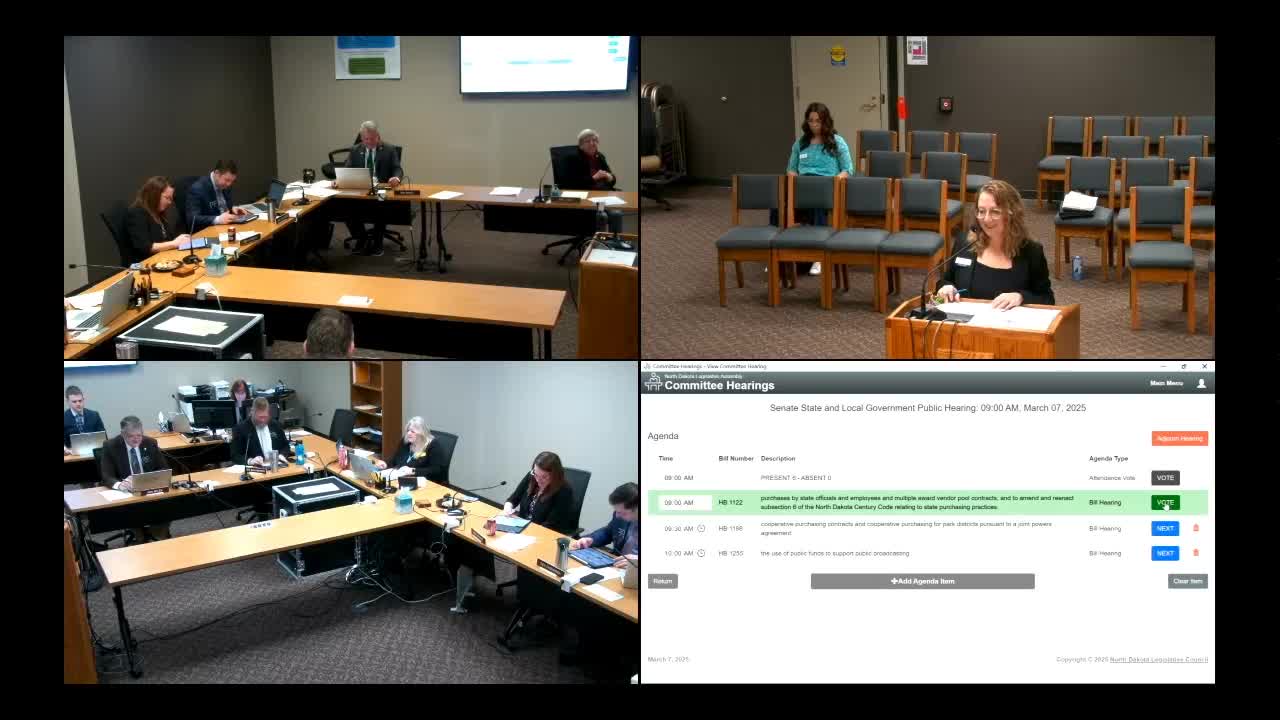
The State and Local Government Committee opened a hearing on House Bill 11-22, which would revise multiple statutes governing state procurement practices and vendor-pool contracts. Sherry Neece, shared services division director with the Office of Management and Budget (OMB), told the committee OMB supports the engrossed bill.
The bill would delete an open-records provision that allowed vendors to learn which firms had submitted bids or proposals before a public opening or a notice of intent to award. "This change ensures that competition for the public contracts remains fair," Neece said during her presentation, describing a two-decade rise in records requests that, OMB says, allows competitors to study and refine bids after openings.
Committee members pressed Neece on specifics. She explained the bill preserves the distinction between bids — opened publicly and subject to immediate disclosure — and requests for proposals, which remain exempt from disclosure until a notice of intent to award. Neece said the change is intended to prevent vendors from identifying competitors before openings or awards.
Beyond the open-records change, Neece outlined several other revisions: adding an information-technology definition and cross-reference to chapter 54-59; clarifying which exemptions apply to agencies, institutions, commodities and services; moving language about the International Peace Garden into the cooperative-purchasing chapter; and specifying that information-technology procurements, even where exempt from competition, must still meet NDIT procedures.
The bill would also:
- Clarify and add cross-references for existing procurement exemptions (for example, lease of space and new construction) and explicitly cross-reference the statutory chapter for prison industries (Roughrider Industries).
- Expand an existing exemption for Department of Health and Human Services programs so training and related materials for clients, contractors or professionals may be exempt from competitive purchase requirements, reducing noncompetitive justifications processed by OMB and DHHS.
- Add an exemption to allow direct media placement (for example, buying a single ad spot) without creating a broad noncompetitive exception for advertising services.
- Add language recognizing recurring software- or firmware-related costs for implemented systems (an example cited was PeopleSoft) so agencies may renew maintenance or purchase necessary software updates for equipment they already own without repeated competitive justifications; the change still requires review by NDIT and rulemaking to define the process.
- Require bidders to register on a bidders list (to be implemented in a new procurement automation system) before submitting a solicitation response.
- Clarify that vendors who must be registered with the Secretary of State must be registered at contract execution rather than at announcement of award.
- Allow agencies, institutions and OMB to send protest and appeal determination letters electronically and add authority for a seven-day extension when additional time is needed for complex, high-dollar procurements.
- Create a cooperative-purchasing authority for the North Dakota University System institutions to establish cooperative contracts for use by other NDUS institutions.
- Require OMB, in coordination with NDIT and the university system, to develop vendor-pool guidelines that set a threshold for direct purchases from a vendor pool and require secondary competition among pool vendors above that threshold. The provision would also limit vendor-pool contracts to a total of five years unless prior written approval is obtained; secondary contracts must be completed within the vendor-pool term.
Neece said the 5-year limit was intended to ensure fair treatment of vendors and to avoid locking up the state's business for an unreasonable length of time. "Shouldn't there be some kind of cap?" she asked rhetorically in explanation of the change.
Committee action: The committee later moved a recommendation of "do pass" on the engrossed bill. Senator Wallen moved the motion and Senator Lee seconded it; the roll call recorded Chair Roars, Vice Chair Castaneda, Senators Barta, Brownberger, Lee and Wallen voting aye (6–0). The committee did not adopt any amendments on the floor during this hearing.
The bill incorporates work from a multi-agency collaborative process including Representative John Nelson (bill sponsor), OMB, a procurement advisory council, the North Dakota University System, North Dakota Information Technology (NDIT), Department of Corrections, Department of Health and Human Services and other agencies. Neece told the committee the bill was amended in the House to remove purchase-from-prison-industries provisions and to add the vendor-pool language at the recommendation of Representative Ben Koppelman.
While the measure is presented as "procurement cleanup," it contains substantive changes that affect disclosure timing, cooperative purchasing authority, rules for recurring IT costs, vendor-pool duration and protest procedures. The committee record shows questions from multiple senators on how the changes would affect local purchasing, joint procurements, and whether the bill would streamline or centralize authority in OMB and NDIT.
If enacted, the bill would require OMB to promulgate rules for several of the new procedures and to develop vendor-pool guidelines in coordination with NDIT and the university system.