Get Full Government Meeting Transcripts, Videos, & Alerts Forever!
Get email alerts on the Health topic
No spam. Unsubscribe anytime.
Health subcommittee adds $66 million in UGF increases, funds child care, early intervention and behavior-health rate increments
Summary
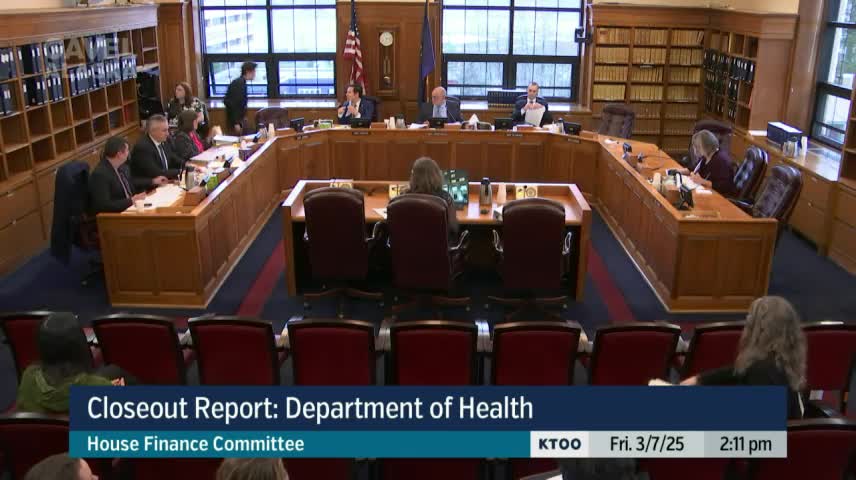
The House Finance Budget Subcommittee recommended $66.14 million in additional unrestricted general funds for the Department of Health above the FY26 adjusted base, funding child-care grants, early-intervention expansions, senior services and temporary behavioral‑health rate increases.
The House Finance Budget Subcommittee recommended a package of increases for the Department of Health that the subcommittee said would restore or temporarily boost several programs, including child care grants, senior services and behavioral-health clinic rates.
Erin Page, aide to Co-Chair Josephson and subcommittee aide for the Department of Health, presented the subcommittee’s recommendation: a total operating package of roughly $3.84 billion across all fund sources, including $1,076,026,300 in unrestricted general funds. Page told the committee the subcommittee’s UGF recommendation represents a $66,140,700 increase over the adjusted base.
Key additions include a $7,725,000 UGF increment to continue child care grant programs for place-based and home-based providers; a $75,000 one-time UGF increment for a safe-gun-storage media campaign; a $1,500,000 increment for community grants in senior and disability services; $3,000,000 to restore senior-center services; $2,700,000 to account for inflation in early intervention and infant learning; and a $1.1 million increment to increase the daily rate for temporary assisted-living facilities from $109.32 to $120. Page said a separate $500,000 UGF and $500,000 federal temporary increment would support a rate increase for private-duty nurses who provide in‑home care for medically fragile patients.
The subcommittee added a $13,750,000 temporary UGF increment to support certain clinic behavioral-health services that exceed Medicaid upper payment limits and noted the increase is temporary to allow for future rebasing.
The subcommittee received 48 amendments, adopted one and rejected eight. The adopted amendment, a $3,020,000 increment, would expand early intervention services under Part C of the Individuals with Disabilities Education Act to serve infants and toddlers with developmental delays of 25% in one area (current services limited to 50% delays), Page said.
Questions from members focused on federal match and upper payment limits. Representative Stapp asked whether the Medicaid increases would breach federal upper payment limits; Page said some items are not subject to the upper payment limit and said she would investigate whether specific rate changes would affect Medicaid match or cost‑neutrality. Page told members the private‑duty nursing rate “has not been adjusted since 1998.”
Procedural note: The subcommittee adopted its narrative and forwarded the budget action report to the full committee; co-chairs set amendment deadlines for the full Finance Committee.