Get Full Government Meeting Transcripts, Videos, & Alerts Forever!
Get email alerts on the County Administration topic
No spam. Unsubscribe anytime.
Iroquois County Board extends housing deadline for employee, reviews digital equity grant application and tax appeals
Summary
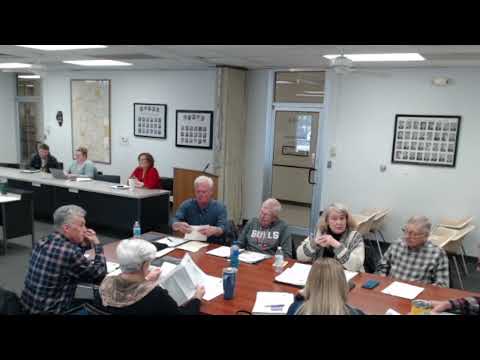
At a recent Iroquois County Board meeting members approved a six-year extension for employee Mia McCandlin to move into CAMI and discussed a digital equity grant application from the Champaign County Regional Planning Commission, property tax appeals including Amber Oaks Farm and Heritage Woods, audit timing and animal disposal procedures.
The Iroquois County Board voted to extend the period during which employee Mia McCandlin must move into CAMI, and reviewed several administrative and county service items including a proposed federal digital equity grant application, two property tax appeals and ongoing audit work.
The board approved a motion to extend “the period of time that Mia McCandlin has to move into CAMI for a period of six years from her date of hire,” moving the deadline to Aug. 1, 2029. The motion was made and seconded and carried on a roll call in which Geiger, Crow, Ferguson, Ohl, Whitlow and Ducat recorded “yes” votes.
The extension was described during the meeting with specific dates: McCandlin’s hire date was stated as Aug. 1, 2023, and the board recorded the extension as effective through Aug. 1, 2029.
Board members discussed a proposed letter of support for a Legal Digital Equity Capacity Grant application submitted by the Champaign County Regional Planning Commission (CCRPC). Paul Ducat, identified in the meeting as county board chairman, described CCRPC’s proposal to provide digital literacy and technology training across the local workforce area, with one-on-one career coaching and provision of laptops at no cost to eligible participants. Ducat said the CCRPC would act as the grant recipient and fiscal agent and would coordinate activities among workforce, education and economic development partners in Local Workforce Innovation Area (LWIA) 17.
Board members asked how the program would reach target populations. Meeting discussion noted the program intends to prioritize people who meet certain eligibility criteria (examples mentioned included people who have dropped out of conventional school programs or who are otherwise disconnected), and that selection processes and detailed eligibility had not yet been finalized because the application was still pending. Ducat said the grant funding, if awarded, would come from the federal government and would not be county-funded. Board members requested the item remain on the agenda for follow-up if the grant is awarded and for staff to share details with local offices such as probation and school contacts once selection criteria are available.
County staff reviewed two property tax appeals that required board attention. One involved a property referred to as Amber Oaks Farm; discussion noted that the purchaser had paid approximately $1.5 million and that the appellant asked for a lower assessment than the sale price. The board’s presenter said assessors may look at sales but that “chasing sales” — changing a single property value without adjusting the broader neighborhood — is not allowed under Illinois rules. The second appeal concerned DSI Watsika Owners LLC, identified in the discussion as Heritage Woods, a supportive living facility. That property’s valuation had been adjusted after the school district and the appellant’s attorney agreed to a valuation using the state-preferred income-capitalization approach; the presenter said the change produced an assessed-value difference on the order of $427,000 in assessed value, and that the new valuation aligned with state guidance.
Financial and audit items drew discussion. Staff said Clifton Larson (audit work in progress) had begun FY24 audit testing and that the county expected the FY23 audit work to be completed in coming weeks. Board members discussed the possibility of putting the county audit out for competitive bid for future fiscal years; later in the meeting a motion was made, seconded and approved by roll call (motion text not specified in the audio transcript) with Fox and Geiger among those recorded voting yes.
Board members also discussed animal-control procedures and disposal of unclaimed animals. Staff described current practices: unclaimed cats and dogs are stored in a deep freeze at the Animal Control building for 60 days, after which they are disposed of through contracted services (Trusted Journey Pet Memorial service was named as the county vendor for animal disposal). The board recorded general support for the sheriff’s handling of animals and for the sheriff keeping animals in custody when appropriate.
No final decisions or funding commitments for the CCRPC digital equity grant were recorded in the transcript; the discussion focused on supporting a letter, clarifying eligibility and sharing information with local partners if the grant is awarded. The board did approve the employee housing extension and approved the unspecified motion later in the meeting by roll call.