Get Full Government Meeting Transcripts, Videos, & Alerts Forever!
Get email alerts on the School District Budget topic
No spam. Unsubscribe anytime.
Nashoba district presents FY26 operating budget; officials cite special-education and insurance cost drivers
Summary
District officials outlined a $70 million-plus FY26 operating budget with a roughly 5.25% increase driven chiefly by special-education cost growth and a 19.92% health insurance rate increase; the school committee will vote next week and the proposal will go to town meetings.
The Nashoba Regional School District held its FY26 budget hearing in March 2025, during which district finance staff and the superintendent outlined an operating budget just over $70 million and said it would increase about 5.25% over FY25, largely because of higher special-education costs and a near-20% rise in health insurance premiums.
District presenters reviewed budget development steps taken since last summer, described cuts and offsets the administration built into the proposal, and fielded brief public comment before the committee closed the hearing. No final committee vote on the FY26 operating budget was taken at the hearing; the committee plans to vote next week and then present the budget at each town’s meeting.
Why it matters: the proposed increase affects the three Nashoba towns’ assessments and could change staffing and program offerings in the coming school year. Superintendent Downing and finance staff described a set of reductions they say were necessary to limit the assessment increase while preserving core services.
District staff said the roughly $3.5 million increase over FY25 is driven mainly by increased special-education costs, higher insurance and benefit charges, and factors tied to the governor’s proposed state budget, including Chapter 70 funding that they said provided only the statutory minimum this year. Finance staff said they had initially modeled larger program additions but removed most new positions to limit the increase to the current level.
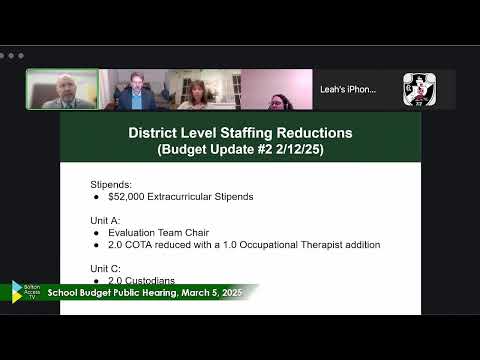
Officials listed specific changes and offsets included in the current proposal: an initial set of about 18 unspecified staff reductions to reach an earlier target, additional reductions in teaching and related services, reallocations from revolving accounts that offset about $500,000, administrative salary freezes (a 0% increase for the leadership council), and other leanings such as reduced extracurricular stipends and consolidation of certain team-chair duties.
Superintendent Downing described deeper cuts required after the district learned it would face a 19.92% increase in health insurance rates. That increase produced an estimated $528,000 budget pressure; to address it, the administration proposed eliminating four dean positions across the three middle schools and the high school and removing an additional 0.5 secretary position, measures Downing called “a deep cut” to the district’s support structure. "This is a deep cut. This is a to the bone cut for us," Superintendent Downing said.
Other staffing changes the administration listed included reductions equivalent to roughly 3.4 high-school teacher positions, consolidation or replacement of some occupational therapist roles with assistants, reductions in middle-school library assistants, and other unit-C staff reductions. The administration also described an administrative headcount change from 24 to 23 positions as part of earlier adjustments.
Officials said they pursued several revenue and offset measures in addition to position reductions: they increased the investment-income estimate by $100,000, identified roughly $432,000 in other reductions, and found a $27,000 duplication to remove. Finance staff reported that, combined, those changes helped hold town assessments lower than they otherwise would be under the operating-budget increase.
Special-education costs and transportation were emphasized as ongoing budget drivers. Presenters noted that circuit-breaker reimbursements, certain grants (identified in the presentation as the PRISM grant and the IDA grant), and other targeted funds partially offset placement and transportation costs but do not cover the full increase the district is experiencing.
Public participation during the hearing was limited. One neighbor who spoke praised the administration’s thorough pre-hearing work and the outreach to town officials. Committee members thanked administrators and staff for the months of work and reminded viewers of an upcoming Budget and Warrants Committee meeting to answer public questions.
What’s next: the school committee is scheduled to vote on the FY26 operating budget next week; if approved, the administration will present and defend the budget at each town’s meeting. District leaders said they will continue to pursue legislative and other solutions to reduce pressures such as health-insurance cost increases.