Get Full Government Meeting Transcripts, Videos, & Alerts Forever!
Get email alerts on the Assessments Cut Scores topic
No spam. Unsubscribe anytime.
Virginia board reviews proposed 2025–26 SOL proficiency cut scores; departments to run division-level impacts
Summary
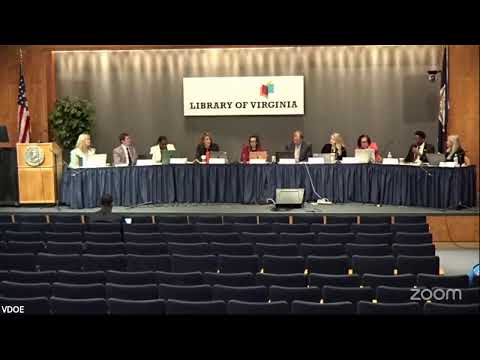
The Virginia Board of Education held a lengthy review of proposed 2025–26 proficiency cut scores for Standards of Learning (SOL) assessments, heard public comments and asked the Department of Education to produce school-division-level impact analyses and communication plans before final adoption.
The Virginia Board of Education reviewed proposed 2025–26 proficiency cut scores for the Standards of Learning assessments and requested detailed, division-level impact analyses and an expanded communication plan before making final decisions.
The discussion, which ran across the board's August meeting and a prior work session, included a technical presentation on the standard-setting process by VDOE assessment staff and extensive public comment from educators and parents. VDOE assessment director James Ellis described this year's process as an “item‑bank ID‑matching” standard setting that included both educator and community members, a change from prior years’ Angoff-style panels.
Board members and public commenters pressed VDOE for clarity about how proposed numerical cut scores translate into number‑of‑items‑correct for parents and how the computer adaptive nature of grades 3–8 tests affects interpretation. Henrico County math specialist and parent Javier Cabezas urged the board to “make explicit what the number of items correct needed to achieve proficiency on each SOL mathematics test is,” saying families need concrete, comparable guidance.
VDOE staff said adaptive scoring means a simple ‘‘items‑correct’’ conversion is misleading because the test selects items of varying difficulty for each student. The department also committed to producing division‑level projections showing how the proposed cuts would affect each school division, not just statewide totals. Superintendent of Public Instruction Jill Gullickson told the board the department will "go out to every region" with assessment and accountability staff to explain local impacts and supports.
Board members emphasized the need for robust supports if cut scores change, particularly for students with disabilities, English learners and seniors already selecting courses. Board member Dr. Mary Ackerman, who has worked in special education, said raising expectations must be matched with supports: “people rise to the bar that we set.” Several members asked VDOE to recommend whether seniors already in diploma pathways should be held harmless for this school year.
Public commenters raised related concerns. Kakeem Fung, an educator from Chesterfield, warned that low cut scores on substitute tests such as CLEP could incentivize divisions to pivot to substitutes rather than improve instruction. Javier Cabezas said a state law (House Bill 2686) requiring automatic placement into advanced math for students in an upper quartile created potential conflicting messages if cut scores changed.
The board did not adopt final cut scores at the meeting. Members directed VDOE to (1) run and publish division‑level impact projections using the most recent data, (2) clarify and publish how cut scores map (where feasible) to understandable performance indicators for families, and (3) present a communication and local support plan when the board takes final action.
VDOE indicated it will produce the requested analyses and regional briefings prior to the September final vote.
Ending: The board framed the next steps as a data‑driven public process: final cut‑score action will follow VDOE’s finer‑grained impact modeling and a statewide outreach plan for school divisions, families and educators.