Get Full Government Meeting Transcripts, Videos, & Alerts Forever!
Get email alerts on the Audit Planning topic
No spam. Unsubscribe anytime.
Baltimore commission adopts 2025 Group A audit plan, defers EMS transport topic
Summary
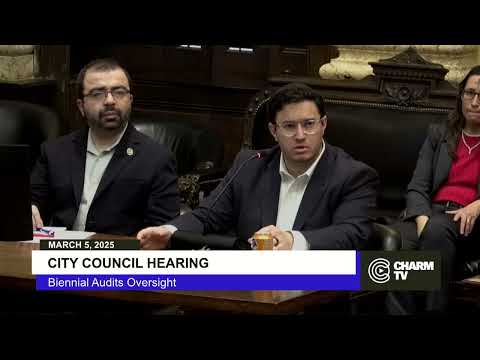
Baltimore City’s Biennial Audits Oversight Commission voted to adopt the city auditor’s proposed Group A audit plan for calendar year 2025 while deferring the proposed audit of EMS external transport arrangements for later review.
Baltimore City Council President Zeke Cohen, chairing the Biennial Audits Oversight Commission, moved and the commission approved the city auditor’s proposed Group A audit plan for calendar year 2025, while excluding the proposed audit of the fire department’s external EMS transport arrangements for later consideration.
The action centers on the city auditor’s presentation of candidate audit objectives for Group A agencies. City Auditor Josh Pash outlined proposed objectives that include two alternative focuses for the Baltimore City Fire Department — either review of the program and controls for assigning take-home vehicles to employees or evaluation of controls over EMS internal billing and collections involving external ambulance providers — along with audit objectives for BCIT (privileged access controls), the Baltimore Development Corporation (performance metrics), the Department of General Services (energy billing/renewable energy), DHCD (emergency services payments and controls), Department of Finance (accounts receivable and billing coordination), DPW (landfill tipping-fee transactions and new software), and follow-ups on federal grant management and prior audit findings.
Why it matters: the commission provides guidance that shapes which agency operations the auditor examines; those audits aim to produce recommendations the city can use to improve service delivery and financial stewardship. Cohen said oversight must produce action, noting that “too often, reports issued by our city auditor sit on shelves when their recommendations should be guiding corrective actions and operational improvements.”
What the commission approved and deferred The commission adopted the auditor’s proposed Group A audit workplan for calendar year 2025 but explicitly removed the EMS external-transport/billing review (the auditor’s EMS billing objective) from this cycle so the commission can revisit that topic later. Josh Pash presented both EMS-related options as distinct objectives and asked the commission to select one; in the meeting members discussed timing, potential value and whether to wait to audit a program that is in the process of change. Comptroller Bill Henry and Councilman Bridal Dorsey both urged holding the EMS-billing objective until after the fire department’s evolving external-EMS program has had more time to develop. Councilmember Danielle McCrae and others expressed interest in auditing EMS billing rather than the take-home vehicle program; McCrae said the EMS-billing topic would better serve residents, while Dorsey and the comptroller suggested delay to examine a program transition.
Planned audit objectives presented by the auditor City Auditor Josh Pash described the proposed Group A objectives as selected from agency risk assessments and stakeholder interviews. Key items presented include: - Fire Department: choice of (a) assessing controls over take-home vehicle assignment and monitoring or (b) evaluating EMS internal billing and collections involving external ambulance vendors (deferred by the commission for later consideration). - BCIT (Baltimore City Information Technology): evaluate effectiveness of privileged access management, including granting and removal of high-level access across city systems (citywide scope). - Baltimore Development Corporation (BDC): evaluate whether BDC met performance measures, specifically: total new and expanding businesses in commercial corridors and private investment leverage through BDC programs (in millions). - Department of General Services (DGS): assess effectiveness of managing energy bills and renewable-energy billing arrangements. - Department of Housing and Community Development (DHCD): evaluate controls over emergency services for displaced residents, including payments to providers for emergency shelter/assistance. - Department of Finance: evaluate controls for billing, recording accounts receivable and monitoring receipts across city services (outside standalone systems such as water and real-estate tax), and follow up on retroactive payroll payment controls noted in prior audits. - Department of Public Works (DPW): evaluate controls over landfill tipping-fee transactions and assess effectiveness of newly implemented software. - Mayor’s Office of Homeless Services (MOHS): follow-up on federal grant management controls tied to findings in the single audit.
Follow-up audits and schedule notes Pash summarized audits issued since January 2024 and planned issuance dates for remaining Group A items: DGS follow-up (issued Jan. 2024), Fire Department (Apr. 2024 issued), Public Works (May 2024), BCIT (July 2024), Police (Oct. 2024), and several others; upcoming expected reports referenced included Baltimore City Health Department (estimated May/June), Mayor’s Office recovery program (May 2025), and Rec & Parks main audit (March 2025). Pash said the office plans to present deeper reviews of individual audits at future commission meetings.
Debate highlights and clarifications Councilmember Isaac Y. Schleifer asked whether the Department of Finance review included procurement card (P‑card) or other spending processes; Pash clarified the proposed 2025 Finance objective focuses on billing and receivables (revenue side) rather than expense processing such as P‑cards. Schleifer also asked whether BCIT’s security review would cover physical access; Pash said the scope is primarily IT system privileged-access controls rather than key-card or door access. Several members emphasized timing concerns: Comptroller Bill Henry recommended delaying an EMS-billing audit until the fire department’s pilot/transition is more established so an audit could examine the transition rather than an older process.
Next steps The commission scheduled to revisit deferred topics and directed staff to provide members the presentation materials by email. Council President Zeke Cohen said he hopes the commission will push to ensure audit recommendations do not “sit on the shelf” and said the commission will meet next quarter to review agency responses to a recent audit of hiring; the chair indicated the commission is targeting June 25 for that meeting.
Ending The commission thanked the auditor’s office team for the presentation and closed the meeting. Josh Pash and his audit team — including Deputy Auditor Tandy [last name redacted], Audit Manager Dave Walton and Audit Supervisor Steve Cohen — will proceed with the adopted Group A workplan and return with additional detail and follow-up items at future meetings.