Get Full Government Meeting Transcripts, Videos, & Alerts Forever!
Get email alerts on the Renewable Energy Ordinances topic
No spam. Unsubscribe anytime.
County seeks to restart renewable-energy ordinance process after legal challenge; public hearings and room capacity among issues
Summary
Committee members discussed redoing solar, battery and wind ordinances after an attorney said the county had not followed required procedures. The county has hired outside counsel to help, is planning public hearings, and debated venue size, hearing officers, quorum needs and draft fees for large-scale projects.
The committee discussed next steps on three renewable‑energy ordinances (solar, battery storage and wind) after an attorney representing an area landowner argued the county did not follow required procedures when it previously revised or adopted local ordinance language.
Doug (committee member) said legal review found the adoption process had gaps and that the county needs to follow the public‑hearing and notice procedures spelled out in state law. He reported that outside counsel with experience in Midwestern renewable‑energy matters had been engaged and had provided suggested edits to the county’s draft ordinances. "We were remiss, or however you wanna say it, on on what we had done and this goes back, I don't know how far it goes back honestly," Doug said.
The nut graf: the county must repeat the ordinance-adoption process correctly to avoid future legal challenges and to set defensible local rules for large projects. Committee members discussed logistics — venue size for public hearings, whether a hearing officer may conduct hearings in the county board’s stead, quorum availability for the County Board of Appeals (CBA), and the appropriate fee structure for conditional‑use applications for large projects.
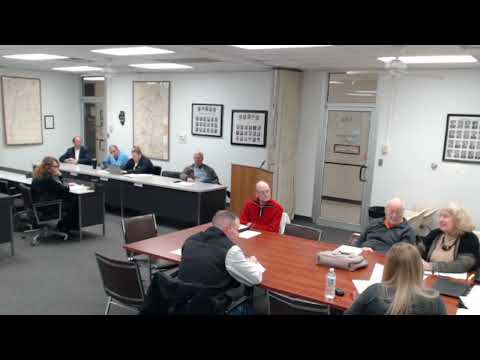
Board members debated venue and scheduling. The committee noted the current meeting room holds about 70 people and that a larger government‑owned site (the former Burns Implement/Unit 9 office) could hold more than 200; attorneys are researching whether the alternative site satisfies the statutory requirement that hearings occur in a county building. Committee members also asked whether it would be fair to ask the public to attend an all‑day hearing and discussed whether separate hearings might be more accessible.
On fees and financial protections, staff said the draft includes a conditional‑use application fee formula that would charge $20,000 per megawatt for the first four megawatts and $5,000 for each additional megawatt; staff described that fee as intended to cover county review costs and to secure cash for decommissioning rather than a bond. "We're requiring cash to be put up before the decommission, not a bond or a problem," a staff member said; some attorneys questioned the amount.
The committee also discussed practical enforcement and ongoing oversight: tracking changes in project ownership, ensuring developers keep insurance and decommissioning funds current, and requiring applicants to correct site problems such as retention‑pond issues raised in a specific Ameren project. Mike Quinlan reported he had contacted a Peoria law firm that has begun reviewing the county’s drafts and advised the committee on next steps.
Ending: Staff will collect comments from board members and pass them to outside counsel for consolidation. The committee asked staff to schedule public‑hearing logistics once attorneys confirm statutory requirements, and to assemble records for existing renewable projects so the county can map which ordinance version applied at the time projects were permitted.