Get Full Government Meeting Transcripts, Videos, & Alerts Forever!
Get email alerts on the Battery Storage Ordinance topic
No spam. Unsubscribe anytime.
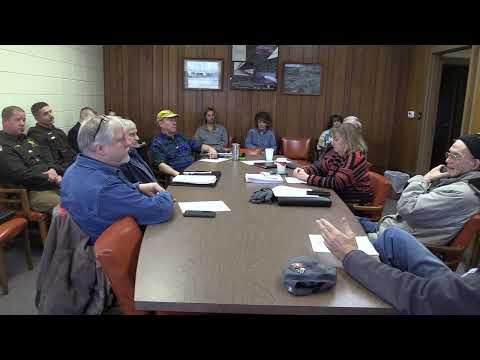
Edgar County board reviews draft battery energy storage ordinance, asks to place on March agenda
Summary
County board members discussed a draft ordinance for battery energy storage systems (BESS), including financial assurance, ownership disclosure, public-notice radius and emergency-management provisions, and directed staff to bring a revised draft to the March meeting for further study and possible vote.
Edgar County board members discussed a draft battery energy storage system ordinance and asked staff to return a revised version for board consideration in March.
The board focused on requirements the draft borrows from a template presented at a UCCI meeting: an irrevocable financial assurance equal to 110% of estimated project costs, a requirement that owners and anyone with 20% or more ownership be listed, a public-notice requirement for landowners and residents within 1.5 miles of the project footprint, and an annual maintenance report filed with the Edgar County Clerk and Recorder.
Board member Jeff, who led the discussion, said the draft borrows heavily from the UCCI template and that he removed zoning language before sharing it with the board. "This one was that, you know, I went to that UCCI meeting and, specifically because they had the attorney from Heil Roaster, talking about battery energy storage system ordinances," Jeff said during the meeting. He noted the template recommends an irrevocable financial assurance set at 110% of estimated project costs.
Members pressed staff on practical items tied to local operations. The draft requires a drain-tile survey and repair of any damage to waterways, drainage infrastructure or field tiles caused by construction or operation. Jeff noted the drain-tile language is broader than the solar ordinance because it is not limited to drainage districts and said the board should review that language carefully. The draft also says warning signs identifying underground wire locations shall be placed at road and water crossings, and that all underground wire locations shall be GPS-mapped and provided to the local GIS office; one member asked whether mapping should instead go to the highway department.
Emergency response and public-safety preparations were recurring themes. The draft calls for coordination with the county emergency management coordinator and local fire and ambulance districts, and sets a requirement that sites be maintained — including snow removal — at a level acceptable to the local fire department. Board members asked for clearer guidance about fire suppression and how local responders would handle a battery fire, and flagged the difficulty of obtaining timely responses from volunteer emergency services.
Jeff said the ordinance also includes a requirement that, if ownership or operation changes, the new operator must apply for a new operating permit and pay a county fee for evaluation. He described this as a change from existing wind and solar practice: "Some of the other ones just change ownership all the time and there's no requirement laid out like this." The draft also establishes an annual reporting requirement: a maintenance report due Feb. 1 each year to the Edgar County Clerk and Recorder.
The draft leaves several numeric fields blank for the board to set, including an initial certified check of $40,000 and an additional per-megawatt fee up to a cap of $250,000; members asked staff to calculate options. The draft also proposes an enforcement fine of $1,000 per day for violations; one member said that amount seemed too low.
The board discussed public-notice and decommissioning rules. The draft requires the applicant to show that a public meeting was held and that all landowners and residents within 1.5 miles of the project footprint were notified; it requires the project site owner or leaseholder to retain responsibility for equipment and components in the event of abandonment. Jeff said such reporting and ownership rules would make it easier for the county to track changes and hold operators accountable.
Board members agreed to gather additional technical information and to continue the matter at the next study session. Jeff said he would try to find objective information on typical BESS composition and risks for the board and asked staff to place the ordinance on the March agenda so that the board can vote before any permit applications are submitted without local rules in place. "So, if we can have it on that agenda. Thank you," Jeff said.
The discussion will continue at a future study session; no final ordinance vote was recorded during this meeting.