Get Full Government Meeting Transcripts, Videos, & Alerts Forever!
Get email alerts on the Education topic
No spam. Unsubscribe anytime.
Superintendent touts Clay County growth, student outcomes and investments at State of Schools address
Summary
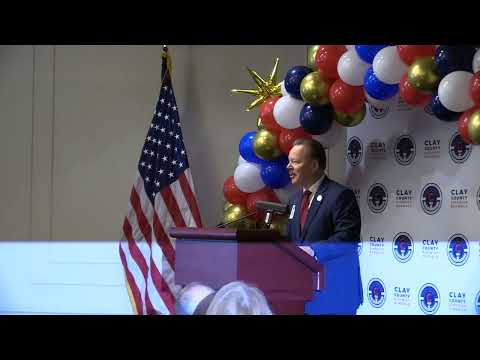
Superintendent David Broski highlighted enrollment growth, facility expansions, higher pay for staff and student success metrics during the Clay County District Schools State of Schools address; a student speaker recounted how district programs and teachers shaped her path to graduate with an associate degree.
Erin Skipper, chair of the Clay County School Board, opened the annual State of Schools address, welcoming elected officials and community partners and turning the program over to Superintendent David Broski.
At the State of Schools event, Superintendent David Broski provided a wide-ranging overview of district growth, operations, student experience and staffing. He framed the presentation around historic photos and data to show how Clay County District Schools has expanded and how the district is preparing for future enrollment increases.
Broski said Clay County Schools is "not just a good school system. It's a great school system," citing the district's A rating from the Florida Department of Education and a 95% graduation rate. He noted Clay County is one of 14 Florida districts with an A rating and that Orange Park Elementary is the state's top-ranked public elementary school.
Growth and facilities
Broski described rapid community and housing growth: he said roughly 19,000 new homes are projected in the county over the next seven to eight years and pointed to planned construction and developer activity concentrated along the First Coast Expressway corridor. To meet rising enrollment, the district has short-, mid- and long-range facility plans and is adding capacity now: two new classroom wings under construction at Lake Asbury Junior High and Oakleaf (Oakleaf/Oakley in the transcript) Junior High, and a 32-classroom addition at Oakleaf that was built by Scorpio Construction.
He estimated a new high school in a fast-growth corridor could cost in the low end of $150 million and said peers have opened schools that cost nearly $200 million, underscoring the scale of capital needs.
Student experience and programs
Broski highlighted career and college pathways available inside high schools, including dual-enrollment and Career and Technical Education programs. He said every high school offers the ACE program and noted students can earn an AA degree before high school graduation; the student speaker onstage, Lindsey Gillis, said she will graduate with an associate degree and has been active in school leadership and career programs.
Broski also emphasized extracurriculars and supports that shape student development: athletics (about 6,000 student athletes), fine arts, and programs for military families (10 Purple Star schools and a district military liaison).
Operations, staffing and costs
The superintendent gave several operational figures to illustrate district scale: about 42,000 students and 43 schools (compared with 10 schools in the 1920s), 5,300 district employees, roughly 6.7 million square feet of air-conditioned building space, and about 3.2 million miles traveled annually by the district bus fleet. He said the district serves about 5.6 million meals per year and listed meal prices as $2.50 for elementary and $2.75 for secondary students.
Broski said the district has invested an additional $56 million in employee compensation since 2020 and described teacher recruitment and retention as a continuing priority. He noted average bus prices (about $150,000–$175,000 for large buses) and the cost differences between older and modern construction, contrasting a historic $22,000 elementary build with current multi‑million-dollar wings.
Community engagement and volunteers
The superintendent repeatedly credited community partners, local businesses and the Clay Education Foundation for fundraising, grants and in-kind support. He said parents and volunteers logged about 29,000 registered volunteer hours in the most recent year and thanked business sponsors, naming Scorpio Construction and Garber Auto Mall among supporters.
Student speaker
Lindsey Gillis, chair of the superintendent's student advisory council and a student with dual-enrollment credits, delivered a personal account of K–12 experiences in Clay County. She described early confidence in elementary school, social struggles in middle school, and a turnaround driven by supportive teachers and counselors. Gillis said she will graduate high school in May with an associate degree from St. Johns River State College and plans to study music education at the University of North Florida.
Why it matters
Superintendent Broski framed the address to show both historical continuity — community support for schools over many decades — and current pressures: fast population growth, significant capital costs for new schools, and the need to recruit and retain teachers. The figures he provided (enrollment, facilities, workforce and compensation investments) are central to the district's near-term budgeting and planning.
What the address did not include
The program was a presentation and celebration rather than a policymaking meeting: the transcript records no formal board motions, votes, budget approvals or binding decisions during the event. Several elected officials and community leaders were recognized but did not debate or vote on district business during the address.
The district said more detailed facility plans, budget numbers and timelines are handled through operations and planning processes that will be presented in future board or committee meetings.