Get Full Government Meeting Transcripts, Videos, & Alerts Forever!
Get email alerts on the Water Management topic
No spam. Unsubscribe anytime.
Selectmen agree to convene stakeholders on Smith River flow after lake-level order; Wolfeboro Waters to organize initial discussions
Summary
After a presentation from Wolfeboro Waters, the Board of Selectmen authorized town staff to convene DES, Fish and Game and other stakeholders to explore whether the town can maintain a minimum flow in the Smith River while remaining within the 1991–1993 lake-level order governing Crescent Lake and Lake Wentworth.
The Wolfeboro Board of Selectmen voted March 5 to move forward with a town-led effort to convene state agencies and local stakeholders to examine how dam operations at Crescent Lake could be managed to preserve continuous flow in the Smith River.
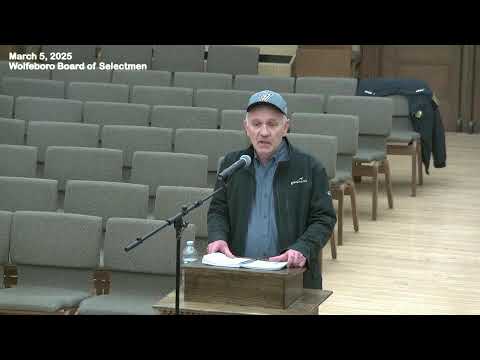
Rich Massey, a member of the volunteer Wolfeboro Waters group, told the board the Smith River — the short channel connecting Crescent Lake and Lake Wentworth to Back Bay — periodically dries when dam operations fully close the outlet. He said that practice kills aquatic life in the river and can change downstream water conditions, including lake flushing and nutrient transport to Wolfeboro Bay. The current lake-level order issued by New Hampshire Department of Environmental Services (DES) in 1991 and reaffirmed in 1993 governs lake elevations but does not explicitly require minimum downstream flow, Massey and other speakers said.
Julie Brown of the Wentworth Watershed Association and Wolfeboro Waters urged the town to take the initiative in bringing stakeholders together. Brown said DES has limited staff capacity and was unlikely to undertake a new lake‑level re-determination, but DES and Fish and Game expressed interest in participating in a stakeholder conversation. Brown warned that maintaining flushing and a minimum flow is important for water clarity and for limiting nutrient accumulation that can increase cyanobacteria risk.
Selectmen authorized the town manager and the director of public works to coordinate discussions, with the goal of inviting DES (water division), New Hampshire Fish & Game, dam operators’ representatives and watershed stakeholders to the table. The board asked staff to return with a list of proposed participants and a meeting plan.
What the town will ask DES and others to explore
Wolfeboro Waters and town staff framed the effort narrowly: the town will not ask DES to reopen or re-evaluate the 1991/1993 lake-level order (a major, resource‑intensive regulatory process) but instead will ask whether the town, dam operators and DES can find an operating approach that maintains the lake levels DES requires while ensuring a small but continuous minimum flow to the Smith River so it does not dry completely.
Selectmen’s rationale
Board members said taking the initiative preserves local influence in shaping technical discussions and possible operating adjustments; several members noted that state agencies are more likely to engage if the town coordinates stakeholder input and proposes feasible, technically grounded options. Public Works Director Steve Randle confirmed the department supports efforts to find workable operating methods that reduce downstream ecological harm while respecting regulatory lake‑level constraints.
Immediate next steps
- Town staff will draft a stakeholder roster and meeting schedule and will reach out to DES and Fish and Game to request participation. - Wolfeboro Waters will continue to supply scientific and observational background (water‑quality monitoring, historical data) to inform the conversation.
Why this matters
The Smith River connects multiple water bodies and is part of the hydrologic flow that influences water quality in Wolfeboro Bay. Finding an operating method that preserves a minimum flow could reduce fish kills in the river, improve flushing of nutrients, and reduce cyanobacteria risk downstream — without a formal re-determination of lake elevation standards.
Ending
Selectmen voted unanimously to authorize the town manager and public works director to begin stakeholder outreach. The town will return to the board with a proposed roster and meeting plan for the cooperative review.