Get Full Government Meeting Transcripts, Videos, & Alerts Forever!
Get email alerts on the Dmva Fy25 Budget topic
No spam. Unsubscribe anytime.
House subcommittee reviews $275.9 million Michigan Department of Military and Veterans Affairs FY25 budget
Summary
The House Appropriations Subcommittee on Military and Veterans' Affairs on a subcommittee meeting heard a presentation on the Michigan Department of Military and Veterans Affairs' (DMVA) fiscal 2025 budget, which the presenter said totaled $275,900,000 in gross appropriations.
The House Appropriations Subcommittee on Military and Veterans' Affairs on a subcommittee meeting heard a presentation on the Michigan Department of Military and Veterans Affairs' (DMVA) fiscal 2025 budget, which the presenter said totaled $275,900,000 in gross appropriations.
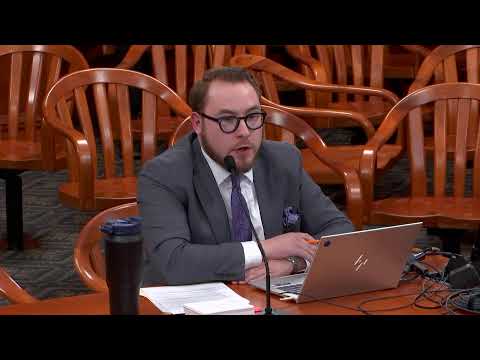
The overview, delivered by Aaron Meek, House Fiscal analyst for the military and veterans affairs budget, detailed that roughly $144.8 million of the total is federal grant and matching revenue and about $117.7 million is from the state general fund, with state restricted funds and private donations making up the remainder. "Fiscal 25 for DMVA, the gross appropriation is $275,900,000," Meek said during his presentation.
The presentation split the department into three core appropriation units: military (Michigan National Guard), the Michigan Veterans Affairs Agency (MVAA), and the Michigan Veterans Facility Authority (MVFA), plus capital outlay, information technology and one-time appropriations. Meek said the military and MVFA units each account for roughly one-third of DMVA's gross appropriation; MVAA comprises about 9 percent of the gross budget but receives most of its funding from the general fund for veterans grants and administration.
Key program and line-item figures cited by Meek included: $45.9 million for military training sites and support facilities; $24.4 million for administrative functions; $11.2 million for the Michigan National Guard State Tuition Assistance Program (MINGSTAP); $10.3 million for the Michigan Youth Challenge Academy (MICA); and federal authorizations and reimbursements that cover about two-thirds of the military unit. For MVAA, Meek said grant lines include $4.25 million each for county veteran service grants and veteran service organization grants, $2.5 million for veterans trust fund grants (plus $1.2 million for administration), and $2.5 million in one-time funding for grants to reduce veteran homelessness.
Meek said the MVFA — which operates the state's three veterans homes and the adjacent Grand Rapids veterans cemetery — accounts for roughly 38 percent of the fiscal 2025 budget, with nearly half of that unit funded by federal revenues, including an authorization to spend approximately $39.9 million in U.S. Department of Veterans Affairs Veterans Health Administration revenues and roughly $10.2 million in funds identified as coming from the Health Care Finance Administration. He said restricted revenue for MVFA (about $6.6 million) comes from income-based assessments paid by residents or their families.
The presentation covered ongoing and recent capital projects. Meek described a sequence of armory and Selfridge Air National Guard Base projects funded in recent years and noted an executive recommendation for an additional $26 million for Selfridge in the fiscal 2026 request. "Since fiscal '23, the legislature has appropriated about $35,800,000 total to fund improvements and construction projects at Selfridge," Meek said, adding most recent projects included runway and infrastructure work and a new hangar intended to attract future fighter missions.
Meek described education and outreach programs: MICA, a voluntary residential program for at-risk 16-to-18-year-olds, received $10.3 million gross in FY25 and, after federal matching, was said to cost the state roughly $5,000 per participant in general-fund dollars on average. STARBASE, a Department of Defense STEM outreach program that operates three Michigan locations, was reported closed as of Feb. 7 because of a pause in DoD funding releases. Meek said STARBASE programs nationwide are closed pending additional federal funds.
Meek also reviewed trends at the veterans homes: gross appropriations to Grand Rapids and Jacobetti homes have decreased since 2016 because of declining populations and transitions to smaller facilities, while the Chesterfield home — opened in 2021 — reached population parity with the others. He noted the homes' combined population has declined about 48 percent since fiscal 2009.
Committee members asked for follow-up on several items. Representative Gavin asked whether FY25 included funding for a northern Michigan veterans cemetery; Meek responded that no funding was in FY25 but said there was a proposal for FY26. Representative Rogers and Representative Maddock pressed for additional detail on procurement and population drivers at the homes and requested departmental follow-up. Meek offered to coordinate responses and supply more detailed line-item information outside the meeting.
No formal appropriations were adopted by the subcommittee during the meeting; the session closed after routine committee business. The only formal action recorded in the transcript was a motion to excuse absent members, moved by Representative Rogers and approved without recorded objection, followed by adjournment.
Votes at a glance: Representative Rogers moved to excuse absent members; motion approved without objection and the subcommittee adjourned.