Get Full Government Meeting Transcripts, Videos, & Alerts Forever!
Get email alerts on the DNR Budget topic
No spam. Unsubscribe anytime.
DNR budget briefing highlights restricted funds, trust-fund cap and recreation revenue
Summary
The House Appropriations subcommittee heard a budget overview for the Michigan Department of Natural Resources highlighting that two-thirds of DNR funding comes from restricted funds and focusing questions on trust-fund rules, recreation revenue and law-enforcement funding.
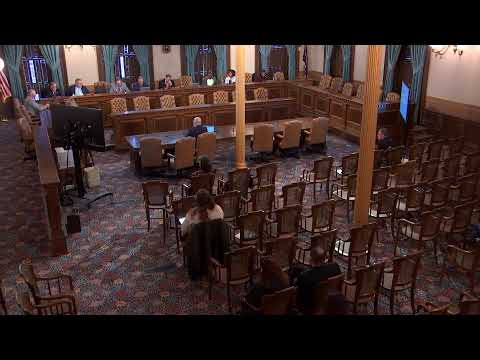
The House Appropriations subcommittee on Agriculture, Rural Development and Natural Resources received an overview of the Michigan Department of Natural Resources (DNR) current-year budget and funding structure, with discussion focused on restricted funds, trust-fund rules, recreation revenue and law-enforcement funding.
House Fiscal Agency analyst Austin Scott told the panel that “two thirds of DNR’s budget is restricted funds,” and that the department’s current-year gross funding is roughly $534,000,000. He said approximately 40 distinct restricted funds support DNR activities and that general fund support is a comparatively small portion of the total. Scott described how several large funds are constitutional in origin and therefore require a constitutional amendment for fundamental changes.
Scott highlighted the Natural Resources Trust Fund, which receives revenue from the sale or lease of state nonrenewable-resource rights (leases and royalties for extraction historically flowed into that trust), and explained that the trust fund has reached its statutory cap in recent years. Revenues formerly going into the trust now flow into the State Park Endowment Fund; when that endowment reaches its cap the constitution was amended to specify where further revenues will be directed.
The trust fund provides grants — most commonly to local governments — for acquisition of land for public recreation or for development of public recreation facilities. Scott said the February 2020 constitutional change set minimums requiring that at least 25% of money made available for expenditure be used for acquisition and at least 25% be used for development; remaining funds may be used for maintenance, pil t or other authorized purposes.
Scott said DNR manages roughly 4.6 million acres (primarily forest land), and that the department operates 103 state park facilities with a 104th (Flint State Park) coming online soon. He described the Recreation Passport program — purchased at vehicle-registration renewal through the Secretary of State — as a growing restricted revenue source for park improvements and local grants. Hunting and fishing license sales generated just over $63.5 million in the most recent fiscal year, Scott said; those receipts are deposited to game-and-fish accounts that chiefly support wildlife, fisheries and law-enforcement divisions.
Law enforcement (commissioned conservation officers) received discussion. Scott said law enforcement has taken a larger share of general fund in recent years to support conservation officer academies and items such as body-worn cameras. He noted the number of commissioned officers has varied year to year with academy completions and retirements; at the start of the current fiscal year the department reported 239 conservation officers.
Scott also described invasive-species prevention and control funding, noting a recurring general fund appropriation historically in the $5 million range and roughly $7.1 million listed in the current line-item summary for invasive-species prevention and control (7 FTE positions in the current year, Scott said). He said there are roughly 19–21 recurring grant programs in the DNR budget that support local governments and recreation-specific clubs.
Representatives asked procedural and statutory questions. Representative Great asked whether revenue changes to the trust fund can be made without a constitutional amendment; Scott replied that fundamental changes require a constitutional amendment and described how the 2020 amendment altered distribution rules. Representative Desena asked whether DNR statutory leasing authority extends to leasing the entire body of state land for projects such as solar; Scott said he was not certain and would yield to the department for a definitive answer: “I can’t confidently answer yes or no,” he said. Representative O’Neil asked whether hunting and fishing license rules are in one statute; Scott said they are included in the Natural Resources and Environmental Protection Act.
No votes or formal committee actions were taken during the presentation; members requested follow-up details and line-item references.
Ending — Scott provided contact information and offered to supply additional detail by e-mail or in subsequent meetings.