Get Full Government Meeting Transcripts, Videos, & Alerts Forever!
Get email alerts on the Appropriations topic
No spam. Unsubscribe anytime.
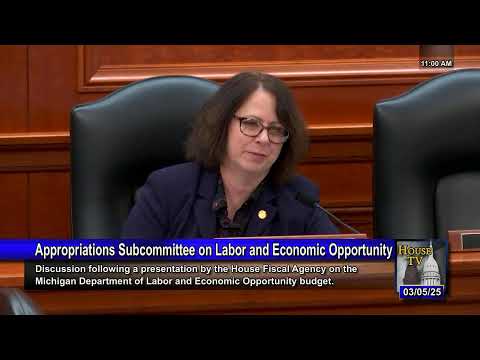
House appropriations panel hears FY2025 overview for Michigan Department of Labor and Economic Opportunity
Summary
House Appropriations Subcommittee on Labor and Economic Opportunity received a high-level fiscal year 2025 budget briefing from the House Fiscal Agency outlining LEO’s $2.4 billion gross appropriation, funding composition, major program changes and reporting limits for one-time grants and the SOAR reserve fund.
LANSING — The House Appropriations Subcommittee on Labor and Economic Opportunity heard a fiscal year 2025 budget overview for the Department of Labor and Economic Opportunity on Oct. 12, when Marcus Coffin of the House Fiscal Agency summarized the department’s $2.4 billion gross appropriation, the mix of ongoing and one-time funding, and recent program and staffing changes.
Coffin told the committee that about $1.2 billion of LEO’s FY2025 appropriation is federal funding, roughly $793.6 million is state general fund, and about $413.8 million is state restricted revenue. He said roughly half of the department’s budget is supported by federal dollars and that one-time appropriations account for about a quarter of the LEO budget.
The briefing put several changes and program highlights on the subcommittee’s radar. Coffin said the Reconnect and Tri-Share child care programs were transferred to MyLEAP under Executive Order 2023-6, reducing LEO’s general fund by $68.7 million and removing 12 full-time-equivalent positions from the department’s roll. He described LEO as “the state’s primary economic development, workforce development and affordable housing department.”
Coffin outlined other FY2025 adjustments: $5.9 million gross ($1.3 million general fund) for expanded vocational rehabilitation services; $4.0 million general fund for the Office of Global Michigan; an additional $3.4 million in federal funding for the Bureau of Services for Blind Persons; and $2.5 million general fund and 10 FTEs for a new Community Worker and Economic Transition Office. He also noted smaller grant allocations, including $1 million for the Pure Michigan program and $1 million for volunteer income tax assistance grants.
On one-time funding, Coffin said FY2025 includes 60 unique grants and programs. Examples he cited: $137.2 million in community enhancement grants (103 recipients), $102.5 million in infrastructure grants (51 recipients), $45.8 million in public safety grants (23 recipients), and $43 million in health-care grants (14 recipients). He told the committee the infrastructure allocations generally supported supplemental infrastructure needs, often for road-related projects, and offered to provide the committee a recipient-level list on request.
Committee members pressed for follow-up information. Representative Robinson asked whether newly authorized FTEs have been filled; Coffin replied that staffing levels fluctuate and that the House Fiscal Agency would defer to department staff for vacancy details, noting “at any given time…there are usually some vacancies.” Representative Robinson also asked about post-award reporting for one-time grants; Coffin said most of the large one-time grant buckets do not carry mandatory reporting requirements to the Legislature, though some specific grants (for example, certain Community Development Financial Institution grants) do require reporting.
Coffin highlighted the Strategic Outreach and Attraction Reserve (SOAR) fund, which supports two subprograms — the Critical Industries Program and the Strategic Site Readiness Program — administered by the Michigan Economic Development Corporation and approved by the Michigan Strategic Fund board. He said roughly $2.4 billion has been transferred from SOAR since its inception and that $456.4 million remained available for allocation at the time of the briefing. He added the executive/agency plan includes a $500 million deposit to SOAR from corporate income tax revenue in FY2025. Coffin told the committee that unless funding receives work-project status or new legislative action, SOAR earmarks could lapse at the end of FY2025.
The presentation also reviewed agency units and major programs within LEO: workforce development (including Going PRO), rehabilitation services (including the Bureau of Services for Blind Persons and Michigan Rehabilitation Services), employment services (including MIOSHA and Wage and Hour), the Unemployment Insurance Agency, MEDC/MSF programs (Pure Michigan, business development, community revitalization), MSHDA housing programs, and the State Land Bank Authority. Coffin noted that approximately 70% of state general fund dollars in the LEO budget are allocated to one-time appropriations in FY2025.
The subcommittee did not take votes during the meeting. Members asked for additional detail on infrastructure grant recipients and oversight; Coffin said the House Fiscal Agency can provide recipient lists and background materials. Chair Jenkins Arno closed the session by noting all members were present and adjourning the meeting.