Get Full Government Meeting Transcripts, Videos, & Alerts Forever!
Get email alerts on the MDARD Budget topic
No spam. Unsubscribe anytime.
Subcommittee reviews MDARD budget; bovine tuberculosis testing and food-safety programs discussed
Summary
The House Appropriations subcommittee received a high-level briefing on the Michigan Department of Agriculture and Rural Development’s $156.9 million budget, with members focusing questions on bovine tuberculosis testing, pesticide and fertilizer programs and the department’s food and dairy regulation responsibilities.
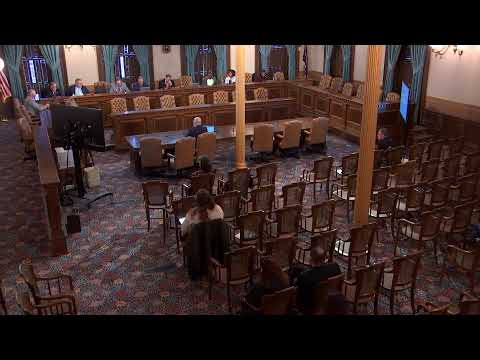
The House Appropriations subcommittee on Agriculture, Rural Development and Natural Resources heard a high-level overview of the Michigan Department of Agriculture and Rural Development (MDARD) budget and asked questions about disease testing and regulatory programs.
House Fiscal Agency analyst William Hamilton told the subcommittee that MDARD’s current-year gross appropriation is $156,900,000 and that the budget is supported primarily by state general fund, state restricted funds and federal revenue. Hamilton said the department’s largest appropriation areas include food safety and animal health, agriculture development, environment and sustainability, and laboratory and consumer protection programs.
Hamilton described MDARD’s food-safety work as a “farm to table food regulation” program established under what he called the food law of February. He said MDARD licenses and inspects about 18,000 food establishments, including processing plants, distribution centers and retail businesses. “MDARD administers a comprehensive program of what they describe as farm to table food regulation,” Hamilton said.
The subcommittee heard that MDARD’s two food and dairy line items — food safety and quality assurance and milk safety and quality assurance — total about $24.8 million, of which roughly $15.3 million is general fund. MDARD also regulates dairy production under state milk laws and oversees roughly 993 dairy farms, Hamilton said, noting that the department works to keep Michigan in compliance with the national Pasteurized Milk Ordinance.
Animal health and bovine tuberculosis (bovine TB) drew focused questions from representatives. Hamilton said Michigan must demonstrate to the U.S. Department of Agriculture that it contains bovine TB; most of the state has a status that allows routine movement of cattle, but four counties remain “modified accredited” with higher testing requirements and movement restrictions. He noted a recent confirmed herd after a multi-year gap: “When we put the PowerPoint together, we hadn’t had one since 2022,” Hamilton said, and he referenced a subsequent confirmed herd announced after the deck was prepared. From 1995 through 2024, Hamilton reported total state spending related to bovine TB of $205,800,000, with MDARD’s share at $150,900,000.
Representative Green asked whether the bovine TB program also governs captive cervids (farmed deer and elk) and whether captive cervid producers pay for required tests. Hamilton said the program regulates farmed cervids and cattle and that cervids are susceptible to bovine TB; he did not have complete details on testing requirements or who pays for tests and said he would follow up. When Green asked whether captive cervids must be tested statewide, Hamilton said, “I don’t know. I’ll find out.”
Representative Roth asked about the pesticide and plant-pest management program (PPPM), referencing roughly $14.5 million in spending. Hamilton said the program includes pesticide registration, licensing of applicators and a fertilizer regulatory program: “So if you wanna sell pesticides in the state of Michigan, you have to be registered,” he said. He offered to provide the subcommittee with more program detail outside the presentation.
Hamilton briefly described MDARD’s laboratory operations, including the Geggley laboratory in East Lansing (food safety and pesticide-residue testing) and a metrology laboratory in Williamston (weights and measures, motor-fuel testing). He also noted a fairs and equine program funded from the agriculture equine development fund ($4,500,000) and $500,000 in general fund grants to county fairs.
Discussion remained at the informational level; no formal committee votes or directives were recorded during the MDARD presentation. Hamilton closed by inviting members to follow up with questions by e-mail or at a later meeting.
Ending — The subcommittee moved on after questions. Staff said they would provide follow-up details requested by members on cervid testing, PPPM program expenditures and any recent developments in bovine TB surveillance.