Get Full Government Meeting Transcripts, Videos, & Alerts Forever!
Get email alerts on the Egle Budget topic
No spam. Unsubscribe anytime.
Subcommittee hears EGLE budget overview; members note heavy federal and restricted funding, SQUIF largely exhausted
Summary
The House Appropriations Subcommittee on Environment, Great Lakes and Energy heard an overview of the Department of Environment, Great Lakes and Energy's current-year budget from Austin Scott, fiscal analyst with the House Fiscal Agency.
The House Appropriations Subcommittee on Environment, Great Lakes and Energy heard an overview of the Department of Environment, Great Lakes and Energy's current-year budget from Austin Scott, fiscal analyst with the House Fiscal Agency. Scott told the subcommittee the department’s budget is a little over $1 billion and that federal grants and numerous restricted funds make up roughly three-quarters of current-year funding.
Scott said, “Most federal funding in the EGLE budget comes from the Environmental Protection Agency.” He told members much of the recent federal funding stems from the Infrastructure Investment and Jobs Act and is channelled to state water programs, particularly water state revolving funds used for drinking water and clean water infrastructure projects such as treatment facilities and pipe replacement.
The presentation emphasized that nearly a third of EGLE’s funding comes from restricted revenue and that the budget includes more than 50 restricted funds. Scott highlighted four large restricted funds that support remediation and cleanup work: the Renew Michigan Fund, the Cleanup and Redevelopment Fund, the Refined Petroleum Fund, and the Underground Storage Tank Cleanup Fund. He said the Renew Michigan program — an income-tax earmark created in recent sessions to replace the Clean Michigan bond authority — directs about two-thirds of its revenue toward cleanup sites, with remaining amounts for recycling and solid-waste initiatives.
Scott also described how the Refined Petroleum Fund and the Underground Storage Tank Cleanup Fund are used. According to Scott, the Refined Petroleum Fund has supported remediation of orphan underground petroleum tank sites, while the Underground Storage Tank Cleanup Fund provides reimbursements to tank owners and operators that qualify for cleanup assistance under department rules.
On one-time funding, Scott said the current-year EGLE appropriation contains roughly $109,000,000 in one-time general-fund appropriations, the largest single portion of general fund in the department this year. He said most of those one-time appropriations are for water-infrastructure projects but that the department’s one-time funding also includes items as varied as a solar energy project, microplastics research and wetland mapping.
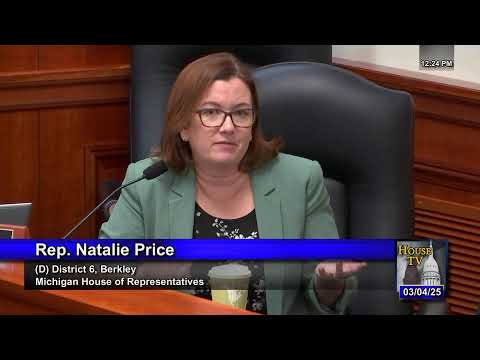
Representative Price asked for further detail about the status of the Strategic Water Quality Initiatives Fund and community demand for grants. “I’d love for Hugh to explain a little bit more about that Strategic Water Quality Initiatives Fund being depleted,” Price said, and asked how local governments have responded to grant opportunities.
Hugh, a staff member who responded to the question, said the 2002 ballot measure — the Great Lakes Water Quality Bond — provided $1 billion in voter-approved general-obligation bond authority and that the bond’s appropriation authority has been largely exhausted over the intervening years. He added that changes during the bond’s life allowed more local governments to access the funding, which increased use while the appropriation authority remained available. Hugh said substantial federal funding became available beginning in fiscal 2022, but that federal appropriations and related principal-forgiveness options have varied from year to year.
No formal votes or committee actions were taken during the presentation; the meeting concluded after questions.
Why it matters: Subcommittee members were briefed that in recent years federal appropriations — notably IIJA funding for water state revolving funds — have supplemented or temporarily replaced bond authority and one-time state general-fund appropriations for water projects. Local governments and water suppliers typically receive loans or reimbursements through these programs and must accept loan repayment terms negotiated with the department.
The subcommittee did not make new budget decisions during this meeting; members were offered contact points at the House Fiscal Agency for follow-up information.