Get Full Government Meeting Transcripts, Videos, & Alerts Forever!
Get email alerts on the Broadband Deployment topic
No spam. Unsubscribe anytime.
Michigan officials outline BEAD, ROBIN and Mitten plans and timelines for last‑mile broadband
Summary
The Michigan High Speed Internet Office briefed the House Communications and Technology Committee on BEAD, ROBIN and Mitten programs, eligibility and timelines, saying the state identified 248,253 BEAD‑eligible locations and will prioritize fiber while using a mix of technologies for remote sites.
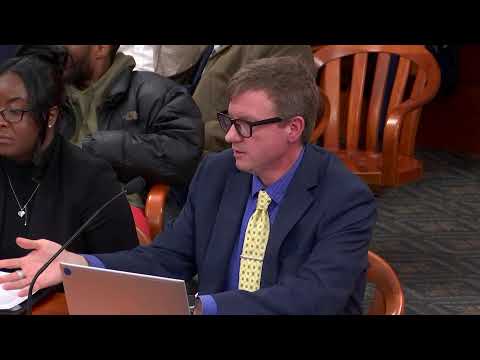
Jaishana Hicks, director of legislative affairs for the Department of Labor and Economic Opportunity, introduced an update from the Michigan High Speed Internet Office to the House Communications and Technology Committee on March 10. Eric Frederick, chief connectivity officer for the office, outlined program goals, funding and a timeline for the Broadband Equity, Access, and Deployment (BEAD) program and related efforts.
"Our mission is to create a more digitally equitable Michigan where everyone can leverage technology to improve their quality of life," Frederick said, describing twin goals of universal availability and increased adoption.
Frederick said ROBIN (Realizing Opportunity with Broadband Infrastructure Networks) is an earlier program funded with $238 million in grants that leveraged about $218 million in matching private funds; 14 subgrantees are building 32 projects that together aim to connect more than 72,000 locations by the end of 2026, with about 17,000 already connected.
On BEAD, Frederick said Michigan—s NTIA allocation is $1,559,000,000 and that the state identified 248,253 locations eligible for BEAD funding after processing more than 2.2 million challenge records. Eligibility follows NTIA speed standards: unserved locations have less than 25/3 Mbps; underserved locations have less than 100/20 Mbps; community anchor institutions without 1 Gbps symmetrical service are also eligible.
Frederick said the office intends to prioritize fiber projects in the initial BEAD round. If locations remain after a fiber‑first round, a second round will accept additional fixed technologies such as hybrid fiber‑coax and licensed fixed wireless, and a later round could consider unlicensed fixed wireless and satellite for the most remote sites. He described a hexagonal grid approach to project boundaries to allow realistic network design and reduce artificial county/zip code edge effects.
Officials described timelines and application windows: preregistration (organizational/financial suitability) was opened in June of the prior year and closes March 10; the BEAD project application window closes April 9; the office will negotiate and deconflict applications, then assemble a final proposal to the NTIA. Frederick warned that NTIA approval timing is the biggest uncertainty.
Committee members asked about costs, oversight and enforcement. Frederick estimated per‑location costs will vary by geography and technology, citing a range of about $3,000–$10,000 per location for BEAD in many areas and noting higher costs in remote parts of the Upper Peninsula. He said ROBIN fiber projects have ranged roughly $3,000–$8,000 per location; a simple arithmetic average of ROBIN funds spent to date yields a higher figure for only already‑connected sites, which he cautioned was not representative of full program averages.
On accountability, Frederick said grant agreements will include clawback provisions and that the office is developing those provisions with the attorney general—s office; he also said Michigan chose scoring methods to incentivize affordability, mobilization milestones to start work before the first construction reimbursement and permitting assistance within the office.
Frederick noted that infrastructure is only one side of the digital divide. The Mitten (Michigan Inclusive Training Technology and Equity Network) program focuses on adoption barriers — affordability, devices, digital skills and technical support — and the office estimates a subscription/adoption gap of roughly 30% among Michigan households. He said BEAD projects must include a low‑cost service option for previously eligible Affordable Connectivity Program households unless a waiver is justified by financial constraints.
Frederick and Hicks outlined permitting touchpoints — county road commissions, drain crossings, pole attachments, railroad crossings, EGLE, DNR and state historic preservation — and said the office has added a permitting specialist to help subgrantees navigate processes. They invited committee follow‑up and said they would return with a post‑round report once the first BEAD application round closes.