Get Full Government Meeting Transcripts, Videos, & Alerts Forever!
Get email alerts on the Health And Human Services topic
No spam. Unsubscribe anytime.
Commissioners approve Manatee Cottages East rezone after contentious neighborhood debate
Summary
After hours of public testimony and sharp divisions among commissioners, the county approved a plan to re-establish a 90‑bed residential program at 5720 Fourth Street East. Supporters said the program saves lives; neighbors cited safety, traffic and zoning conflicts.
Manatee County commissioners narrowly approved a zoning ordinance and general development plan allowing a large residential treatment/assisted‑living use at 5720 Fourth Street East, commonly called Manatee Cottages East, after a lengthy and emotional hearing.
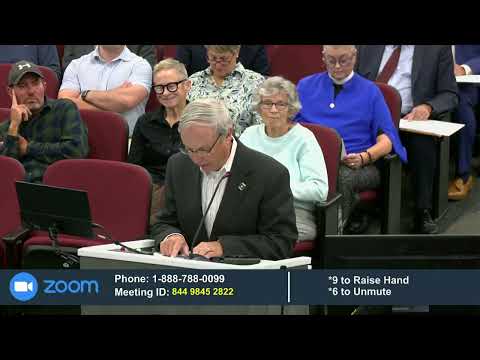
The vote followed more than two hours of public comment and a broad turnout from both supporters and opponents. Supporters — including program graduates, veterans and volunteers — urged the board to approve the site so the nonprofit operator could continue offering residential recovery services. Opponents, including many long‑time Meadow Lakes residents, said the facility’s current operations have altered neighborhood traffic patterns and raised safety concerns and that the site and its operations do not meet the county’s current locational standards for residential treatment programs.
The applicant said the property was originally developed and used for health‑care related residential uses dating to the 1980s and that later approvals and final site plans supported residential care. Patricia Petruff, land‑use counsel for the owner, said the 1997 PDR ordinance that governs the site authorized the facility’s residential uses and that the recent filings were intended to clarify which long‑standing uses remain permitted. “We’re not asking for anything more, anything less than the historical uses that it has been on the property since 1986,” she told the board.
Neighbors and neighborhood advocates disputed that history and urged denial. “Putting this large unlicensed residential treatment facility in the middle of a neighborhood on a dark dead‑end street…does not make sense,” said resident Deepa Piawano, who organized a petition opposing the project. Speakers cited increased foot traffic, concerns about trespass and overdoses reported to the Sheriff’s Office during the prior year, and the single‑access road (20 Fourth Street East) that requires residents and visitors to travel through a quiet subdivision to reach the site.
Staff advised the board that the application presented two distinct possible uses — a large residential treatment facility (RTF) and a large assisted living facility (ALF) — and that the county’s Land Development Code contains a provision (Sec. 531.46(a)) that requires RTFs to be located on a collector roadway or higher. Staff reported it had worked with the applicant to craft stipulations and that, if approved, the board could add conditions to address neighborhood concerns. Staff also noted the 1997 PDR ordinance language that governs the property was ambiguous and that recent zoning verification letters and legal memoranda had yielded differing interpretations.
The board ultimately voted to approve the applicant’s ordinance and general development plan. The motion to approve was made by Commissioner Bearden and seconded by Commissioner Cruz; the motion passed 4–1 (Commissioner Ballard opposed; Commissioners McCann and Siddique absent). The ordinance approval includes the applicant‑proffered stipulations and staff‑recommended clarifications, and includes language that the site will not operate both RTF and ALF uses simultaneously and that a 6‑foot opaque fence and other mitigations be installed along the northern property line in areas lacking mature vegetation. The board also discussed (but did not require as a condition) creation of a neighborhood liaison committee and additional traffic/street‑safety measures.
Supporters said the facility provides an irreplaceable route back to stability for people recovering from substance use disorder and for justice‑involved residents who need housing and services. A number of program graduates testified they had turned their lives around after treatment at the program and urged approval. Several residents who opposed the project said they didn’t object to recovery services as a concept — many explicitly supported treatment elsewhere — but argued the location and the way the property had restarted operations without prior neighborhood notice or a current zoning determination created safety and process problems.
The board’s approval authorizes the applicant to continue the residential/assisted‑care use under the approved general development plan and the enumerated conditions. Commissioners who voted in favor said they were troubled by some of the neighborhood testimony but concluded the county already had a history of residential care on the site and that the applicant had offered concrete steps to reduce neighborhood impacts. Commissioners who opposed it cited the single access route, concerns about the program’s prior unlicensed operation, incomplete notice to neighbors, and the county code requirement that RTFs be sited on a collector roadway.
The applicant and staff agreed during the hearing to work with neighborhood representatives on additional, time‑bound mitigations and to meet publicly to report progress; the board flagged the liaison committee approach as the next step. The board’s action does not remove any statutory enforcement authority; if violations of county code or licensing law occur staff and sheriff’s deputies may act under the county’s normal enforcement process.
Evidence in the public record included the 1997 PDR ordinance for the site, the applicant’s general development plan and legal memoranda, staff memoranda and two updated staff reports, multiple citizen petitions and sworn public statements, and Sheriff’s Office incident reports supplied in the public record.