Get Full Government Meeting Transcripts, Videos, & Alerts Forever!
Get email alerts on the Equity Capital Budgeting topic
No spam. Unsubscribe anytime.
City auditor says Planning Department has not implemented prior equity recommendations; data cleanup expected this summer
Summary
A biannual follow-up audit found several prior recommendations for Baltimore’s Department of Planning and the Office of Equity and Civil Rights remain incomplete. City officials said a major data cleanup is underway and the city has identified funding to solicit a consultant to complete a citywide equity assessment.
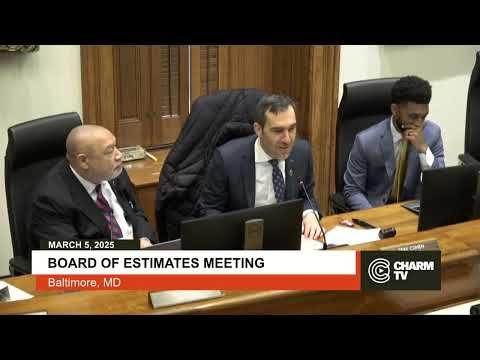
City Auditor Josh Pash presented a biannual follow-up performance audit on the Department of Planning on March 5, saying multiple prior audit recommendations have not been implemented.
The audit found that several recommendations from a December 2022 report — including revisions to equity evaluation criteria for capital projects, tracking actual project locations and expenditures, and a citywide equity action plan — remain unfinished. “All findings and recommendations from the prior audit were not implemented due to the following reasons,” Pash told the Board, citing leadership turnover at the Office of Equity and Civil Rights (OECR) and competing agency priorities.
The audit team reported that about 40% of the capital improvement plan is not reported by community statistical area for equity analysis because certain projects are excluded under the ordinance of estimates, and recommended the Planning Commission and Director of Planning revise scoring and require equity analyses for excluded projects.
Director Ryer of the Department of Planning acknowledged the scale of the task and described an ongoing effort to repair data problems after the city’s transition to Workday. “This monumental task undertaken by the Department of Planning with significant assistance from the Department of Finance has been ongoing for over a year and won't be complete until this summer,” Ryer said, adding, “there can be no equity without accurate data.” He told the Board the department has used the Urban Institute’s spatial equity tool in a case study during the CIP process for FY25 and has made staffing additions to strengthen outreach and equity work.
Lisa Kelly, interim chief equity officer at the Office of Equity and Civil Rights, told the board OECR has hired a division chief and a data analyst and has drafted a request for proposals to complete the comprehensive equity assessment. “We have been approved to begin soliciting detailed proposals for completion of the comprehensive equity assessment and plan,” Kelly said, and she said OECR plans to finalize the RFP within two weeks and would follow up with the Board on procurement timelines and consultant timeframes.
Comptroller Bill Henry and Mayor Brandon Scott both pressed for clarity on how equity requirements intersect with other inputs such as 3-1-1 service requests; Henry said he was surprised OECR had not completed a citywide baseline in two years. Mayor Scott cautioned that 3-1-1 usage reflects who has time and access to report issues and said equity must be balanced with other measures of need.
Why it matters: the audit covers capital projects that shape where the city directs public investment. The findings point to data and process gaps that, according to auditors, prevent the city from fully measuring whether capital spending advances equity goals. Director Ryer and OECR said they expect the data cleanup to finish in summer 2025 and that an external consultant will be solicited to complete a citywide equity assessment.
The Board had no formal votes tied specifically to the audit presentation; the item was noted by the Board and moved on to the next agenda item.