Get Full Government Meeting Transcripts, Videos, & Alerts Forever!
Get email alerts on the Elementary Education Performance topic
No spam. Unsubscribe anytime.
Bucks Hill principal outlines attendance, behavior and reading plans as math improves
Summary
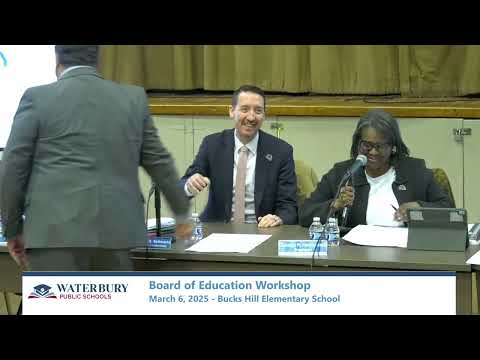
Principal Jimenez told the Waterbury Board of Education on March 6 that Bucks Hill School has lowered suspensions, is targeting chronic absenteeism and has launched literacy interventions while math gains continue.
Principal Jimenez told the Waterbury Board of Education on March 6 that Bucks Hill School is addressing chronic absenteeism and reading deficits while sustaining gains in mathematics.
Why it matters: The school, serving kindergarten through fifth grade, presented specifics on programs, staffing and data targets the district oversees for elementary performance and student supports.
At the meeting Principal Jimenez said the school operates three programs under one roof — regular education, bilingual education and a center-based learning autism program — and described classroom counts and supports. “We have 14 elementary regular ed classrooms, 11 bilingual classrooms, and 4 CBL classrooms,” she said.
Jimenez told the board Bucks Hill’s chronic absenteeism goal for the school year is 15.5 percent; earlier figures shown in her report placed this year at 20 percent, down from 25.4 percent in 2021–22. She defined chronic absenteeism as students at or near 18 or more unexcused absences and described the school’s response: a family support liaison from the Department of Children and Families, monthly team review of trends and attendance incentives including “walk of fame” recognition for perfect attendance.
On student behavior, Jimenez said Bucks Hill uses PBIS (Positive Behavioral Interventions and Supports), daily pledge recitation, assigned recess stations and increased lunch waves to reduce incidents. She reported the school currently has 11 out-of-school suspensions and five in-school suspensions and set a goal to remain under 15 out-of-school suspensions this year.
Reading was described as the primary academic challenge. Jimenez said the school is focusing professional learning on phonics, fluency and vocabulary and has implemented an “Enhanced Core Reading Instruction” program in both regular and bilingual classrooms. She reported a first-year implementation gain of 17 percent and said the school’s goal is 45 percent proficiency by year-end.
By contrast, she described math as a current strength. Jimenez said the school uses small-group instruction, weekly data monitoring and programs such as Reflex Math to produce growth; she noted last-year figures showing 42 percent of students at grade level in math.
Board members praised the report and asked operational questions (for example, Commissioner O’Brien asked about lunch start times and length; Jimenez replied lunches begin at about 10:30 a.m. and run through roughly 1:30 p.m., with a 30-minute lunch period for each student). The discussion included recognition of staff and descriptions of partnerships such as a Career Academy “Ed Rising” pen-pal internship and an upcoming career day.
Looking ahead, Jimenez said the school will continue targeted literacy interventions, monthly professional development aligned to phonics, and the bilingual vocabulary strategies that support ML (multilingual) students transitioning to regular education.
Principal Jimenez closed by thanking the board for the opportunity to present and asking if there were questions; none changed the recorded plans.
Staff and board members who spoke about Bucks Hill did so as part of the principal’s informational presentation; no formal policy action was recorded on this item.