
Beaufort advisory panel: Title 59 glossary added to state standards; county teachers trained and ancillary materials flagged
Get AI-powered insights, summaries, and transcripts
Sign Up Free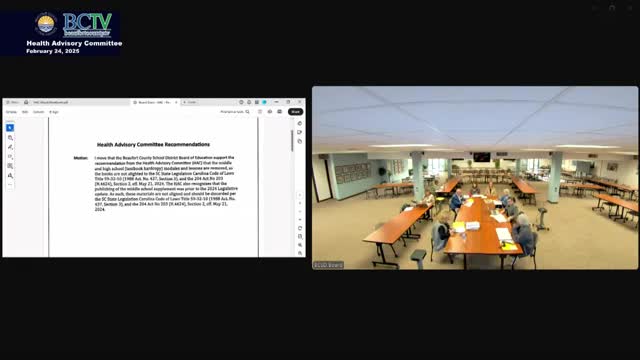
Summary
At a Feb. 24 Health Advisory Committee meeting, staff said South Carolina added an academic glossary to the State Standards under Title 59, county teachers received district training and the committee flagged ancillary textbook materials for noncompliance with a state proviso.
On Feb. 24, 2025, the Beaufort County Health Advisory Committee heard that the South Carolina State Standards now include an appended academic glossary under Title 59, and county health and physical-education teachers have completed district training to align classroom materials with the updated guidance.
The glossary — presented to the committee by Ms. Gray, a district staff member — is an appendix to the State Standards and is tied to Title 59, which the presenter described as “the document that sort of is the guide and the drive for the reasons why things are included, excluded.” Ms. Gray said the glossary and the Title 59 guidance are not part of the textbook core but were added as state-level material that teachers must follow.
The update matters because committee members said ancillary textbook materials used in some Beaufort County schools were developed before the state proviso and, therefore, contain items that the committee found not compliant. The committee earlier forwarded recommendations to the school board; committee members reported the board voted unanimously on Feb. 4 to support replacing the electronic ancillary materials with hard-copy ancillary packets for the high school and middle school, where most noncompliance was found.
Ms. Gray told the committee the district held a professional-development session on Feb. 14 and that, as of the prior Friday, “every single teacher in Beaufort County that teaches this material has had this presentation on Title 59 because we collectively feel that they need to know the law and then move forward and teach the material.” She said teachers who missed the live session were offered make-up Zoom sessions and that physical copies of the approved materials were couriered to schools so instructors would not need to rely on a link.
Ms. Gray outlined the district’s rollout steps: meet with middle-school teachers face to face this week to review textbook materials; meet with high-school department heads for team briefings; and present details to principals at a scheduled principals meeting. She said the goal is for some instruction aligned to the glossary and Title 59 to begin before the end of the current school year so the district can count this year toward implementation and then continue through the next school year.
Committee members discussed whether the district could accelerate a formal textbook-adoption cycle for physical education; Ms. Gray and other staff said they would raise that with the superintendent’s office and pursue the superintendent suite rather than individuals making separate requests. She said the district also planned follow-up contact with the State Department of Education to clarify implementation questions.
Next steps the committee recorded included distributing the approved hard-copy ancillary materials at schools, meeting with principals to finalize classroom rollout, and following up with the superintendent and the State Department of Education for clarification on possible earlier textbook adoption.