Get Full Government Meeting Transcripts, Videos, & Alerts Forever!
Get email alerts on the Bridges And Capital Financing topic
No spam. Unsubscribe anytime.
Henry County considers bonds, $2M loan option to fix failing bridges and culverts; consultants to model multiple scenarios
Summary
County officials discussed bonding, a $2 million-per-project loan option and use of bridge fund levy to pay for urgent culvert and bridge repairs. Baker Tilly will model scenarios including a sample $5 million bond and the potential effect on circuit‑breaker losses and debt service.
Henry County council members and commissioners heard detailed financing options for capital needs — particularly failing bridges and culverts — during a joint work session with Baker Tilly consultants Jason and Paige. Officials discussed several paths: using a short-term loan program for small structures, issuing general obligation (GO) or lease revenue bonds, or reallocating levy to bridge/cumulative funds; consultants were asked to produce comparative scenarios.
What was discussed and why it matters County officials described multiple small structures (box culverts under 20 feet) and at least two larger bridges that are near failure and may be closed if funding is not secured. County staff and council members said recent inspections have triggered barricades and immediate closures on at least one roadway and that a larger set of failures could require dozens more closures if not addressed.
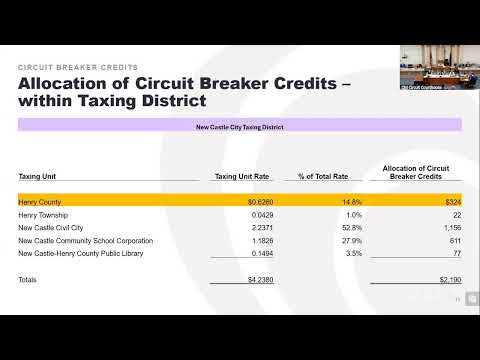
Financing options and examples from the presentation - Short-term loan statute (per discussion): a loan program that permits up to $2,000,000 per project with a maximum 10‑year repayment term was described as one available route for culverts/bridges; speakers said the loan could be used if the cumulative bridge fund is not statutorily permissible for a given structure. The meeting noted you can use multiple loans to reach larger totals but that origination costs would increase. - Sample $5 million GO bond illustration: Jason presented an illustration that issuing $5 million on a multi‑year repayment schedule could raise the county’s debt-related property-tax rate from about 7¢ to about 8¢ (a roughly one‑cent increase). He said that example could pay off $5 million in four years and estimated the additional debt service in the first year at about $258,000; consultants cautioned the county that any increase in tax rates could push more taxpayers into circuit‑breaker caps and thereby increase circuit‑breaker losses shared across overlapping taxing units. "If we increase it to 8¢, so about a penny, we could pay off $5,000,000 in 4 years," Jason said. - Debt capacity and alternatives: consultants showed the county’s statutory GO debt limit (about $15.3 million in the presentation) and listed current outstanding principal that counts against that limit (food-and-beverage bonds and a 2022 GO bond). For projects larger than remaining GO capacity, the consultant noted the county can use lease/lease‑rental (building corporation) structures similar to the previously issued jail bonds, which do not count against the GO cap. - Federal grants and matches: attendees discussed two major bridges for which federal aid (about 80% reimbursement) might be available; meeting discussion referenced county match estimates in the hundreds of thousands of dollars for each bridge (the county’s 20% share cited approximately as $400,000 and $350,000 for two discussed locations). Consultants and staff noted that bonding to fund the county match could speed projects and reduce long-term costs if federal grants are awarded, but warned that bonding before final grant awards creates a repayment-risk profile if expected federal funds are delayed or not awarded.
Operational and timing considerations County officials said they need funding quickly to avoid road closures; staff reported barricades already placed and cautioned more closures could come in weeks as inspections conclude. Consultants advised waiting for the end of the legislative session to incorporate any statutory changes before finalizing long‑term financing, but also offered short-term options (the $2M loan program or reallocating levy to bridge funds) to address immediate needs. Jason said he can run scenarios for multiple approaches and recommended the county identify priorities and provide those to Baker Tilly by email.
Selected direct quotation - "We could pay off $5,000,000 in 4 years," — Jason (Baker Tilly consultant).
Next steps County leaders asked staff and consultants to model multiple financing scenarios (bridge-fund levy adjustments, $2,000,000 loan options, varying bond terms up to 20 years, and combinations including federal grant matches) and to return options that show projected tax-rate impacts, circuit‑breaker effects and multi-year cash-flow and debt-service schedules. Officials said one of them will email Jason this afternoon with project priorities to guide the work.
Ending Council and commissioners signaled the road-and-culvert needs are a top capital priority and requested Baker Tilly return with a short list of feasible options; no formal vote or commitment to a specific financing approach was recorded at the work session.