Get Full Government Meeting Transcripts, Videos, & Alerts Forever!
Get email alerts on the County Budget And Revenue Forecast topic
No spam. Unsubscribe anytime.
Henry County advisors say proposed Senate Bill 1 would sharply limit property-tax growth; officials urged to update financial plan
Summary
Baker Tilly consultants Jason and Paige told a joint Henry County Council and County Commissioners work session that proposed state legislation and existing tax constraints will make budgeting more difficult in 2026–2029 and beyond.
Baker Tilly consultants Jason and Paige told a joint Henry County Council and County Commissioners work session that proposed state legislation and existing tax constraints will make budgeting more difficult in 2026–2029 and beyond. They urged the county to update its comprehensive financial plan and run revenue/expense scenarios once the legislature finishes action.
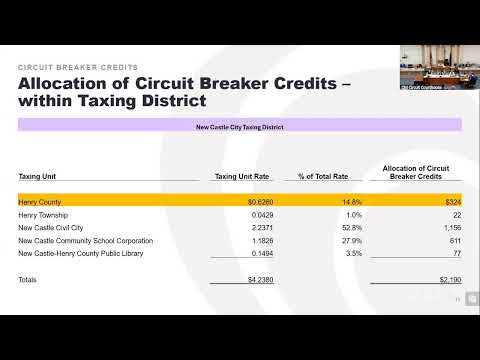
Paige, introducing a “Budget 101” overview, said the county’s property tax collections are determined by a statutory maximum levy rather than by the raw number of new homes or population growth. "The amount of property tax that you receive doesn't have anything to do with population, property values, how much you're spending. Remember, I said it's a set amount," she said. The consultants used Henry County figures to show how other revenues and circuit-breaker credits interact with the levy.
Why it matters: the consultants warned that Senate Bill 1, as drafted at the time of the meeting, would limit maximum levy growth to 0 percent in 2026, 1 percent in 2027 and then cap future growth at a much lower rate than the historical 4–5 percent. That reduced growth, combined with circuit-breaker credits and any future changes to homeowner deductions or farmland assessments, would shrink available revenue and likely force counties to use reserves, cut services or raise other local taxes.
Key facts presented - Revenue mix (2023 actuals, county figures cited by the consultants): property tax ~$9.4 million, local income tax ~$9.2 million, with gas tax, wheel tax and other smaller streams making up the remainder. Paige said the county’s total levy including funds outside the maximum levy is about $14.4 million. - Net assessed value: consultants used a $2.3 billion net assessed value as the working base to show rate impacts. - Maximum levy and reserve levels: the county’s maximum levy was shown at roughly $11.8 million; two funds outside the maximum levy (debt service and the QM Capital Development Fund) add roughly $2.5 million of levy capacity. The consultant said the county’s general-fund reserves reached about 40% at the end of 2023 and that a 50% reserve target had been discussed previously. - Circuit breaker losses: the consultants reported a circuit-breaker loss of about $1.7 million in 2024 (about a 14% revenue loss versus certified levy), down from roughly 18% in 2022; increases in assessed value have reduced that loss in recent years. - Senate Bill 1 (as described in the presentation): would limit levy growth to 0% in 2026, then step up slowly and apply a different growth formula beginning in 2029; consultants cautioned the county could “miss” $1.1 million or more in revenue by 2028 if limits remain.
Options and next steps discussed - Update the comprehensive financial plan (CFP): Paige and Jason recommended updating the county’s CFP after the legislative session so the model can incorporate final changes and show multi‑year effects of revenue limits. Paige said the CFP is a decision tool to test raises, additional staff or capital and “see if it can be sustainable throughout future years.” - Use reserves cautiously: the consultants warned reserves and temporary federal/state one‑time funds (ARP, opioid settlements, supplemental income) have supported balances in recent years and are not reliable long-term revenue sources. They advised planning for scenarios that assume those one-time sources decline. - Local income tax capacity: the county’s expenditure-rate capacity remains below the statutory 2.5% maximum (the county’s unit rate shown at about 1.77% with 0.73% capacity remaining). Consultants noted that some legislators expect counties to use local income tax authority rather than rely on property-tax increases.
Selected direct quotations - "The amount of property tax that you receive doesn't have anything to do with population, property values, how much you're spending. Remember, I said it's a set amount," — Paige (Baker Tilly consultant). - "I think the next few years are gonna be very challenging when it comes to building your budgets and trying to have balanced budgets," — Paige (Baker Tilly consultant).
Discussion and local reaction Council members and commissioners pressed consultants on how large proposed statutory changes would affect specific funds (public safety, motor-vehicle highway) and on whether the county should use reserves, reallocate levies among funds, or increase local income taxes. Jason and Paige said the county could shift levy among eligible funds (for example moving levy from health to general or bridge funds where statutory rules permit) but cautioned that some funds are rate-limited and adjustments can require approvals and careful timing with DLGF (the state Department of Local Government Finance).
Paige and Jason said they will provide updated CFP scenarios after the legislature finishes action and asked county officials to identify priority projects and funding preferences. One council member said a five-year CFP update will be necessary this year; the auditor agreed publicly.
Ending The work session concluded with council and commissioners asking Baker Tilly to run multiple scenarios — including a conservative case that assumes constrained levy growth and reduced one-time revenues — and to return options the county can use during formal budget hearings. The consultants said they will provide the updated CFP and scenario outputs once legislative action is final and the county sends its project priorities.