Get Full Government Meeting Transcripts, Videos, & Alerts Forever!
Get email alerts on the County Grants topic
No spam. Unsubscribe anytime.
County grants coordinator outlines EV, CDBG, ERA2 and childcare funding activity
Summary
Will County staff updated the finance committee on multiple grant programs: an IDOT-funded alternative fuels plan, EPA-funded EV charging ports, ongoing CDBG awards, a funded Fairmont sewer rehab, and the closeout and targeting of ERA2 rental assistance funds.
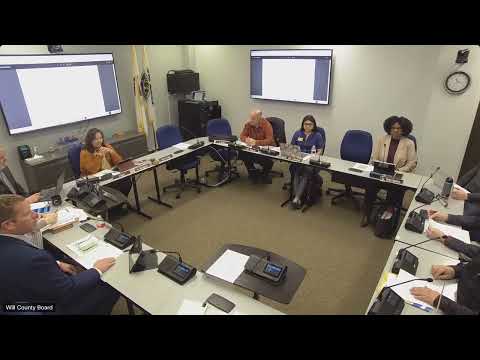
Samantha Markham, grants coordinator for the county executive’s office, briefed the Will County Finance Committee on a range of grant-funded efforts tied to the county’s 2021 Energy Conservation Plan, community development programs and pandemic-era rental assistance.
Markham said the county’s alternative fuels planning effort — funded by a $560,000 IDOT grant — is about 70.5% expended and expected to be completed by April; the plan includes a fleet analysis and an executive summary to guide municipalities on alternative-fuel infrastructure. She also said the county has secured $100,000 from the U.S. Environmental Protection Agency under the Driving a Cleaner Illinois program to install 20 EV charging ports (10 at two county locations); the grant term runs through June 2030.
On community development, Markham reviewed Community Development Block Grant (CDBG) year-23 accomplishments: the packet she presented lists 58 households that received housing rehabs, two group-home units rehabbed, 24 homes made affordable through down-payment assistance, 110 households supported with rental assistance and 93 households provided housing counseling. She said a recommendation to award CDBG funds to the Housing Authority of Joliet for construction of three rental units in the Squire’s Mill subdivision will likely come to the full county board for final approval in April.
Markham gave an update on a $1.1 million Fairmont sewer system rehabilitation: she said an intergovernmental agreement is in place and phase one will begin soon, with phase-one completion expected in summer 2025. Separately, she said the Safe at Home program (previously managed by Senior Services) has been discontinued and the Community Development Division will apply to the Illinois Housing Development Authority for a pilot program to provide similar home-rehabilitation assistance; that grant application is due in March.
On federal Emergency Rental Assistance (ERA2), Markham said the county has stopped accepting ERA2 applications because federal ERA2 funds have been fully obligated. She said the county has assisted 1,874 unique households through ERA2, with an average assistance duration of about 3.8 months; she reported 95.4% completion on project payouts and said closeout reporting is expected in the next quarter. Markham said future tenant-based assistance focus will shift toward more vulnerable households (defined in committee discussion as those earning below 30% AMI and with balances under $10,000 facing pre-eviction) and that cannabis-tax dollars are under consideration as a future funding source for some housing programs, though the amount had not been finalized.
Markham also summarized the county’s child-care provider grant (funded from cannabis retailer occupation tax allocations). She said applications are open, awards range from $0–$10,000, and that, as of the meeting, 12 applications had been received (last year’s 130+ applications many arrived in the final week); applications are due March 14. She told the committee the division received a current list of DCFS-licensed child-care providers and will target outreach accordingly.
The grants coordinator noted the We Will Grow program (community composting and youth training) will receive its final $50,000 allocation from Waste Management this fiscal year; the Community Development Division is seeking replacement funding to continue that program beyond fiscal 2025.
Committee members asked about geographic distribution of childcare applications and whether the grants coordinator applies for grants on behalf of all departments. Markham said geographic and county-board-district data were provided last year and district-level information will be available for the current round; she also said her role is to work with departments on grant opportunities but not to prepare every department’s applications unless the executive office has asked.