Get Full Government Meeting Transcripts, Videos, & Alerts Forever!
Get email alerts on the Alcoholic Beverage Franchise Law topic
No spam. Unsubscribe anytime.
Ohio bill would let small breweries negotiate distribution contracts
Summary
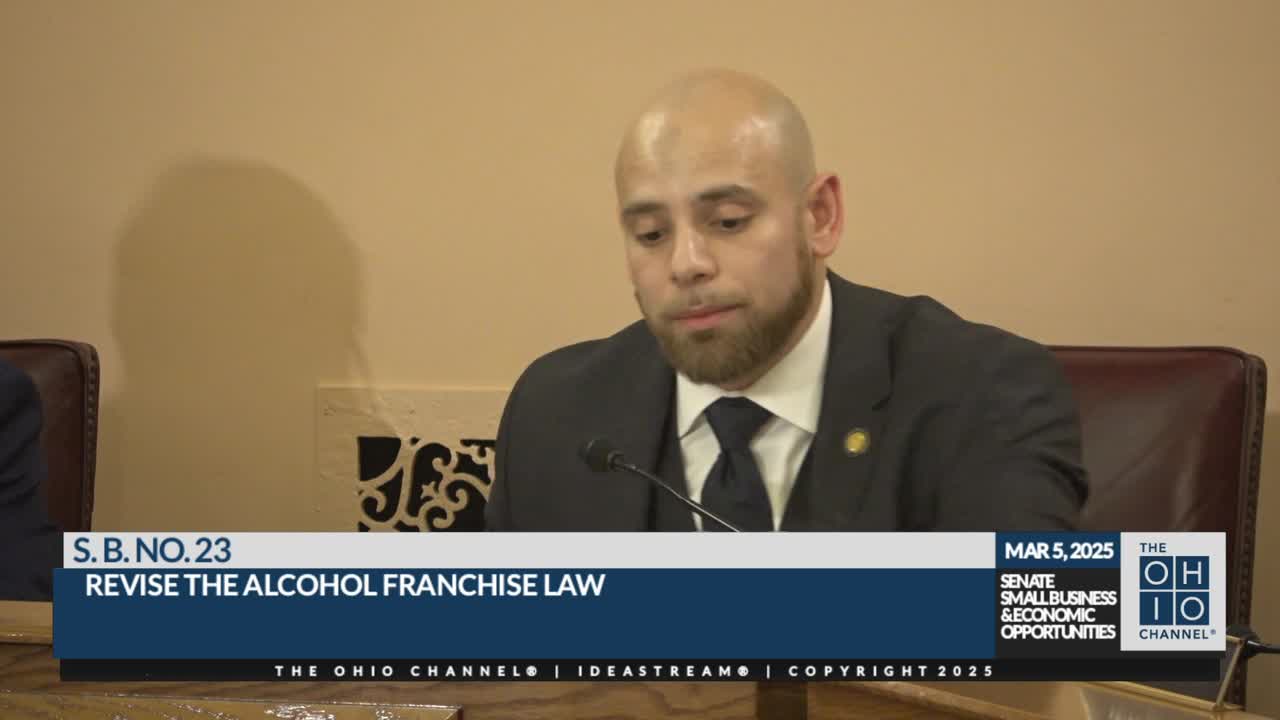
Senator Brunner, sponsor of Senate Bill 23, told the Small Business and Economic Opportunity Committee at a first hearing that the bill would modernize Ohio's alcoholic beverage franchise law to reflect the current craft-brewing market.
Senator Brunner, sponsor of Senate Bill 23, told the Small Business and Economic Opportunity Committee at a first hearing that the bill would modernize Ohio's alcoholic beverage franchise law to reflect the current craft-brewing market.
"This legislation would modernize alcoholic beverage franchise law to reflect the reality of the current brewery industry," Brunner said during sponsor testimony, noting the measure is a reintroduction of Senate Bill 138 from the last General Assembly.
The bill would create a carve-out for small breweries that produce fewer than a quarter-million barrels a year, allowing those brewers to enter into and enforce contracts with delivery services without the state's automatic franchise protections keeping agreements in effect, Brunner said. "Today, there are over 400 craft brewers located across the state," Brunner added, and the change is intended to give small brewers the same ability to negotiate service agreements as other small businesses.
Brunner said Ohio's current franchise law, enacted in 1974, can lock small brewers into so-called evergreen contracts even if distribution practices fail to meet the brewer's needs. He described the practical effect for many small operations: expensive, lengthy litigation is the only available remedy to sever a distributor contract, a path few small brewers can afford. "Without this change, small breweries are effectively locked into this arrangement unless both parties agree, to sever the agreement until the brewery gets into the court, or breaks a contract," Brunner said.
The sponsor argued the change would not undermine distributors but would allow both parties to negotiate and enforce ordinary service agreements. He also cited retail-market shares, saying the breweries make up "less than 13% of the grocery store sales and less than 3% of convenience store sales," to underline that the carve-out targets small producers, not large national manufacturers.
During committee questions, a committee member asked, "What statutes would regulate them? Have you looked at that?" Brunner replied that the bill would carve out small brewers from parts of the franchise law but would not change other licensure or sales laws that govern brewery operations and alcohol sales.
No vote was taken. Brunner said he was "open to input" and that staff and interested parties were working to refine the legislation. The committee concluded the first hearing on Senate Bill 23 with no further action recorded.
Details from the hearing: the sponsor described Senate Bill 23 as a reintroduction of Senate Bill 138; the committee heard sponsor testimony and asked clarifying questions but did not vote on the bill.