Get Full Government Meeting Transcripts, Videos, & Alerts Forever!
Get email alerts on the Solar Battery Noi topic
No spam. Unsubscribe anytime.
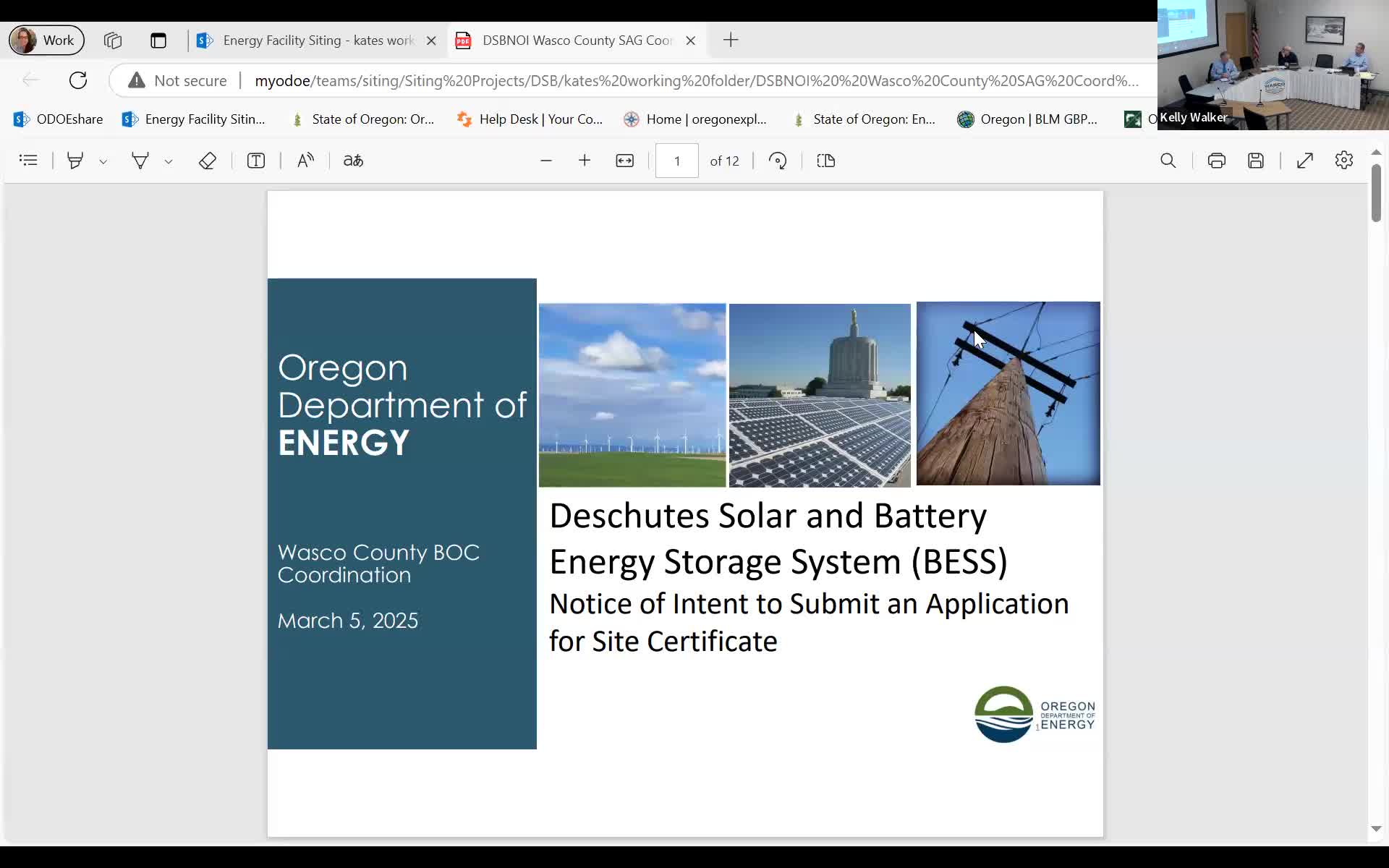
State receives notice of intent for large Juniper‑Flat solar and battery project; ODOE begins agency coordination
Summary
The Oregon Department of Energy told Wasco County March 5 that BrightNight affiliate Dechen LLC has filed a notice of intent for a large solar-and-battery project in the Juniper Flat/Moppin area; the NOI maps a roughly 13,600‑acre study boundary and lists potential build‑out scenarios.
The Oregon Department of Energy (ODOE) notified Wasco County March 5 that a proposed large solar and battery project has filed a notice of intent (NOI) to pursue a state Energy Facility Siting Council (EFSC) site-certificate application. The applicant listed in the NOI is Dechen (d e c h e n) LLC, a BrightNight affiliate; the project boundary is shown in the NOI as about 13,626 acres in the Juniper Flat/Moppin area and the company identified a potential build-out of utility-scale solar plus battery energy storage.
What the NOI says: the applicant listed up to 1,000 megawatts (MW) of solar arrays and up to 1,000 MW of battery energy storage (the NOI included an example of a four‑hour duration battery, i.e., 4,000 MWh of duration at peak). The NOI also shows a proposed point of interconnection to existing high‑voltage transmission (the applicant’s preliminary design indicates a short gen‑tie to an existing Buckley transmission line and a new switchyard/substation at that tie‑in).
Why the state is involved: under ORS 469.300 and implementing rules, a project that proposes solar development over a large acreage threshold (the NOI used the site‑acreage jurisdictional trigger) can fall under EFSC jurisdiction and requires a site certificate from the council rather than local land-use permitting alone. ODOE staff emphasized the NOI stage is early: the company has defined a large study area and will narrow a buildable footprint as studies proceed.
Public process and timing: ODOE’s siting staff described the state’s multi-step review process for an EFSC application. The NOI launches agency and stakeholder coordination; ODOE will issue a project order that specifies studies and application exhibits the applicant must submit with a preliminary application. ODOE staff said the department will publish a project‑order draft for comment after the NOI public comment period closes. The public-information meeting on the NOI was scheduled in Moppin on March 27 (ODOE to host a hybrid in‑person and WebEx session). The NOI public-comment window closes April 25; ODOE staff said a project order will follow after comments are summarized.
County role and special-advisory group (SAG): ODOE designated Wasco County as a special advisory government because the project footprint lies in county jurisdiction. The role of the county SAG is to document county land‑use policy, local infrastructure and public‑service impacts and offer recommendations on studies ODOE should require in the project order. ODOE asked the county to identify applicable comprehensive‑plan policies and potential impacts (wildfire, roads, public safety, water, cultural resources, and others) that should be addressed in the application.
Community concerns and next steps: ODOE staff said the NOI includes “carve‑outs” — nonparticipating parcels inside the larger study boundary — and cautioned the NOI is a planning boundary, not a final permit. The county and ODOE invited public comment and indicated the state will take land‑use and environmental studies at greater detail in the preliminary and final application stages. County staff and commissioners were advised to consider which local policies and services should be brought forward in the county’s SAG comments to ODOE.
Why it matters: the proposal is large in scale and would be reviewed through the state EFSC process rather than only through county land‑use hearings if the project proceeds as proposed. Neighboring jurisdictions, utilities and tribes will be in the early coordination role with ODOE and the applicant.
What to watch next: ODOE’s March 27 public meeting in Moppin, the April 25 NOI comment deadline, ODOE’s project order (expected after the comment window), and any subsequent preliminary-application filing by the applicant.
At the meeting: Kathleen Sloan (ODOE) presented the NOI and asked the board to identify local substantive criteria and to participate in the special‑advisory group process. ODOE encouraged early, specific input on fire and emergency response, infrastructure impacts, comprehensive‑plan consistency (including Goal 3 farmland considerations), and sensitive resource surveys.