Get Full Government Meeting Transcripts, Videos, & Alerts Forever!
Get email alerts on the Transportation Budget topic
No spam. Unsubscribe anytime.
OPWC requests slight LTIP appropriation increase; senators press for rural weighting
Summary
The Ohio Public Works Commission sought a modest increase to the local transportation improvement program (LTIP) line in House Bill 54, citing higher-than-expected revenue and a small surplus; rural senators pressed for changes to scoring and allocation to address disproportionate bridge and road needs in low‑population counties.
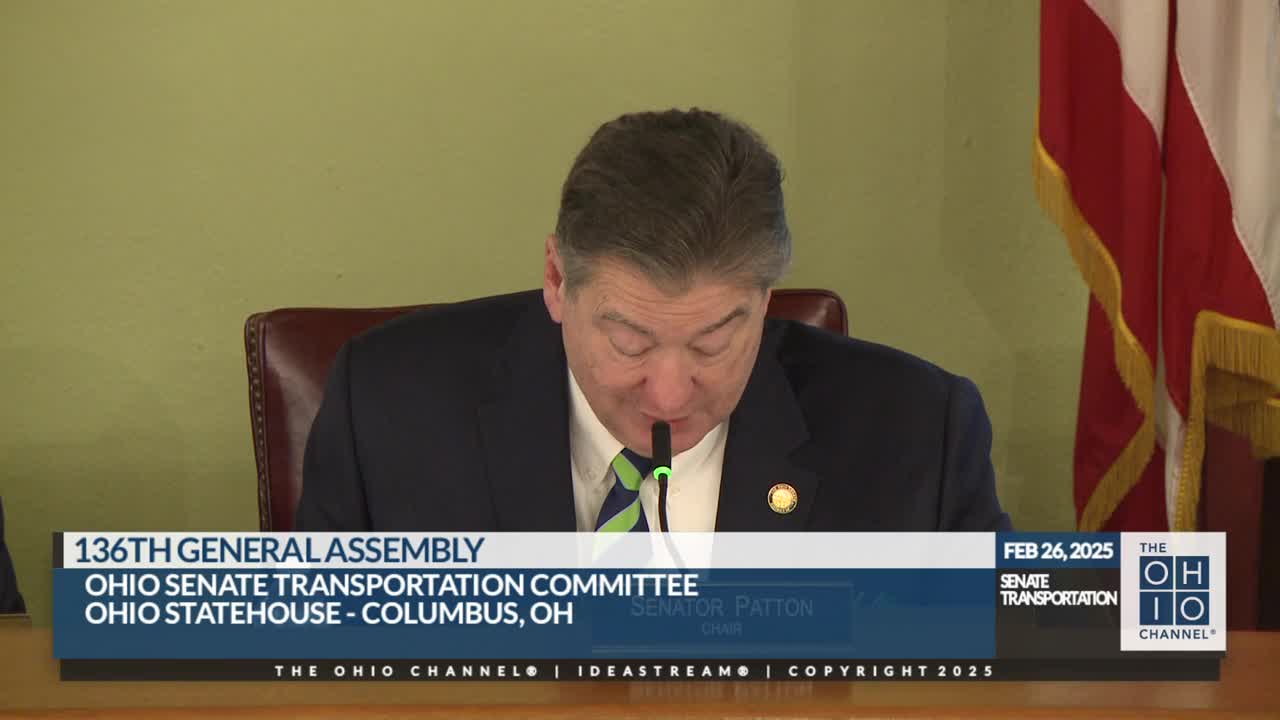
The Ohio Public Works Commission asked the Senate Transportation Committee on Feb. 26 to allow a modest increase in appropriations for the Local Transportation Improvement Program, the agency’s director said, while rural senators urged legislative changes to help counties with many bridges and roads but low population.
Linda Bailiff, director of the Ohio Public Works Commission, told the committee the transportation portion of HB 54 contains funding for the LTIP, “funded by 1¢ of the 28¢ motor vehicle tax levy distributed under Ohio Revised Code §5735.05.” She said LTIP supports about 300 road and bridge projects on a biennial basis and that the commission administers LTIP together with the state capital improvement program as a combined infrastructure program.
Bailiff said projected fuel tax receipts and recent higher-than-expected revenue and interest earnings left the commission with a slight surplus that could be applied to the upcoming biennium. She also described the commission’s operating cost allocation: “Our total operating, administrative maintenance and equipment is prorated between our various programs of which 20% is assigned to LTIP,” and said administrative costs represent about one-half of one percent of the commission’s capital funds.
Why it matters: Senators from less-populated, infrastructure‑heavy districts said the current per-capita allocation method disadvantages counties with many bridges and complex topography. Senator Chavez and Senator Schafer described counties with relatively low population but high numbers of bridges and roads that need repair and said the per-capita model makes it difficult for those local governments to compete for funds.
Bailiff answered that the commission is constrained by statute and by how the 19 district integrating committees interpret scoring criteria. She noted two statutory set‑asides: a five‑year rolling requirement that a statutory percentage of LTIP go to counties, townships and villages, and a 10% set‑aside from the state capital improvement program for a small government program that gives “villages and rural townships less than 5,000 in population” a second chance if they are not funded at the district level.
Senators asked whether changing the per‑capita calculation or the district scoring thresholds would require legislation. Bailiff said it would: “Since it’s a per capita arrangement, the only set‑aside in statute… So yes, we are bound by statute and that’s what we have.” Senators asked Bailiff to draft possible amendment language to give rural and Appalachian counties a more level playing field; Bailiff agreed to bring proposals to the committee within the next week for informal review.
Committee action and next steps: The committee reviewed and approved the minutes from Feb. 19 before hearing testimony. Senators asked the Ohio Public Works Commission to draft potential legislative language or a scoring proposal aimed at improving LTIP competitiveness for rural, Appalachian counties; Bailiff agreed to present ideas to the committee chair for distribution to members.
Sources and context: Testimony and questions occurred during an informal hearing on HB 54 and were delivered in committee; committee members repeatedly emphasized that any change to allocation or scoring would require statutory amendment.