Get Full Government Meeting Transcripts, Videos, & Alerts Forever!
Get email alerts on the Property Tax School Funding topic
No spam. Unsubscribe anytime.
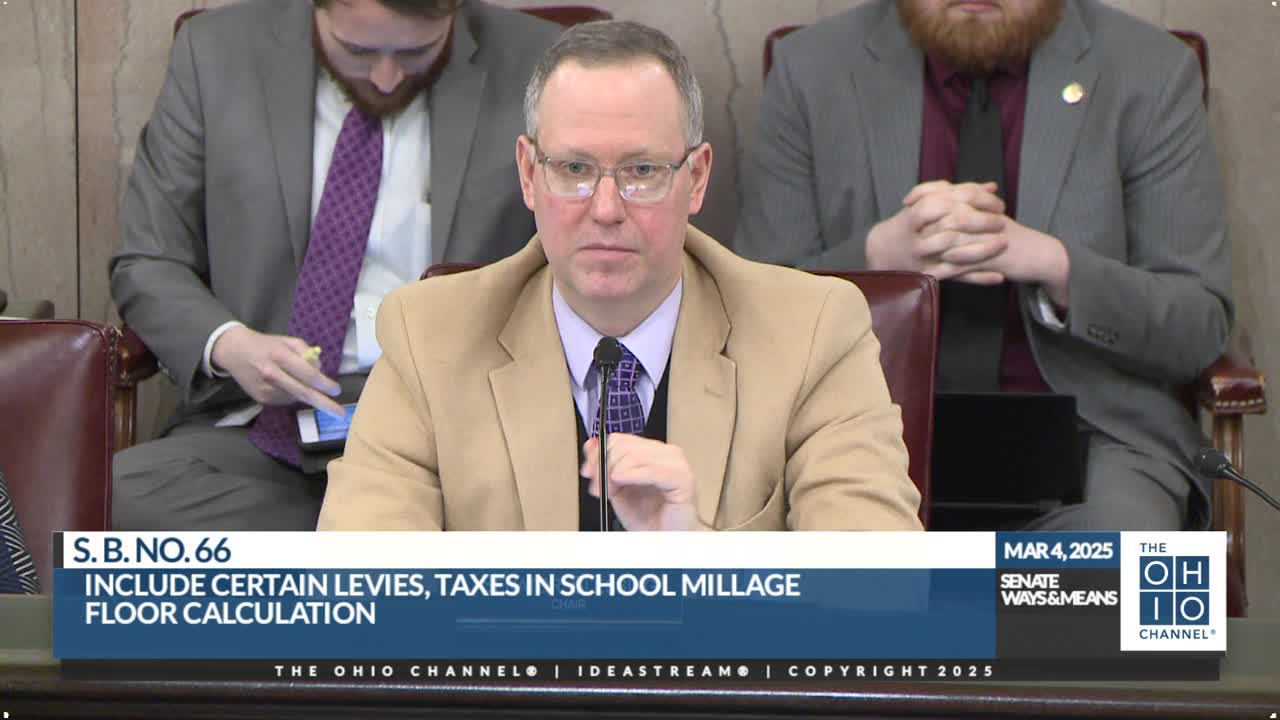
Senate Bill 66 divides education and taxpayer groups over property-tax formula changes and the 20-mill floor
Summary
Senate Bill 66 would change how the 20-mill floor is calculated for school districts by adding income taxes, emergency and substitute levies and inside millage; proponents say it restores protections against unvoted tax growth while school finance organizations say the bill risks constitutional and budgetary disruption.
Senate Bill 66 drew extended testimony from school finance groups, taxpayer advocates and business coalitions at a Ways and Means Committee hearing, centering on whether the bill restores protections against unvoted tax increases or would retroactively and substantially reduce local school revenue.
Katie Johnson, representing the Ohio Association of School Business Officials (OASBO), told the committee the bill "fundamentally alters the 20 mil floor calculation" and warned it raises constitutional and fiscal concerns for districts and taxpayers. Johnson explained Ohio’s property-tax and school-funding framework and said the 20-mill floor—intended to prevent a district's combined real-property millage from falling below 20 effective mills—has been part of school funding for decades. She said SB 66 would expand the floor calculation to include income taxes, emergency levies, substitute levies and inside millage, which OASBO believes conflicts with statutory and constitutional boundaries and would have immediate effects on five-year forecasts and contract certifications required under Ohio law. "By applying new property tax calculations retroactively to previous approved levies, Senate Bill 66 raises significant legal concerns," Johnson told the committee.
Paul Imhoff (Buckeye Association of School Administrators) and Nicole Piscatani (Ohio School Boards Association) said they support property-tax relief in principle but oppose SB 66 as drafted. They argued the bill would not provide relief to all districts at the floor and could force cuts or additional levies. Imhoff suggested alternatives such as limiting revenue growth tied to reappraisals to the rate of inflation, expanding homestead exemptions, or creating a tax-circuit-breaker program as more targeted approaches.
Proponents of SB 66 — including Donovan O'Neil of Americans for Prosperity Ohio and witnesses from the Ohio Taxpayer Protection Act Coalition — said the bill restores the intent of the 1976 reduction-factor law (House Bill 920) and would prevent unvoted inflationary increases that have pushed many districts to the 20-mill floor. Tom Zaino of the taxpayer coalition presented data the coalition says shows rapid property-value growth and rising district cash reserves; coalition testimony cited Department of Education data that average district cash reserves rose from roughly 22% of annual expenses in 2012 to over 45% in 2024. The coalition argued SB 66 would tamp future unvoted revenue growth rather than claw back current revenues.
Tara Stacy, a board member and witness from Springboro Community City Schools, said SB 66 would cause her district to lose about $4,400,000 in revenue over a two-year period (between fiscal 2028 and fiscal 2029) and described the district’s tight budgets and low reserves. Stacy and other school witnesses said some districts are operating with small cash reserves and that retroactive changes would undermine planning dependent on five-year forecasts.
Committee members debated whether the bill is retroactive. Witnesses from school associations argued that retroactive application could violate constitutional protections and break voter expectations; proponents replied that SB 66 is prospective and that the constitutional prohibition on retroactive laws does not apply to political subdivisions based on existing case law cited by proponents.
Several senators asked about the state/local split in the school funding formula, how inside mills and voter-approved levies interact with state funding, and whether the bill would produce targeted relief for low-income homeowners. Witnesses suggested multiple alternatives for relief (expanded homestead exemptions, circuit breakers, means-tested relief) and urged negotiations with school finance stakeholders. No committee vote was taken during the hearing.