Get Full Government Meeting Transcripts, Videos, & Alerts Forever!
Get email alerts on the State Tax Flat Tax topic
No spam. Unsubscribe anytime.
Senate sponsors pitch phased-in flat tax as economic boost; lawmakers press fiscal trade-offs
Summary
Senators presented Senate Bill 3 to the Senate Ways and Means Committee proposing a phased-in flat personal income tax for tax years 2025–2026. Sponsors argued it will spur business growth and population gains; other senators questioned revenue loss, local tax shifting and whether the change benefits middle- and lower-income Ohioans.
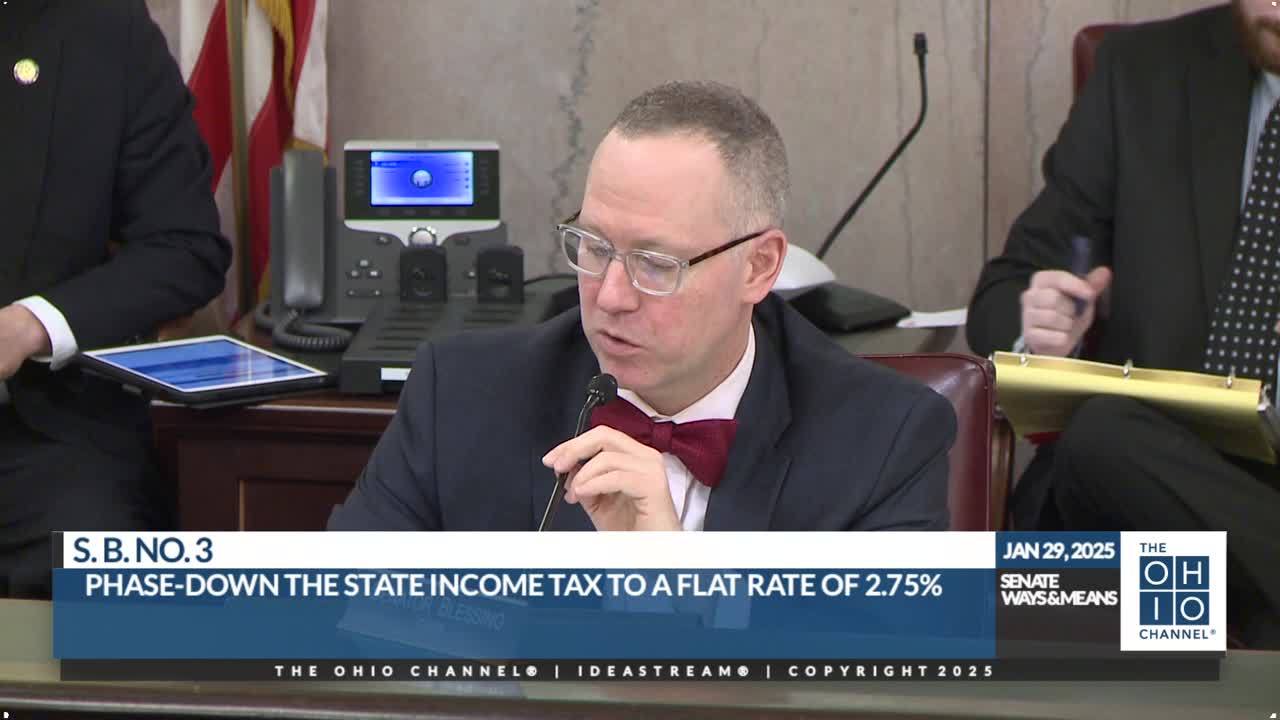
Senators on the Ohio Senate Ways and Means Committee heard sponsor testimony Thursday on Senate Bill 3, legislation that would enact a statewide flat personal income tax phased in across tax years 2025 and 2026.
The bill’s sponsors told the committee they expect the flat tax to spur business formation and attract residents and employers to the state. “This bill seeks to enact a flat tax that will be phased in over the next 2 years. Tax years 2025 and tax years 2026,” Senator Lang said in opening remarks. He and joint sponsor Senator Huffman framed the proposal as part of a multi-year effort to simplify Ohio’s tax code and compete with neighboring low-tax states.
Supporters told the committee they view the change as an economic development tool. “This bill will make Ohio an important economic model for the Midwest and provide many new opportunities for Ohio families and businesses to succeed and thrive,” Senator Huffman said, adding the measure would “simplify the tax code, keeping more earnings in the pockets of Ohioans and their communities.” Sponsors referenced recent state-level tax reductions and a business income deduction as part of the rationale for further cuts.
Committee members pressed sponsors on the bill’s fiscal impact and distributional effects. Senator Liston asked who the measure is intended to help and noted that, by the sponsors’ own figures, the proposed rate change would mostly affect higher-income filers. Liston and others said many constituents are more immediately concerned about property taxes and school levies.
Lawmakers cited Legislative Service Commission (LSC) estimates during the hearing. Chairman Blessing referenced a prior LSC calculation that “a 2 and a half percent flat tax would cost … about $1,600,000,000” annually; sponsors disputed static-loss assumptions and argued for dynamic effects that could preserve or increase revenues. Sponsors pointed to recent job-creation data and startup counts as evidence the state’s tax changes have encouraged business growth.
Members also questioned how much a typical taxpayer would benefit. During committee exchange, senators used an example to illustrate scale: for a household with roughly $180,000 in income, the change was described as roughly a $600 annual difference under the proposal, a figure lawmakers debated as either meaningful consumer spending or marginal savings for higher-income households.
Several senators warned of downstream effects for local governments and schools. Committee members noted the state’s estimated revenue reduction would reduce the state general revenue fund and could shift tax burdens to local property taxes or levies, a concern sponsors acknowledged but disputed in terms of long-term revenue dynamics.
No committee vote was taken; the session was a first hearing for the bill and concluded with sponsors offering to provide additional analyses and amendments. Several senators signaled interest in additional modeling, including dynamic revenue studies, and suggested future amendments might address business-owner effects or other technical concerns.
The committee moved on to other business after sponsor and committee questions, and no final action on Senate Bill 3 occurred at this hearing.