Get Full Government Meeting Transcripts, Videos, & Alerts Forever!
Get email alerts on the Economic Development Rural topic
No spam. Unsubscribe anytime.
Senators propose fourth tier for rural business growth program, setting $150 million investment target for Appalachian counties
Summary
Senate Bill 110 would reauthorize Ohio’s rural business growth program with $150 million of private investment authority, a $90 million state tax-credit contribution, and a new fourth tier targeting the state’s 32 Appalachian counties; sponsors described clawbacks, reporting requirements and timelines to safeguard public investment.
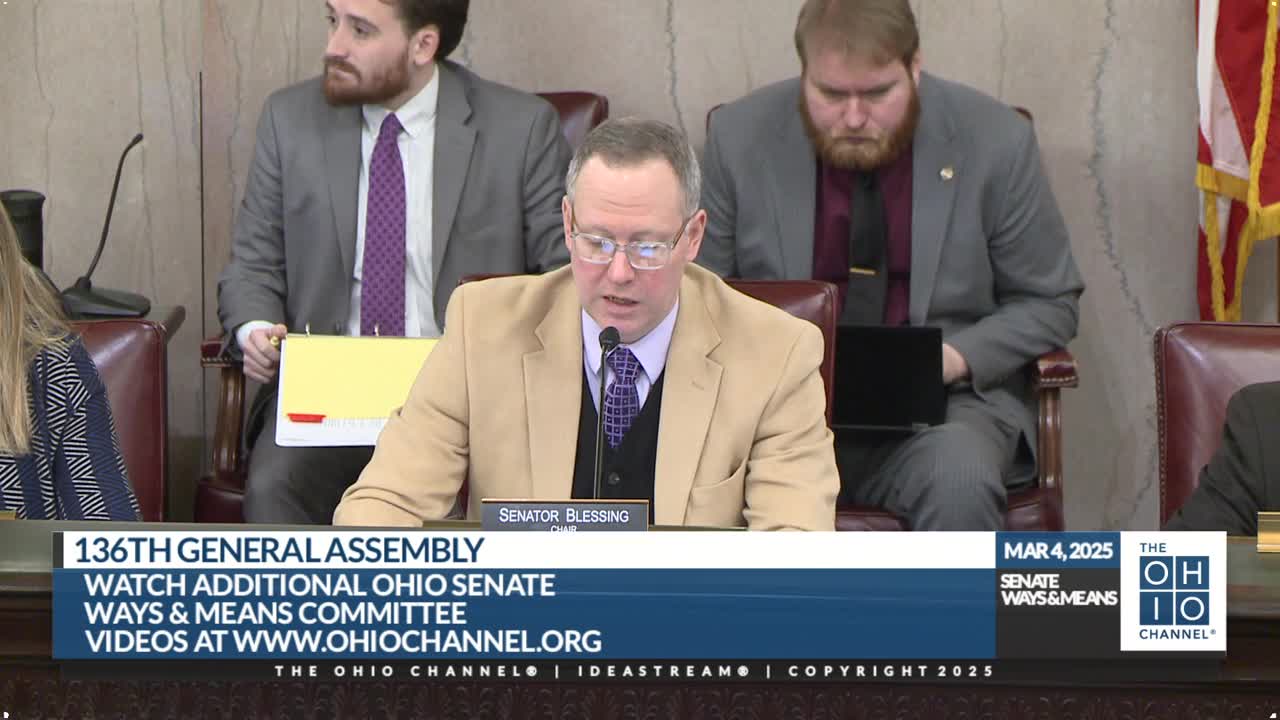
Senators introduced Senate Bill 110 to reauthorize Ohio’s rural business growth program and create a fourth tier specifically for the state’s Appalachian counties, sponsors told the Senate Ways and Means Committee.
Sponsor testimony from Senator Serino and Senator Chavez said the bill would establish an additional $150,000,000 of investment authority, with the state contributing $90,000,000 in nonrefundable tax credits and safeguards intended to ensure investments serve rural communities. "This is really important for the rural counties," Senator Serino said, describing Appalachia as "part of the state that is simply not participating in economic growth like we are in other parts of the state." Senator Chavez said the measure would help address gaps in financing that prevent small rural businesses from accessing bank credit.
The sponsors reviewed the program’s history: the original Ohio Rural Business Growth Program was established in Senate Bill 8 of the 132nd General Assembly and later expanded in HB 10 (the 134th General Assembly operating budget) into a tiered structure. According to testimony, since February 2017 more than $188,000,000 has been invested through earlier iterations, distributed to 52 companies across 29 rural counties in sectors ranging from manufacturing to software and pharmaceuticals.
Under SB 110 as described to the committee, Program 3 would require $150,000,000 of private capital to be raised and invested; the state would issue tax credits totaling $90,000,000. The bill would add a fourth tier defined by Ohio Revised Code section 107.21 (the Appalachian region, 32 counties) and require that at least $75,000,000 (50 percent of the $150,000,000) be invested in that tier. The bill also would require at least 25 percent of the $150,000,000 to be invested in the existing Tier 3 counties; Tiers 1 and 2 together would be capped at no more than 25 percent of the total.
Sponsors described a multi-step application and oversight process: USDA- or SBA-approved investors would apply to the Ohio Department of Development to participate; approved fund managers would aggregate capital from insurance companies and private investors and then work with local banks and officials to place investments. Testimony said all $150,000,000 must be invested within three years or tax credits are recaptured by the state and that principal investments must remain invested for at least six years or face recapture. The state would not issue tax credits until the program’s third year, with $22,500,000 to be issued annually in years three through six.
Senators on the committee asked for clarifications about eligible firm size, measures of success and the bill’s anti-abuse provisions. Senator D'Amore asked why the employee-size threshold was raised from 250 to 299; Senator Serino replied that the change was a modest adjustment intended to expand the pool of eligible firms while keeping job-creation clawbacks and reporting requirements in place. In response to questions about oversight and success metrics, sponsors said the Department of Development reviews project viability and that job creation and local economic growth are primary measures; sponsors emphasized clawbacks and annual investor reporting, and said distributions could not proceed until any penalties owed to the state were recovered.
No formal action or vote occurred in the hearing; the committee closed the session and called the next bill for its hearing.
Ending note: Sponsors asked the committee to consider the bill’s emphasis on Appalachia as a way to bring investment into counties with smaller populations and limited access to traditional financing.