Get Full Government Meeting Transcripts, Videos, & Alerts Forever!
Get email alerts on the Sales Tax Exemption Firearms topic
No spam. Unsubscribe anytime.
Sponsors present bill to exempt most firearms and ammunition from sales tax and add job credit for manufacturers
Summary
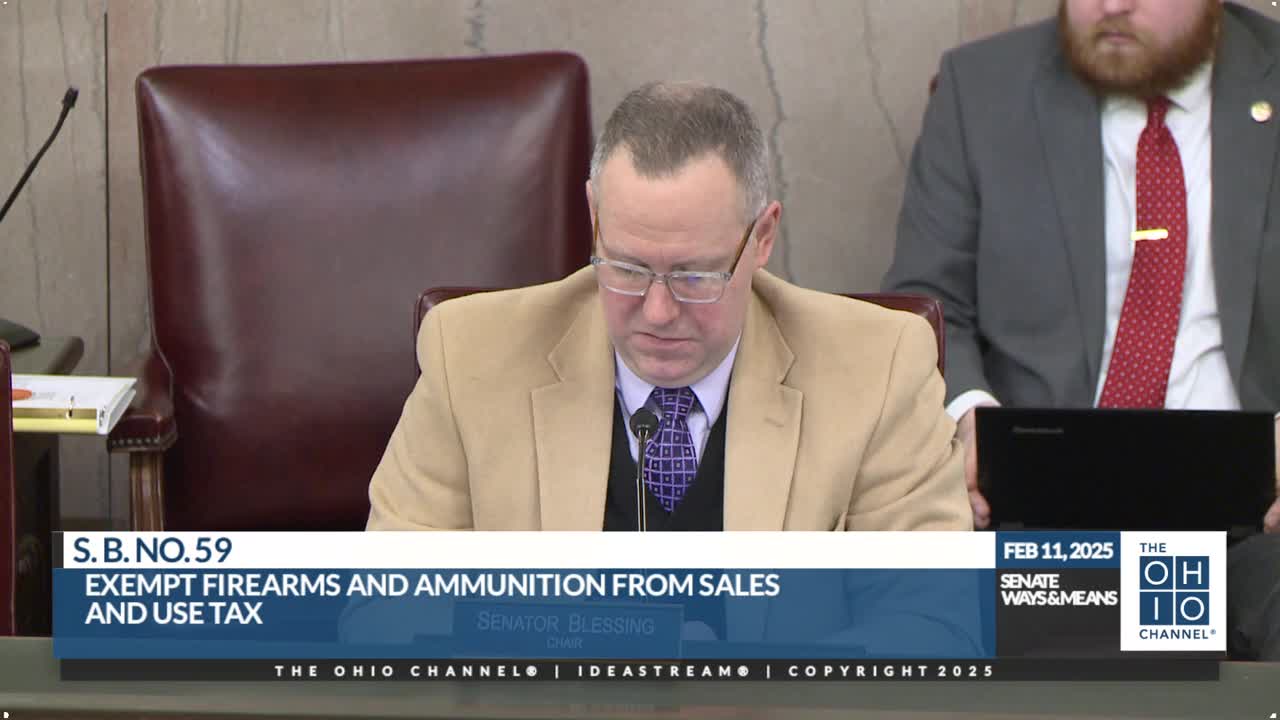
Senate Bill 59 would exempt qualifying firearms and ammunition from state sales and use tax and create a job tax credit tied to capital investment; sponsors said the change would keep business in Ohio while the Legislative Service Commission estimated substantial revenue reductions if enacted.
Senate sponsors presented Senate Bill 59 to the Ways and Means Committee, saying the bill has two goals: exempting firearms and qualifying ammunition from state sales and use tax, and creating a job-creation tax credit for manufacturers that make a qualifying capital investment.
The exemption discussed would apply to non-shotgun firearms 50 caliber or smaller, shotguns 10 gauge or smaller, and ammunition designed for those firearms. Sponsors argued the exemption would make Ohio retailers more competitive with neighboring states that have similar exemptions and said the change would help retain sales and jobs in areas near state borders.
The sponsors also described a job-credit program that would grant tax credits to companies that invest $2,000,000 in capital in Ohio, tied to payroll and intended to attract or retain manufacturing jobs. The sponsors said they discussed the proposal with industry at trade events and that the measure aims to make Ohio competitive for gun-related manufacturing.
The Legislative Service Commission (LSC) was cited in sponsor remarks estimating that removing the sales and use tax on these products would reduce annual general revenue fund receipts by roughly $22.5 million to $38 million and reduce local sales tax collections by roughly $5.9 million to $9.8 million per fiscal year compared to 2024 GRF totals.
Senator DeMora asked whether sales tax had actually prevented purchases; the sponsors replied that the greater risk is cross-border purchases, citing West Virginia's 2021 exemption and local examples where residents travel across state lines for tax-free purchases, which the sponsor said harms in-state retailers. No vote was taken; this was the bill's first hearing and the committee did not hear opponent or neutral testimony during this session.