Get Full Government Meeting Transcripts, Videos, & Alerts Forever!
Get email alerts on the Truck Parking topic
No spam. Unsubscribe anytime.
Witnesses Urge State Investment in Truck Parking, Citing Safety and Supply‑Chain Effects
Summary
A trucking-industry witness told the Ohio Senate Transportation Committee that lack of safe, legal truck parking reduces driver safety and supply‑chain efficiency and supported House Bill 54 language funding engineering and siting work for truck parking spots.
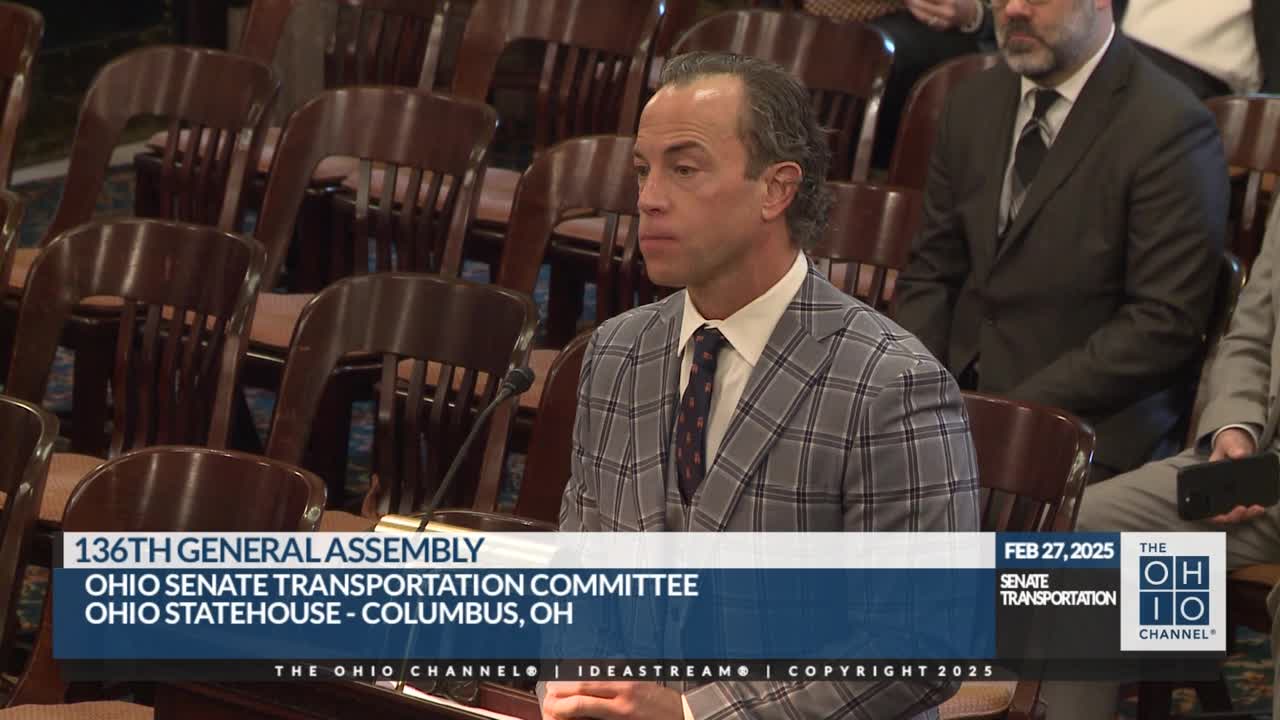
Mr. Balzer, a witness representing the trucking industry, told the Ohio Senate Transportation Committee that a shortage of safe, legal truck parking creates roadway and workforce safety hazards and lowers supply‑chain efficiency.
"Safety is the number 1 priority that we have," Mr. Balzer said, describing drivers who must park in unsafe locations and sometimes face vandalism or assaults. He told senators the American Transportation Research Institute found that "90 percent of truck drivers have difficulty finding safe and legal parking spots," a factor he said pushes drivers to make inefficient choices about when and where to stop.
Why it matters: Committee members heard that state investment could pay for engineering and siting studies to place parking where drivers can rest safely and where facilities — fuel, food, access ramps — support operations. Witnesses and some senators framed the issue as both a worker‑safety and a freight‑efficiency concern tied to the biennial transportation budget under consideration in House Bill 54.
Details from testimony
- Mr. Balzer said the federal hours‑of‑service rules allow up to 11 hours of driving but that the average driver currently drives about 6.5 hours, in part because drivers shorten trips to avoid running out of legal parking time. He said that dynamic reduces productivity and creates supply‑chain inefficiencies.
- A chart cited in testimony showed 81% of existing truck parking spots are privately owned (truck stops or private truck parking facilities), and witnesses said private operators report being at or near capacity.
- Cost estimates discussed by senators and the witness ranged widely; one committee member calculated a per‑spot construction range of roughly $100,000 to $220,000 based on prior ODOT testimony and the witness's figures. Mr. Balzer said federal grant programs created by recent federal highway policy provide additional funding and are not structured as a typical matching program but as a grant to help offset costs.
- Mr. Balzer said private operators would expand parking only if profitable, but that many private operators reported having no additional land or capacity to add spots.
Committee questions and concerns
Senators asked about how locations for spots would be selected, whether state funds would be matched by federal funds, and whether the program would use existing state‑owned land where feasible. Mr. Balzer said the proposed budget funding would pay for engineering and studies to find appropriate locations and that the department would try to use existing state land or expand existing sites when feasible. He also said federal grant funding identified in recent federal legislation would contribute to the program but described it as a straight grant rather than a matching program.
What the testimony did not include
No formal vote or disposition occurred on the committee floor about funding for truck parking during the hearing. The witness repeatedly framed the proposal as engineering, siting and construction work to be paid from the transportation budget language in House Bill 54; the committee did not, in the transcript, record a formal motion or vote on that language.
Ending
Committee members pressed for assurance that public dollars would be spent efficiently and asked staff to verify cost estimates, siting plans and how federal programs would interact with state funding. Mr. Balzer told senators the trucking membership supports spending on truck parking and that members want more investment, subject to efficient engineering and siting.