Get Full Government Meeting Transcripts, Videos, & Alerts Forever!
Get email alerts on the Utility Regulation topic
No spam. Unsubscribe anytime.
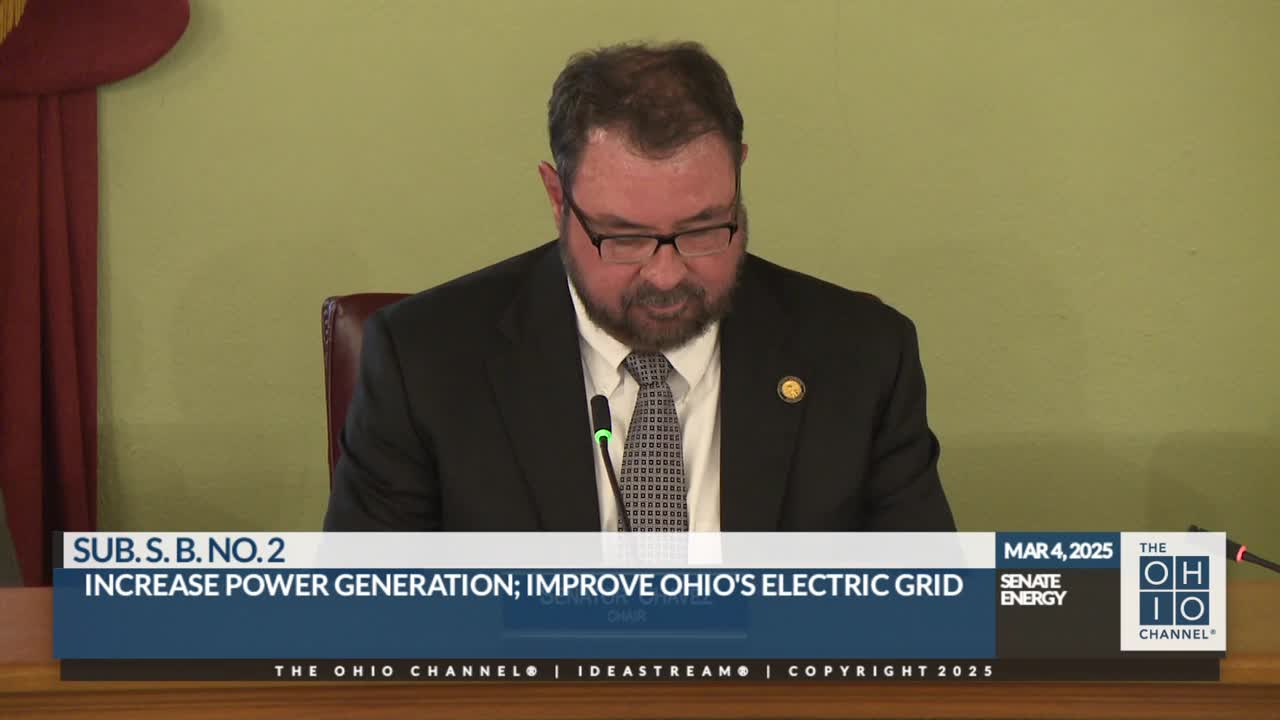
Senate Energy Committee adopts substitute to SB 2 after testimony on rates, behind‑the‑meter generation and grid reliability
Summary
The Ohio Senate Energy Committee unanimously adopted a new substitute to Senate Bill 2 (sub. 0333-3) and heard competing testimony on refund rules, multi‑year rate-making, utility-owned behind‑the‑meter generation, and grid reliability.
The Ohio Senate Energy Committee adopted a substitute to Senate Bill 2 (substitute bill 0333-3) as its working document and heard more than a half dozen witnesses arguing over changes to utility regulation, rate-making and generation policy.
The substitute bill was moved by Senator Jay Reineke and adopted without objection after committee discussion; Chair Chavez said the new version would be posted on the committee and senate websites after the hearing. The adoption makes the new text the working draft for further hearings and amendments.
Why it matters: The bill would change how utilities and the Public Utilities Commission of Ohio (PUCO) handle refunds, rate cases, and what kinds of generation and storage the state treats as eligible energy resources. Proponents said the changes would spur investment and grid reliability; opponents warned they would weaken consumer protections, allow regulated utilities to compete with independent providers, and create rate volatility for residential and business customers.
Key provisions described in committee testimony and the substitute text include: refunds tied to the date the Ohio Supreme Court finds rates unlawful rather than to the original rate case approval; restoration of audit-process language for PUCO reviews; a rule that interruptible rates not be discriminatory; an interim “midpoint” staff-recommended rate that utilities may charge subject to refund; clarified deadlines (45 days for an application to be deemed complete, and up to 180 days for PUCO staff to issue a staff report after completeness); permission for certain behind‑the‑meter generation where no ratepayer dollars are used and the facility is directly connected to the customer; a three‑year multiyear rate-making option with annual true‑ups; designation of linear generation as a renewable resource; parity of energy storage with generation for tax treatment; a three‑year mandatory rate‑case filing cadence; and an authority for the Ohio Air Quality Development Authority to create a solar‑for‑schools loan fund.
Proponent arguments
Joe Price, representing the Ohio Energy Group, said the group supports the substitute and singled out language that would allow PUCO to approve programs that support economic development and grid reliability, including interruptible rate programs. "Interruptible rate is a voluntary thing that a company can do," Price said, describing how participants accept temporary shutoffs during emergencies in exchange for bill discounts and noting the role such programs played during a multiday winter emergency.
Todd Schnitzler, president and CEO of the Electric Power Supply Association, urged repeal of the electric security plan (ESP) option in favor of a market rate offer (MRO) and argued competitive markets have delivered lower costs and new generation in Ohio. "By defining those bright lines and giving the EDUs the clear direction to focus on the wires business," Schnitzler said, the state will encourage independent investment in generation.
David Proano of the Ohio Energy Leadership Council thanked the committee for retaining authority for interruptible and economic‑development programs and cautioned that the three‑year rate concept, as drafted, could disadvantage consumers because reconciliation can take time and customers could face interim higher bills.
Reliability perspective
Timothy R. Gallagher, CEO of ReliabilityFirst Corporation (a NERC regional entity), gave technical testimony on reliability risks in the PJM footprint, warning that demand growth and generator retirements have reduced margins. "Please be careful in the policies, regulations, and legislation not to call for removing generation that exists now faster than we can replace it," Gallagher said, adding that essential reliability services (load following, ramping, frequency and voltage response, black start capability) remain largely supplied by dispatchable plants.
Consumer and manufacturing concerns
Maureen Willis, director of the Ohio Consumers' Counsel (OCC), said earlier versions of SB 2 contained stronger consumer protections and that sub. -3 moves away from that path. Willis recommended restoring full refund language when PUCO rates are later found unlawful, strengthening prudence and "used and useful" standards in the so‑called mini rate cases, and opposing utility entry into behind‑the‑meter generation because of cross‑subsidization and enforcement challenges. "It is very hard to police," Willis said of the bill's prohibitions on cost recovery for utility‑owned behind‑the‑meter projects.
Kim Boyko, representing the Ohio Manufacturers Association, said OMA moved from proponent to interested party because of version 3's changes. Boyko criticized the draft's forecasted three‑year rate model, arguing it could give utilities guaranteed returns on projected assets and permit stacking of riders and other adjustments that would make rate predictability for manufacturers worse. "A guaranteed profit on projected assets. That is not good for customers," she said.
Concerns raised by opponents and other interested parties
Opponents warned sub.‑3 could reintroduce cost shifting and reduce regulatory transparency. Joseph DeMear of the Wood County Green Party urged removing language that could categorize methane and nuclear as "green" and advocated for prioritizing wind, solar and storage. Randy Emminger of the Energy Policy Network and other witnesses pointed to recent NERC and PJM assessments that show rising reliability risk as older generation retires and large new electric loads are added.
Committee action and next steps
Senator Reineke moved to adopt substitute bill 0333‑3; the committee adopted the substitute without objection and made it the working document. Chair Chavez said the new substitute would be posted on the committee website immediately after the meeting and on the senate.gov site later in the day. Committee members and witnesses indicated further changes and supplemental testimony are likely as stakeholders review the substitute.
Discussion vs. decisions
Discussion: Committee testimony focused on the balance between encouraging new generation and economic development programs (interruptible rates, transmission support) and preserving consumer protections and rate predictability (refund scope, prudence standards, policing cost recovery).
Direction/assignments: Chair Chavez and members signaled continued work on the substitute; several witnesses asked to submit supplemental written testimony after reviewing the new sub.‑3 text.
Formal action: The committee adopted substitute bill 0333‑3 as the working document (motion by Senator Reineke; adopted without objection). The substitute will be posted publicly and used for further hearings.
Ending
The committee proceeded to take testimony from additional witnesses during the same hearing day and concluded the scheduled testimony list. The substitute will return to the committee docket for additional review and possible amendment following supplemental filings and stakeholder comment.