Get Full Government Meeting Transcripts, Videos, & Alerts Forever!
Get email alerts on the Grid Resilience topic
No spam. Unsubscribe anytime.
Senate concurrent resolution urges federal, state and regional action to harden grid against geomagnetic and electromagnetic threats
Summary
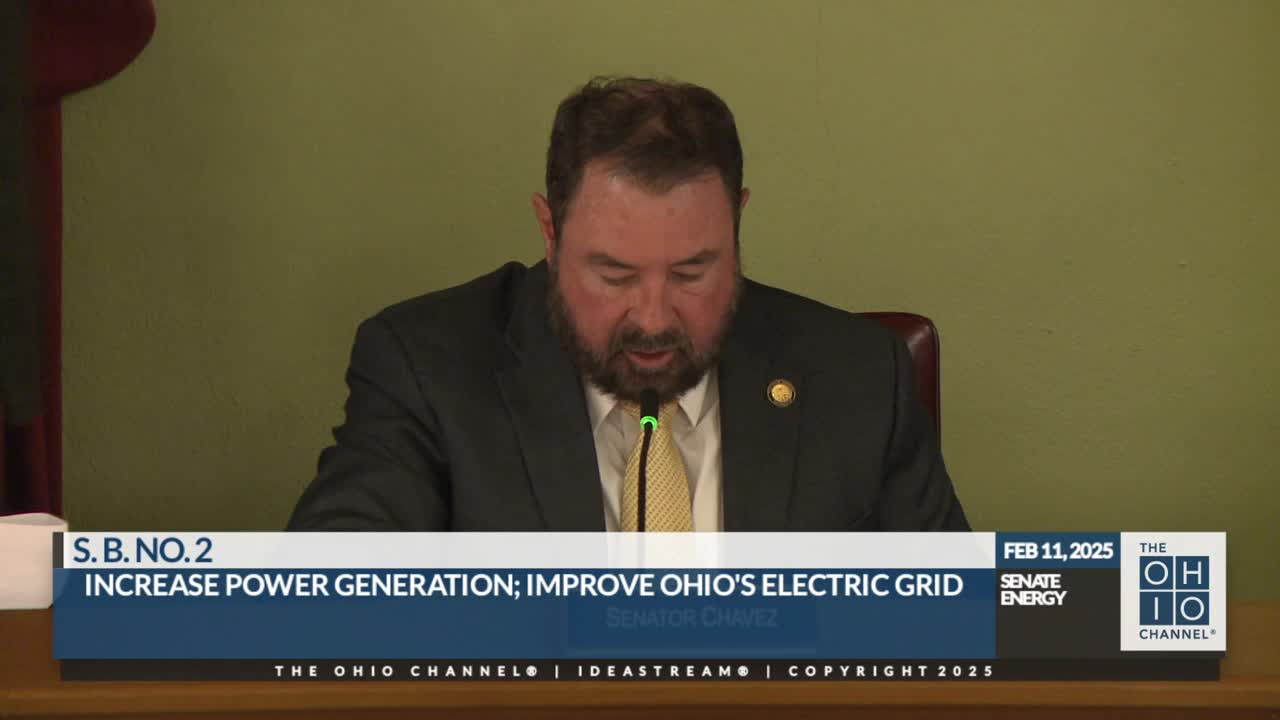
Senate Concurrent Resolution 2 would urge Congress, the governor, PJM and other entities to invest in planning and hardening the electric grid against geomagnetic disturbances and electromagnetic pulses, sponsor Senator Johnson said in testimony.
Senate Concurrent Resolution 2, presented to the Senate Energy Committee by Senator Johnson, urges federal and state authorities, regional operators and utilities to increase planning and investment to harden the electrical grid against naturally occurring geomagnetic disturbances and man-made electromagnetic pulse (EMP) threats.
In sponsor testimony, Senator Johnson said the resolution "will strongly urge Congress, the governor, PJM and other regulatory groups, and our state energy providers, to invest further resources and enhance planning for naturally occurring and man made threats to our interconnected grid system, hardening its composition." He framed the issue as nonpartisan and a matter of public safety.
Johnson described risks from coronal mass ejections (solar events) and from EMPs, saying former events have historically damaged power systems and that a high-altitude nuclear detonation could render electrical devices unusable. He said such outages could cascade into transportation, health care, financial services and other critical functions, and that "This is truly a public safety issue." The testimony cited obstacles identified by federal agencies and auditors, including aging components, gaps in federal-state communication, cyber and physical security vulnerabilities, and supply-chain concentration for transformers and other electrical components.
The sponsor noted policy tools and private-sector options to improve resilience: microgrids, blocking devices for geomagnetically induced currents, black-start and islanding requirements for projects receiving state support, and incentives for local siting and zoning to reduce risk. Johnson referenced the Government Accountability Office's findings that many recommendations for critical infrastructure security remain unimplemented and suggested Ohio consider incentives and harmonized state-federal outcome-based policies. He also urged increased domestic manufacturing of key grid components.
The committee took no formal action on the resolution in the hearing; Senator Johnson concluded by offering to answer questions, and the committee adjourned after testimony.