Get Full Government Meeting Transcripts, Videos, & Alerts Forever!
Get email alerts on the Energy And Public Utilities topic
No spam. Unsubscribe anytime.
Senate Energy Committee adopts substitute for Senate Bill 2 after hours of testimony on utility rate-making, OVEC and siting rules
Summary
The Ohio Senate Energy Committee on Wednesday adopted, without objection, a substitute for Senate Bill 2 and heard hours of testimony on sweeping changes to utility rate making, tax incentives for new generation, the legacy generation rider and siting rules.
The Ohio Senate Energy Committee on Wednesday adopted, without objection, a substitute for Senate Bill 2 and heard hours of testimony from investor‑owned utilities, cooperatives and public‑interest groups about major changes to utility rate making, tax incentives for new generation, the legacy generation rider and changes to the Ohio Power Siting Board process.
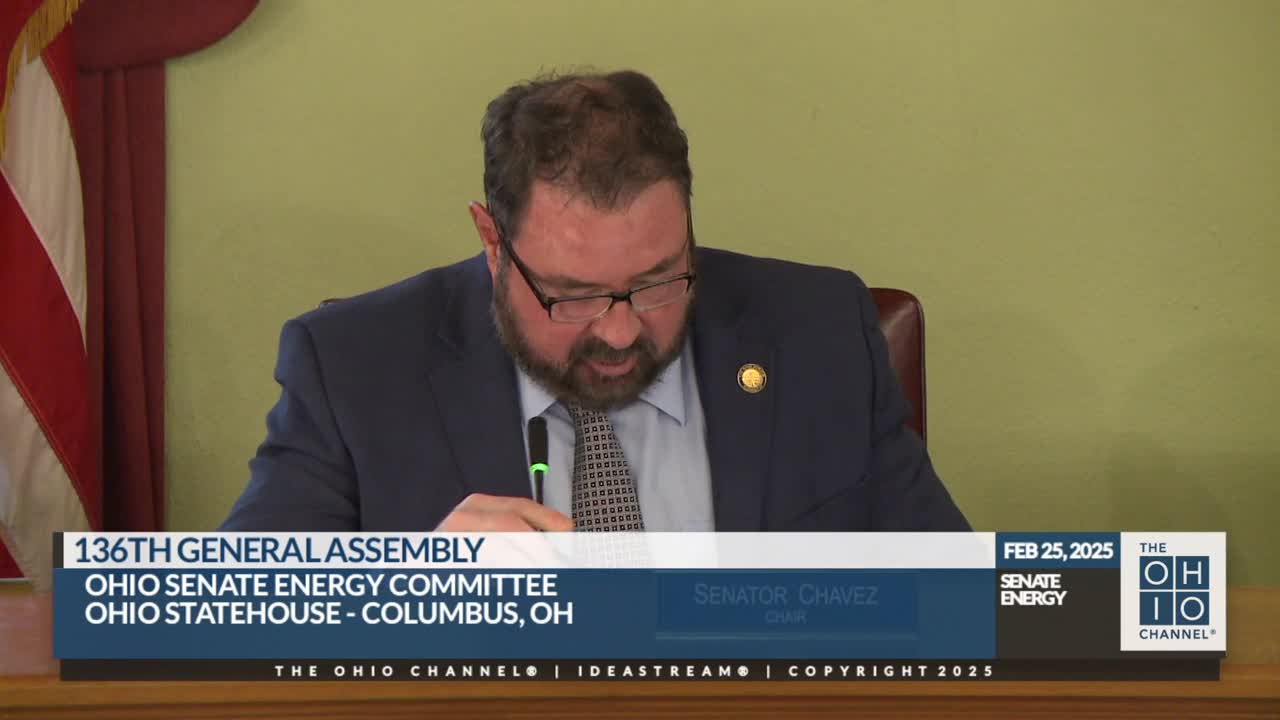
The substitute bill was agreed to by unanimous consent after Senator Steve Reineke (R) moved to adopt substitute bill 0333‑2; committee chair Matt Chavez said the new sub bill "will now be the working document" and directed staff to post it to the committee website and to senate.gov.
The measure — described by proponents as a package of regulatory reforms to modernize how electric distribution utilities recover costs — would remove electric security plan (ESP) provisions, enable some nontraditional billing models and flexible payment schedules, create mini rate‑case procedures and accelerate siting timelines for transmission and distribution projects. The substitute also proposes a 25% tangible personal property (TPP) tax reduction on newly built transmission, distribution and pipeline infrastructure, inserts language clarifying repeal of the legacy generation rider (LGR) in uncodified law, and directs a periodic PUCO rate‑case schedule (PUCO = Public Utilities Commission of Ohio).
Why it matters: witnesses warned the combination of repealing ESPs and the substitute’s retroactive‑refund language could increase regulatory lag, raise financing costs and reduce utilities’ ability to make timely infrastructure investments. Utilities pushed for forward‑looking, multi‑year rate frameworks or carefully structured true‑ups; consumer advocates and environmental groups urged stronger protections for ratepayers and for public input on siting and behind‑the‑meter generation.
Key provisions and debate
- ESP repeal and rate‑making modernization: Several witnesses said ESPs have allowed timely recovery for distribution investments between base rate cases. Mark Ryder, president and chief operating officer for AEP Ohio, told the committee that ESPs "create key alternative regulatory mechanisms" that help fund economic development programs, grid modernization and large‑customer interruptible rates. Utilities (AEP, AES, Duke) urged that any elimination of ESPs be paired with a credible replacement that addresses regulatory lag; they repeatedly proposed multi‑year rate plans or forecasted test years with annual true‑ups.
- Legacy generation rider and OVEC: The substitute clarifies repeal of the LGR in uncodified law. Utilities warned the LGR provides a hedge tied to OVEC contractual arrangements and helps protect customers from volatile wholesale market prices; witnesses told senators they rely on the statutory framework in business planning. Duke Energy Ohio testified repeal would "deprive customers of the benefits of the hedge and also create ... uncertainty and financial implication for Ohio's utilities." Opponents and some citizen witnesses argued the OVEC pass‑through has cost ratepayers hundreds of millions of dollars and should be reconsidered.
- Solar generation fund and dollar amounts: Sponsor remarks and testimony referenced a $16,000,000 set‑aside for solar company commitments; Senator Reineke and witnesses acknowledged that figure may need upward adjustment after consultation with the Ohio Air Quality Development Authority. The substitute also restores certain payment‑in‑lieu provisions and contains language about reimbursing ratepayers if a solar fund balance remains at the end of the stated period (transcript language: "by the end of 02/1930, those dollars will be erase reimbursed to the ratepayers").
- Tangible personal property (TPP) tax and new generation: The bill would reduce TPP taxation to 25% on newly built transmission, distribution and pipeline infrastructure. Ohio Electric Cooperatives and other witnesses supported the TPP change for new generation but urged clarifications to avoid unintended cost shifts to cooperative members.
- Customer choice billing and behind‑the‑meter/self‑generation: The substitute includes a customer choice billing proposal some utilities oppose. AES and Duke warned the current draft could create duplicate billing systems and higher costs; Save Ohio Parks and other public‑interest witnesses flagged the bill’s expanded definition of "self generator," saying it might enable large commercial customers (for example, data centers) to avoid paying full system costs by netting behind‑the‑meter generation and shifting costs to other customers.
- Ohio Power Siting Board timelines and public input: Utilities generally supported faster siting timelines; public‑interest groups urged longer review windows and stronger requirements for spoken public comment and environmental review. Cathy Becker, board president of Save Ohio Parks, told the committee she was concerned the substitute shortens timelines and lacks procedures for meaningful public testimony and environmental evaluation in siting decisions.
What witnesses said
- Mark Ryder, president and COO of AEP Ohio, said riders and ESP‑era mechanisms allow annual prudence audits and preapproval that "keep utility investments better aligned with regulatory priorities." He warned that eliminating those mechanisms without an adequate replacement would constrain grid investments; AEP said it plans roughly "$5,000,000,000 over the next 5 years" in capital investment under timely cost recovery assumptions.
- Sharon Schroeder, senior director of regulatory and RTO affairs for AES Ohio, told the committee AES views the bill as a constructive step toward rate‑making modernization but urged clarifying language so PUCO orders explicitly set "just and reasonable" rates and to preserve protections against retroactive rate making.
- Amy Spiller, president of Duke Energy Ohio and Kentucky, said the state should consider multi‑year rate plans and warned that the substitute's refund language "would require that every charge from a utility could be subject to refund," creating accounting and borrowing risks that could raise customer costs. She also told senators: "Ohio currently ranks dead last among the 50 states for regulatory lag."
- Craig Grooms, president and CEO of Buckeye Power and Ohio’s Electric Cooperatives, supported the TPP incentive for new generation but asked the Legislature to clarify that expanded behind‑the‑meter provisions not apply to electric co‑ops because of stranded‑asset and cost‑shift risks.
- Cathy Becker, Save Ohio Parks, asked the committee to preserve the solar fund dollars for Ohio solar projects or to refund unused funds to ratepayers, and urged stronger protections against siting projects on public lands and for environmental review and meaningful public testimony.
Committee action and next steps
Senator Reineke moved adoption of substitute bill 0333‑2 and the committee agreed without objection; the substitute will be posted to the committee and senate websites. Committee members and witnesses said they expect additional drafting and amendment work as stakeholders negotiate language on LGR repeal timing, solar fund dollars, PUCO processes, and the final structure for replacing ESPs.
Votes at a glance
- Substitute bill 0333‑2 — Motion to adopt substitute bill moved by Senator Steve Reineke; no second recorded; adopted by unanimous consent (no objection). Outcome: agreed to as the working document; committee to post the substitute online.
Ending note
The hearing concluded after more than an hour of witness testimony and questioning. Committee members indicated they plan follow‑up discussions and potential amendments to address the areas of concern raised by utilities, cooperatives and public‑interest groups before further floor action on Senate Bill 2.