Get Full Government Meeting Transcripts, Videos, & Alerts Forever!
Get email alerts on the Electricity Market topic
No spam. Unsubscribe anytime.
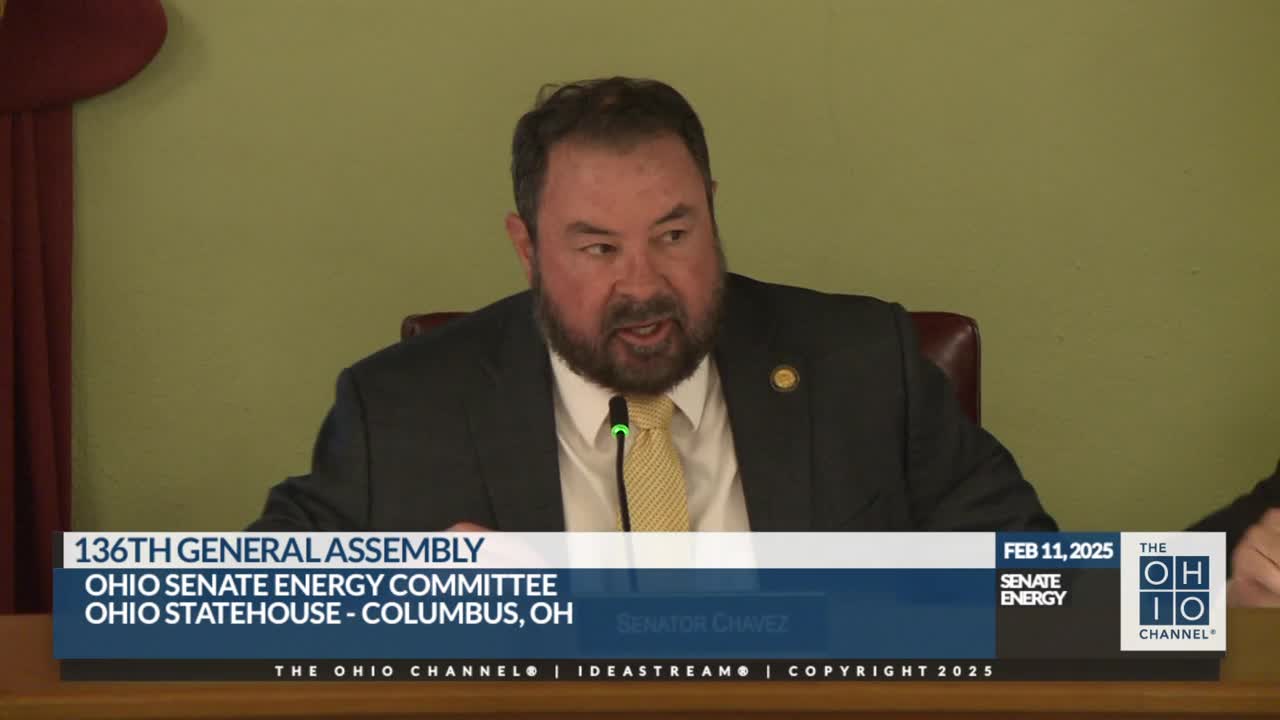
Senate committee adopts substitute for SB2 to promote competitive electricity market and limit utility-owned generation
Summary
The Senate Energy Committee agreed without objection to a substitute for Senate Bill 2 that sponsors say would create an intrastate competitive electricity market, restrict utility ownership of generation, repeal certain subsidies from House Bill 6 and change rate-case timelines.
The Senate Energy Committee on the motion of Senator Reineke adopted, by unanimous consent, a substitute to Senate Bill 2 that backers say would create a competitive intrastate electricity market, speed new generation, and limit ratepayer subsidization of existing plants.
Senator Reineke, sponsor of Senate Bill 2, told the committee the substitute "makes changes to create a comprehensive, competitive electricity market, enhance grid reliability as our load growth demand increases, and keeps energy affordable." He said the bill aims to bring new power-generation investment to Ohio to meet growing demand and avoid transferring costs to consumers.
The substitute would repeal the Electric Security Plan (ESP) framework for future cases and require standard service offers (SSOs) to be market-rate offers, prohibit future electric distribution utility ownership of generation that was paid for by distribution customers, and bar distribution utilities from bidding into wholesale markets with such assets, Reineke said. The bill also removes the tangible personal property (TPP) tax on new generation and would exempt new transmission or pipeline infrastructure in designated priority investment areas from TPP for five years.
Reineke said the bill would repeal the OVEC-related subsidies enacted in House Bill 6 and "prohibits future ratepayer subsidization of the power plants." He told the committee the OVEC subsidies have added about $670,000,000 to consumer bills. On the topic of solar incentives created under House Bill 6, Reineke said the fund "has collected $60,000,000 and has only spent $10,000,000 on 5 projects." When asked for detail, Reineke said he would provide additional information to the committee.
The substitute also sets deadlines for utility rate cases and regulatory review: all electric distribution utilities must be in a rate case by 2030; the Public Utilities Commission of Ohio (PUCO) would be required to complete a rate case within 275 days with discovery closed after 215 days; and cases at the Ohio Power Siting Board (OPSB) must be completed in 90 days under current text, with priority investment area projects decided within 45 days, according to testimony.
The bill creates a framework for self-generation and "mercantile customer self-power systems," which Reineke said would enable very large users such as data centers to pursue behind-the-meter base-load generation and avoid lengthy PJM interconnection processes. He said priority investment areas would be designated in coordination with local jurisdictions and the Department of Development to encourage siting on brownfields and former coal sites.
Committee members asked clarifying questions. Senator Spinn asked whether the five solar projects funded under the current program were complete and what would happen to the roughly $50,000,000 remaining; Reineke said he would obtain those details. Senator Smith raised concerns that mandating a one-time deadline of 2030 could allow long gaps between rate-case reviews and asked whether a recurring 48-month requirement might be preferable; Reineke said the 2030 deadline was intended to ensure every utility has appeared before PUCO within the next five years and that he was open to suggestions going forward. Senator DeMora questioned why repeal of the OVEC rider is tied to the phaseout of ESPs; Reineke said the bill avoids immediately "ripping the carpet from underneath anyone" by allowing existing ESPs to run their course while prohibiting future ESPs.
The committee chair asked if there was any objection to adopting the substitute as the working document; none was raised and the committee "agreed to" the substitute without objection. The substitute (0333-1) is now the working document for further committee work on Senate Bill 2.