Get Full Government Meeting Transcripts, Videos, & Alerts Forever!
Get email alerts on the Ovec Subsidies Refund topic
No spam. Unsubscribe anytime.
Proponents at Senate hearing push to end OVEC coal subsidies immediately and refund unspent solar funds
Summary
Supporters of Senate Bill 2 urged the Senate Energy & Public Utilities Committee to eliminate Ohio Valley Electric Corporation (OVEC) subsidies upon enactment and to refund solar generation fund balances to ratepayers, saying continued subsidies distort markets and cost consumers hundreds of millions.
Supporters of Senate Bill 2 told the Ohio Senate Energy & Public Utilities Committee that the bill should immediately end long-standing subsidies to the Ohio Valley Electric Corporation and return unspent solar-generation fund money to consumers.
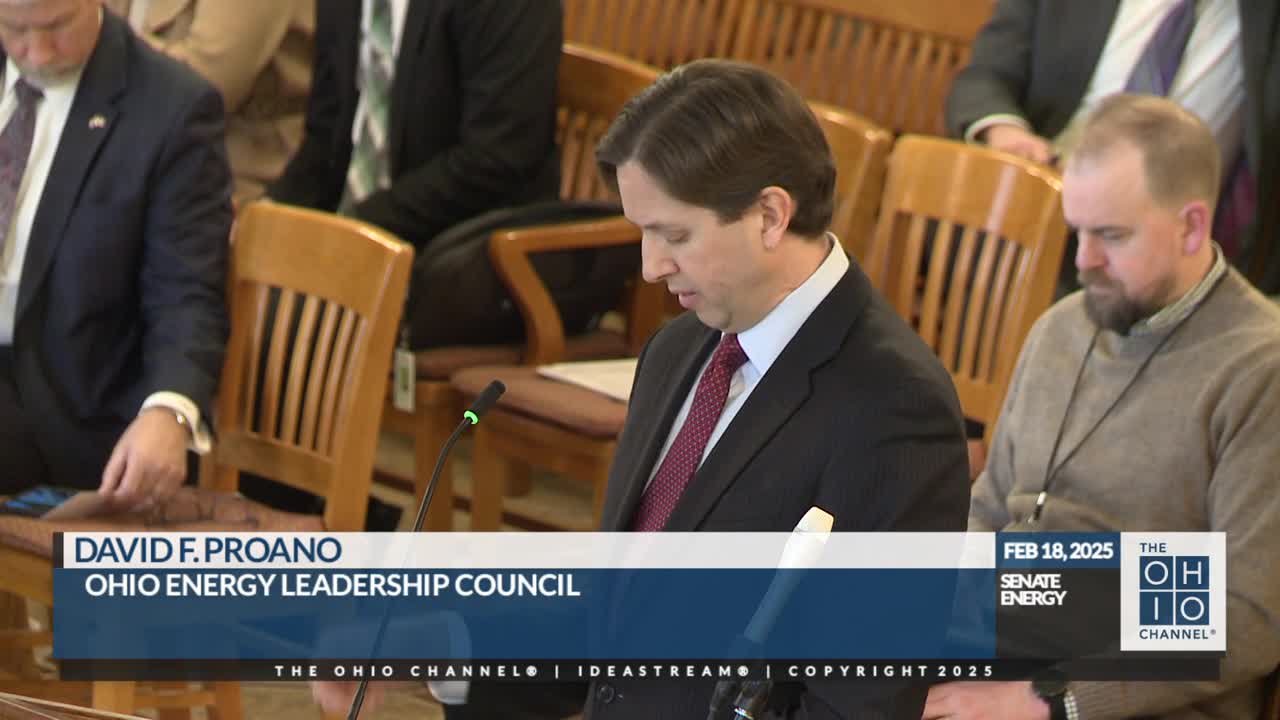
At a second hearing on the bill, industry and consumer witnesses said OVEC subsidies — which were put into Ohio law in prior legislation and are collected through riders on customer bills — have cost Ohio ratepayers hundreds of millions of dollars and continue to distort wholesale markets. David Proano, regulatory counsel to the Ohio Energy Leadership Council, said OVEC-related riders have cost “over $600,000,000” since the rider was enacted and asked that the bill be amended so the charges end on enactment rather than being tied to each utility’s later expiration date for electric security plans.
The Ohio Consumers’ Counsel’s director, Maureen Willis, called the bill’s provision requiring prompt refunds for PUCO-approved charges “one of those ‘pinch me’ provisions,” and urged the committee to ensure consumers receive refunds for charges that courts or regulators later find unjust or unreasonable. Willis and other witnesses said HB 6–era subsidies, including solar program payments, have left large balances and that any remaining solar-generation fund money should be returned to customers.
Proponents from the Ohio Independent Power Producers and the Ohio Manufacturers Association likewise supported ending the OVEC subsidy now. Tom Copas of OIPP said the OVEC plants are aging (built in the 1950s) and that continued subsidies blunt market discipline and discourage investment in new generation. The Ohio Manufacturers Association asked that the subsidies be ended immediately, saying continued payments could add hundreds of millions more to consumer bills.
Not all details were agreed: witnesses warned the committee the timing of elimination interacts with pending PUCO audits and utility electric security plan (ESP) expirations. Proano and consumer advocates asked the committee to preserve the PUCO’s pending audit authority so the commission can complete prudency reviews of OVEC charges paid to date before the subsidy language is removed.
The bill as introduced would repeal the solar generation fund and OVEC-related riders; proponents urged the committee to add explicit language that (1) ends OVEC charges upon enactment and (2) preserves PUCO authority to audit past OVEC charges so that refunds or other remedies can be determined.
Ending the subsidies and refunding unspent solar funds were framed as market‑level fixes that would encourage private investment, restore fair competition in PJM wholesale markets, and reduce ongoing costs imposed on residential and commercial customers.
Several witnesses asked the committee to weigh how quickly to end OVEC payments and to preserve auditing and refund mechanisms so the state can both stop further subsidies and hold any past charges subject to review.
Looking forward, proponents said repeal would not necessarily force plant closures; OVEC’s intercompany agreements run for decades and owners in other states may continue to recover costs from their own ratepayers.