Get Full Government Meeting Transcripts, Videos, & Alerts Forever!
Get email alerts on the False Alarms topic
No spam. Unsubscribe anytime.
Largo amends false‑alarm rules; commission approves ordinance on first reading after fee schedule change
Summary
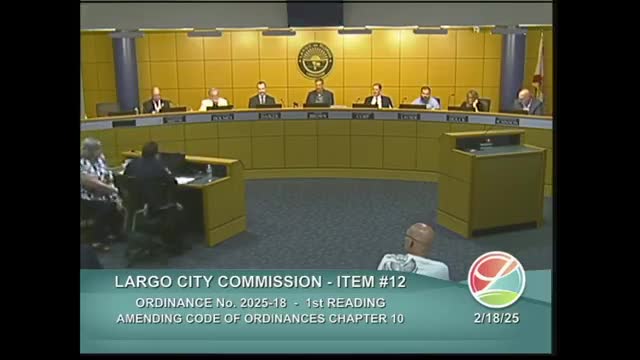
The Largo City Commission voted 7–0 on first reading to approve Ordinance No. 2025-18, revising the city’s false‑alarm definition and fee schedule and adding operational codes to exempt victim‑related alarms from fee assessment.
The Largo City Commission voted 7–0 on first reading to approve Ordinance No. 2025-18, which updates the city’s false‑alarm code to change the definition of a false alarm, revise the fee assessment schedule and permit police officers to classify certain alarms as victim‑related so charges are not assessed.
Deputy Chief Anne Starling and records manager Anita Fowler presented background and data showing less than 1 percent of alarm calls were valid over a recent three‑year period. Staff said the ordinance aligns local practice with federal guidance, including the Violence Against Women Act provision noted in presentation materials that a victim should not be charged for requesting emergency assistance. To reflect operational realities, staff proposed separating residential and commercial fee schedules, reducing the number of free alarms for residential registrations from five to four and applying a different progression for commercial accounts.
Under the proposed operational changes, the city will add disposition codes allowing officers to indicate when an alarm call is crime‑related or victim‑related; those calls would not be counted toward an owner’s alarm charge tally. Staff also proposed that when a fee becomes payable the crime‑prevention officer will meet with the homeowner or business to identify causes of false activations (faulty sensors, user error, employee training) and that the city will waive the initial fee if the owner participates and the problem is remediable.
During discussion, commissioners and staff debated fee progression. After discussion, the commission approved an amendment to the fee schedule that inserted a $50 charge earlier in the progression for commercial accounts (the motion to amend and subsequent final motion to approve were both approved 7–0). Staff explained annual registration runs Oct. 1–Sept. 30 and that the fee schedule resets each registration year.
Several commissioners noted operational challenges such as dispatch timing, brief calls that may be cancelled by owners, and the city’s practice of sending letters to unregistered alarm sites. Fire department staff told commissioners they typically do not assess false‑alarm fines for life‑safety detectors and instead send inspectors when repeated activations occur.
The motion to approve Ordinance No. 2025-18 as amended on first reading and to schedule a second reading and public hearing for March 18, 2025 passed 7–0.