Get Full Government Meeting Transcripts, Videos, & Alerts Forever!
Get email alerts on the Agriculture And Natural Resources topic
No spam. Unsubscribe anytime.
Ohio officials report major HPAI outbreak in west-central counties; call for federal aid and lab support
Summary
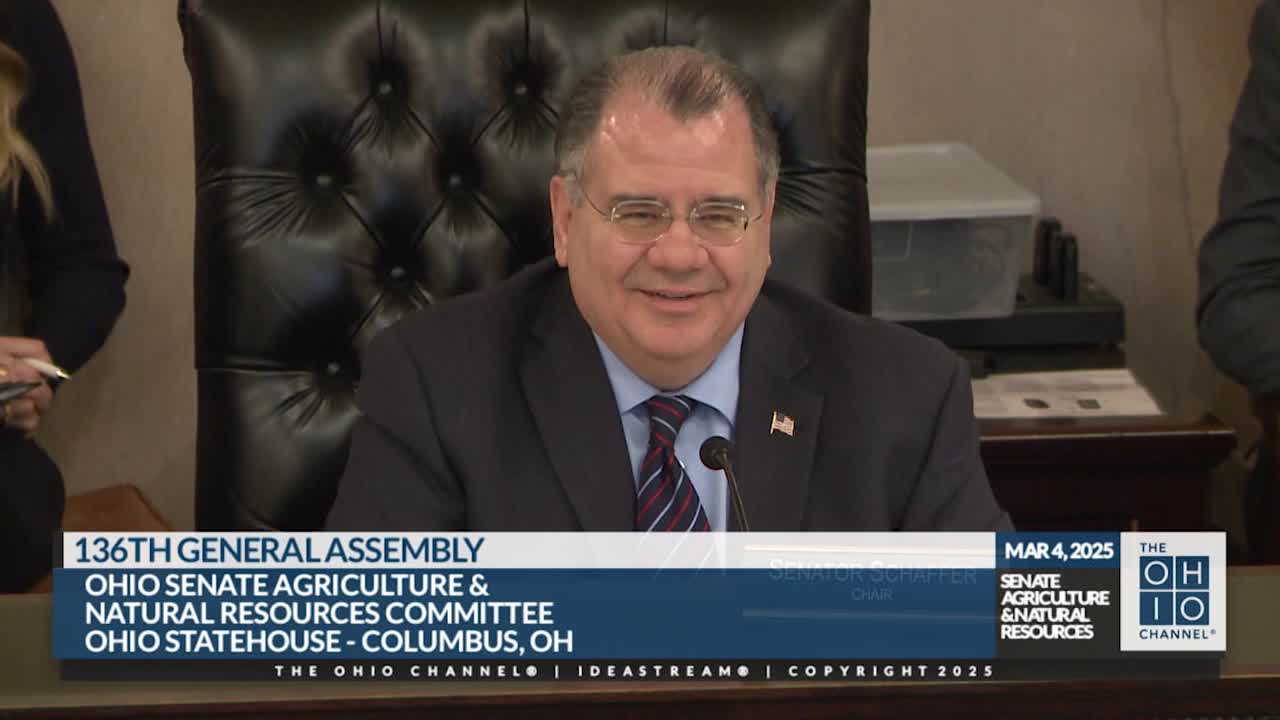
Ohio Department of Agriculture Director Brian Baldridge and Jim Chiquiris, executive vice president of the Ohio Poultry Association, told the Senate Agriculture and Natural Resources Committee at a hearing that a highly pathogenic avian influenza outbreak has affected roughly 74 premises in west‑central Ohio and has required depopulation of more than 15 million birds since Christmas Eve 2024.
Ohio Department of Agriculture Director Brian Baldridge and Jim Chiquiris, executive vice president of the Ohio Poultry Association, told the Senate Agriculture and Natural Resources Committee at a hearing that a highly pathogenic avian influenza (HPAI) outbreak has affected roughly 74 premises in west‑central Ohio and has required depopulation of more than 15 million birds since Christmas Eve 2024.
The committee was told the outbreak has concentrated in Darke and Mercer counties, has driven a major surge in diagnostic testing, and is prompting industry and state officials to seek increased federal indemnity payments, expanded lab capacity, and consideration of vaccine strategies. Both speakers emphasized biosecurity and the human health protections that come from preventing disease in animals.
“The first line of animal defense when it comes to diseases” is the state’s animal disease diagnostic lab, Baldridge said, describing a testing surge: in the last 60 days the lab ran more than 11,600 HPAI‑related tests, a 244% increase over a normal period. Baldridge told the committee the department has worked with USDA, the Ohio Poultry Association and other state agencies and that the Ohio Animal Disease Diagnostic Laboratory (ADDL) is accredited and operates daily during the emergency. He said a new, fully funded diagnostic lab is planned to open in 2026 and that the existing, 40‑year‑old facility currently covers only about 30% of the state's testing need.
Jim Chiquiris gave industry testimony that the outbreak has “wreaked havoc” on Ohio commercial flocks and said the association counted more than 15,500,000 birds lost at 74 premises. He urged federal support for indemnity and for vaccine development, saying, “We need an HPAI vaccine for our birds.” Chiquiris also urged clear and consistent federal communication about changing national policies and programs.
Committee members pressed officials on human‑health risk, testing and local impacts. Baldridge and Chiquiris said human infection has been rare and associated with direct contact at infected sites; Baldridge described the most recent human cases nationally as worker exposures rather than foodborne transmission and repeated that pasteurization and cooking protect consumers. Chiquiris added that farms provide personal protective equipment for workers and that products moving into commerce are restricted: “anything 48 hours prior to [detection] does not move into commerce,” he said.
Officials described two programmatic strains of response. On the diagnostic side, Baldridge outlined the laboratory workload and the department’s collaboration with adjacent states and USDA reference labs to confirm results. On the industry side, Chiquiris and Baldridge described the depopulation‑cleanup‑testing‑repopulation sequence used by producers: after depopulation the flock is composted on site, barns are cleaned and disinfected, swabs are sent to ODA labs, and repopulation waits through two incubation cycles before young birds are placed. Officials estimated that the turnaround from depopulation to repopulation typically ranges from about 45 to 75 days, with pullet production timelines (21 days to hatch; ~18 weeks to production) adding several months before supply recovers.
Committee members asked about costs borne by producers inside control areas. Baldridge said farms inside a 10‑kilometer control radius can incur daily testing costs to move product; for the Darke and Mercer region combined he estimated out‑of‑pocket testing costs of roughly $6,000–$7,000 per day. He said the department plans to seek budget support, including funding for the ADDL, in the state budget process.
Both witnesses highlighted federal actions announced by USDA leadership. Baldridge cited an announcement of roughly $1 billion in federal support for HPAI response and described two portions discussed in the hearing: funding to help producers enhance biosecurity and increases to indemnity payments. Chiquiris welcomed that funding and said industry needs clarity on whether new indemnity rates will be applied retroactively to cover already‑incurred losses.
On prevention and long‑term tools, witnesses stressed biosecurity and research. Baldridge described tighter on‑farm biosecurity steps and interagency coordination among health, public safety, mental health and natural resources agencies. Chiquiris urged expanded research at institutions such as The Ohio State University, advanced biosecurity measures, improved bird genetics and vaccine development, while noting trade and compartmentalization concerns for vaccinated versus unvaccinated segments of the industry.
Several senators raised local consequences for communities and youth programs. Vice Chair Kaler asked how county fairs and 4‑H poultry shows would be affected; Baldridge said officials were monitoring and aiming to make short‑term decisions by May 31, and cautioned that shows may be restricted while outbreaks continue. Senators from Darke and Mercer counties described empty barns and local economic impacts that ripple to feed mills, grain farmers and plant workers.
Officials and lawmakers also discussed mental‑health effects in the hardest‑hit communities. Baldridge said the outbreak has taken a “very human” toll in affected counties and urged neighbors to look out for each other and to use available mental‑health resources.
No formal votes or actions were taken by the committee during the hearing; witnesses requested and received commitments to continue interagency coordination, to pursue state budget support for the diagnostic lab and to work with USDA on indemnity and vaccine policy.
The committee adjourned after the question period.