Get Full Government Meeting Transcripts, Videos, & Alerts Forever!
Get email alerts on the Avian Influenza topic
No spam. Unsubscribe anytime.
Ohio officials outline losses, testing and timelines as avian influenza hits West Central poultry farms
Summary
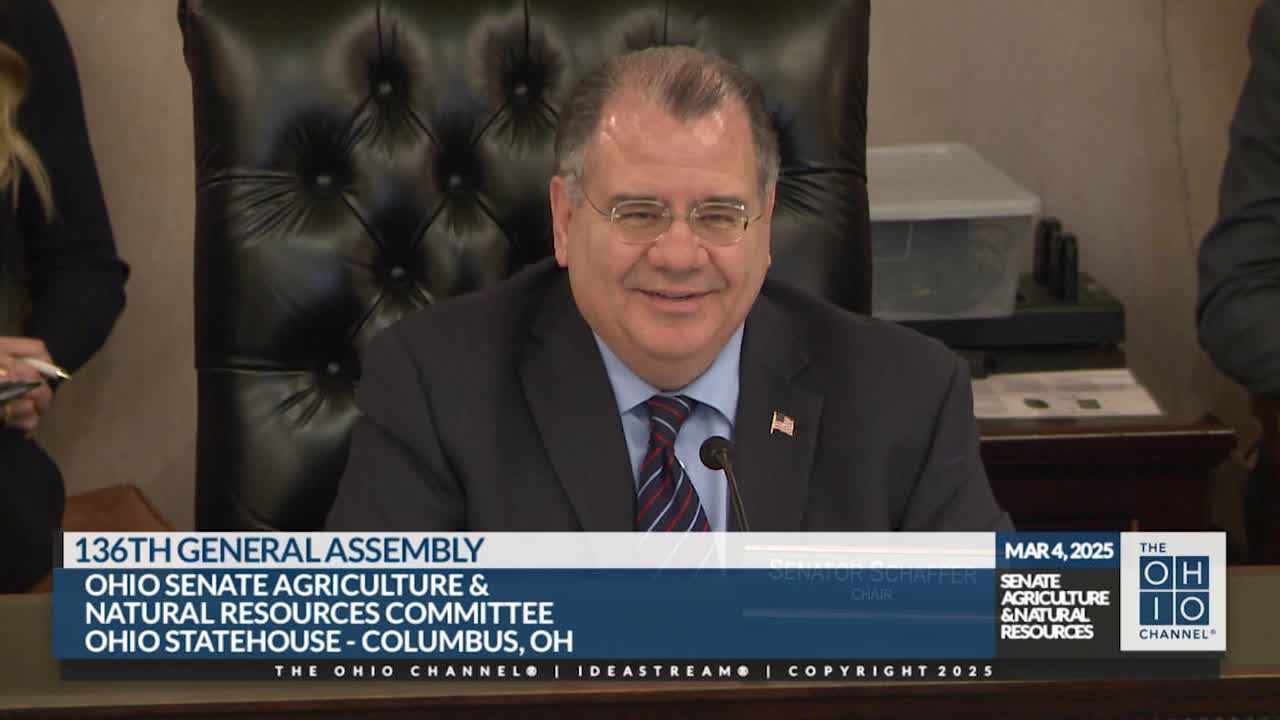
Chairman Randy Schafer convened the Senate Agriculture and Natural Resources Committee to hear testimony on highly pathogenic avian influenza from Ohio Department of Agriculture Director Brian Baldridge and Jim Chiquiris of the Ohio Poultry Association.
Chairman Randy Schafer convened the Senate Agriculture and Natural Resources Committee to hear testimony on highly pathogenic avian influenza (HPAI) from Brian Baldridge, director of the Ohio Department of Agriculture (ODA), and Jim Chiquiris, executive vice president of the Ohio Poultry Association.
Director Brian Baldridge told the committee that Ohio has been responding to HPAI since 2022 and that the state identified its first commercial-flock detection on Christmas Eve 2024. "Prior to Christmas Eve in 2024, we have depopulated about 9,400,000 birds in Ohio since 2022," Baldridge said, adding that since the December detection the state has depopulated "over 15,000,000 birds during this outbreak." He said the cases are clustered in a handful of counties and that the department is working with USDA and industry on testing, depopulation, composting on-site and deep cleaning of facilities before repopulation.
Jim Chiquiris said the industry estimate was slightly higher: "we have currently lost over 15,500,000 egg laying hens, pullets, turkeys, and ducks at 74 premises," and that Darke and Mercer counties account for the majority of infected flocks. Chiquiris and Baldridge both described sustained collaboration with federal and academic partners and urged stable funding and staffing for Ohio's Animal Disease Diagnostic Laboratory (ADDL) and faster clarity on federal indemnity rates.
Why it matters: committee members heard that the outbreak has immediate economic consequences for farms and supporting businesses — feed mills, grain growers and local employers — and will affect production and supply for months. Baldridge said egg-laying stocks already lost represent roughly 30% of the state's layer population, and industry witnesses explained that it typically takes weeks to months to bring a house back into production (21 days for an egg to hatch, 18 weeks for a pullet to begin laying).
Testing, labs and costs: Baldridge described ADDL work at elevated capacity — the lab is operating seven days a week and in the prior 60 days had performed more than 11,600 tests, a 244% increase over normal levels. Committee members were told that producers in control areas must test daily to move product; Baldridge estimated the collective out-of-pocket cost in the Darke/Mercer area at roughly $6,000–$7,000 per day. The department said a new, funded ADDL facility is expected to open in 2026.
Human health and food safety: both witnesses emphasized the outbreak has been primarily animal-to-animal. Baldridge said the human infections reported nationally involved direct contact with infected birds; "products are very safe, healthy, wholesome," he said. Chiquiris added that thoroughly cooking poultry products and pasteurization of milk mitigate food-safety risks.
Vaccination, indemnity and research: witnesses urged federal and state support for vaccination research and deployment. "We need an HPAI vaccine for our birds," Chiquiris told the committee, while acknowledging challenges for trade and supply. Both speakers welcomed USDA announcements increasing indemnity funding and programs but said producers need clarity on whether new rates will apply retroactively to Ohio losses.
Wild birds, geese and biosecurity: committee members pressed on wild-bird control and on-farm biosecurity. Baldridge and Chiquiris described industry efforts — truck washes, restricted access, farm-level deterrents — but said migratory and resident waterfowl remain a major vector and that policy and federal wildlife tools are part of the conversation.
4-H and fairs: Vice Chair Kaler asked about youth fairs. Baldridge said the department is monitoring short-term local shows and that officials were considering guidance through May 31 to allow time for decisions ahead of typical fair seasons; final decisions will depend on outbreak status and state-veterinarian guidance.
Dairy surveillance: Baldridge described a separate dairy-associated HPAI detection in 2024 and participation in the federal milk-testing strategy for surveillance of raw milk. Both witnesses told the committee that pasteurization protects the commercial milk supply.
Mental-health impacts: Baldridge highlighted the toll on affected rural communities, saying producers in the hardest-hit counties are experiencing significant stress and that the department is coordinating with state mental-health and public-safety partners to provide resources.
Repopulation timelines and economic ripple effects: officials described the depopulation→composting→deep-cleaning→swab/testing→waiting period before repopulation. Baldridge and industry witnesses said the process can take roughly 45–75 days for a facility depending on size, plus the time needed to raise replacement pullets to production, meaning months before full industry recovery. Senators from affected counties urged state support for producers during that gap.
What was not decided: the hearing was informational; there were no committee votes or formal actions recorded. Witnesses asked the legislature to consider budget support for the ADDL and to stay engaged on indemnity, vaccination strategy and producer assistance.
Outlook: both ODA and industry witnesses said detections had been trending downward in recent days but cautioned that migratory cycles could change risk. Baldridge said he would not expect the committee or the public to "breathe a sigh of relief for at least another 60 days," pointing to seasonality and the potential for renewed spread as birds return north.
Ending: committee members thanked the witnesses; with no further business the chair adjourned the session.