Get Full Government Meeting Transcripts, Videos, & Alerts Forever!
Get email alerts on the Wastewater topic
No spam. Unsubscribe anytime.
Largo plans deep-injection wells, seeks $26 million construction funding to stop surface discharge by 2032
Summary
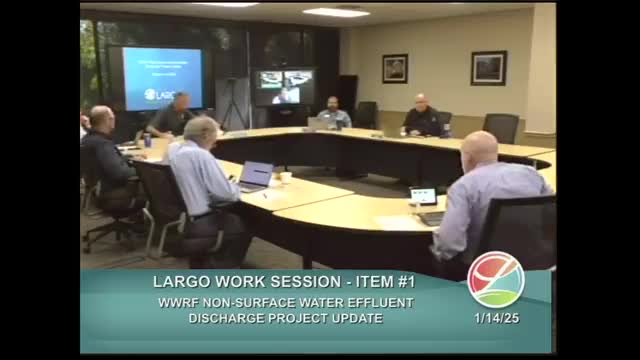
City staff briefed the commission on a project to eliminate surface-water discharge from the Largo Wastewater Reclamation Facility by Jan. 1, 2032, including design of two deep-injection wells, a $26 million construction estimate, SRF loan pursuit, and pending state and estuary grants.
Largo City staff on Jan. 14 told the City Commission the wastewater reclamation facility must stop discharging treated effluent to surface waters under Florida statute 403.064 and the Jan. 1, 2032 compliance deadline.
Jerry Walasinski, director of engineering services, told commissioners that “the deadline for compliance, to eliminate our surface water discharge is 01/01/2032. And I'll just say we're on track to meet that deadline.” He said the city has completed a disposal plan and has a project design under way that includes two deep injection wells, two monitoring wells and about 1,800 feet of new piping to connect the plant’s effluent pumps to the wells.
Why it matters: the plant currently discharges to retention ponds at Feather Sound that flow to Old Tampa Bay. Walasinski said the current permit limits the plant to no more than 19 tons of nitrogen per year to Tampa Bay and that the injection-well approach “will essentially take that as close to 0 as possible,” a benefit that helped secure a roughly $450,000 Tampa Bay Estuary Program grant already awarded to the project.
Project funding and timeline: staff gave a $26 million construction estimate and said FY2026 CIP contains construction funding requests. The city intends to apply for the Florida State Revolving Fund (SRF) loan program and to pursue a 50% state water-quality grant request (staff identified a $12,250,000 grant request tied to the construction portion). Walasinski said the city recently received final well-construction permits from the Florida Department of Environmental Protection (FDEP). Key near-term milestones staff listed include a February 4 commission agenda item on the estuary grant, solicitation for well-drilling on Feb. 17, SRF loan application submission timed for the SRF executive board cycle in early August, and commission contract awards planned for the October meeting depending on funding.
Technical and operations details: staff said monitoring wells will check for upwelling as required by the operating permit. Walasinski summarized typical well geometry based on regional examples: casing depths “about 700 to 900, maybe a thousand feet deep,” with borings into the Avon Park aquifer potentially around 1,200 feet. Monitoring wells are expected to be roughly 300 feet deep. He said the plant’s current average flows translate to roughly 6 million gallons per day that could be injected, and staff said they are optimistic one well might handle that flow but plan two wells both to distribute pressure on the aquifer and to allow maintenance outages.
Operations cost and reuse opportunities: staff said the primary ongoing operating cost for injection will be electricity for pumps but that the design uses a “pump-once” concept intended to avoid additional pumping costs compared with the current discharge arrangement. Walasinski also described a parallel effort to maximize reclaimed-water use and to reduce inflow-and-infiltration (I&I) in the collection system. Since 2016–17 the city has targeted basin-by-basin I&I work; staff said they are currently working in Lift Station Basin 2 and Basin 3 and expect the I&I program to continue through 2027 with targeted corrective work in identified basins.
Potable reuse possibility: staff described a pending FDEP draft notification on potable reuse that would open co-permittee arrangements with suppliers such as Tampa Bay Water. Walasinski said the statute could create a pathway to treat and transfer reclaimed effluent for potable use and that one of the proposed well locations was selected in part because it could later link to a reverse-osmosis facility if a partnership materializes.
Commission questions and contingency: Commissioners asked about cost confidence, drilling-permit lead times and contingencies for high-flow events. Walasinski said the city’s consultant team and early permitting work give confidence in the $26 million estimate and that the SRF loan program offers very low interest rates. He confirmed the city will retain the current Feather Sound discharge point for emergency or temporary discharges allowed under the FDEP plan and that the golf-course irrigation agreement (described by staff as a long-term agreement without a per‑gallon charge) will continue.
What’s next: staff will bring grant and contract items to the commission as milestones are reached and said they plan disbursement and federal-compliance procedures tied to the SRF loan (Davis-Bacon wage rules and Buy America/Build America compliance).