Get Full Government Meeting Transcripts, Videos, & Alerts Forever!
Get email alerts on the Counter Drone Oversight topic
No spam. Unsubscribe anytime.
Former senator urges Joint Law Enforcement Oversight Committee to address counter‑drone threats
Summary
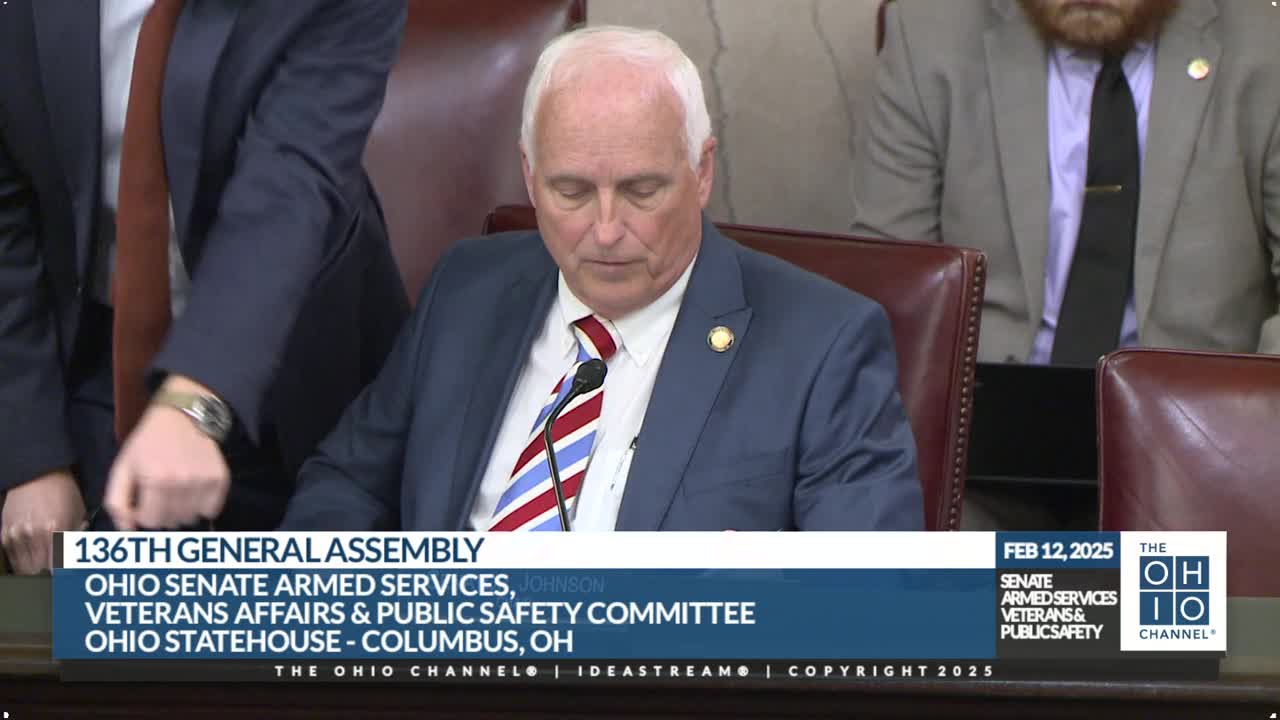
At a second hearing on Senate Bill 26, former Senator Frank Hoagland told the Senate Armed Services, Veterans Affairs and Public Safety Committee that Ohio needs an empowered oversight body and updated tactics to address evolving unmanned systems threats at mass events and other target‑rich environments.
At a second hearing before the Senate Armed Services, Veterans Affairs and Public Safety Committee, former Senator Frank Hoagland urged lawmakers to pass Senate Bill 26 to create a Joint Law Enforcement Oversight Committee focused on countering threats from unmanned systems.
Hoagland told the committee the technology behind drones and related unmanned systems has moved rapidly from reconnaissance to platforms that can carry harmful payloads. "These technologies can carry payloads that will cause massive casualties," he said, and added that the state needs both better training and authorities to act quickly.
The bill, Hoagland said, would bring legislators closer to the technology and help law enforcement adapt. He described the proposal as a task force with the authority to develop tactics, techniques and procedures (TTPs) and standard operating procedures for responding to threats involving unmanned aerial vehicles (UAVs), unmanned surface vehicles and robotic platforms.
Committee members asked for specifics. Senator Craig asked whether police academy curricula cover the new threats; Hoagland replied that current training largely reflects what officers encounter today and suggested looking at national models, but said the state needs additional capacity to counter novel systems. Hoagland described past training exercises that required Federal Communications Commission clearance and coordination with Pittsburgh International Airport and noted a typical flight hard deck of 100 feet used during those tests.
Hoagland emphasized operational authority and decentralized decision making: "We need experienced leaders that can lead from the front," he said, arguing that top‑down bureaucracy could slow responses. He also described examples of threat vectors — robotic “dogs” carrying platforms, high‑speed RC vehicles, unmanned boats and underwater systems — and asked the committee to treat the measure seriously so law enforcement can both train and act.
The committee recorded proponent testimony; no motion or vote occurred during the hearing. The measure remained at the hearing stage at adjournment.
Ending: The committee will retain SB 26 on its docket for further consideration; no vote or committee action was recorded during the hearing.